
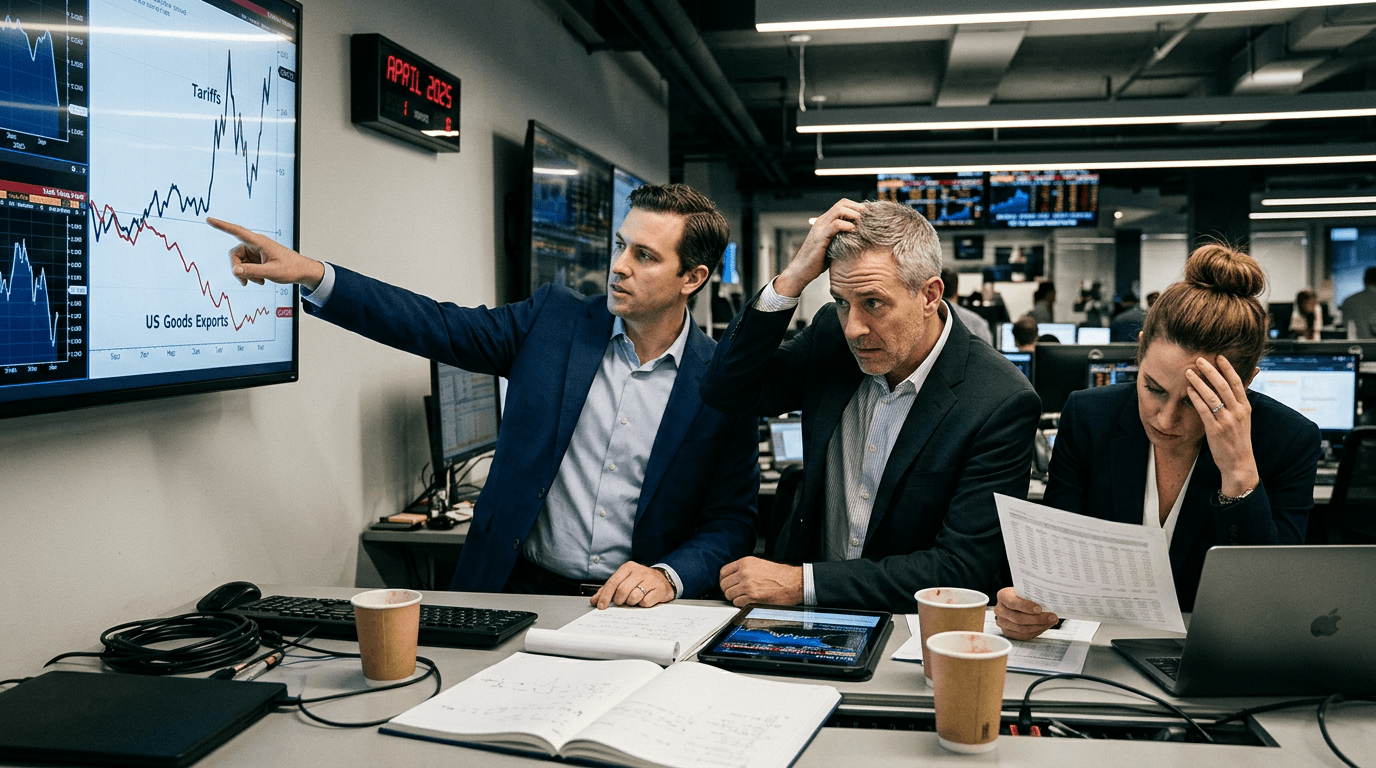
When China announced a stunning 125% tariff on US goods in April 2025, the trade war between the world's two largest economies shifted into a new and unforgiving gear. What began as measured retaliatory measures transformed into an economic standoff that reverberated through global markets, disrupting supply chains, rattling equity prices, and forcing traders to recalibrate their entire strategic playbooks. This wasn't merely another round in an ongoing dispute—it represented a critical threshold where both sides appeared willing to accept severe economic consequences.
The Escalation Timeline And Breaking Point
The path to the 125% tariff tells a story of rapid escalation and dwindling diplomatic solutions. On April 10, 2025, the United States raised tariffs on Chinese goods to 145%, a move that was immediately perceived as exceptionally aggressive even within the context of an already heated trade conflict. China responded swiftly but initially with measured restraint, implementing 84% tariffs the following day on April 11. However, just one day later, on April 12, Beijing unleashed the 125% tariff—a move that signaled the conflict had entered a fundamentally different phase.
What made this number significant wasn't arbitrary. China's Ministry of Finance released a statement indicating that 125% represented a critical economic threshold. Beyond this level, US exports would become economically unfeasible for Chinese importers to absorb, regardless of actual demand. The ministry declared that "under the current tariff levels, the market can no longer accept US goods exported to China," essentially drawing a line in the sand. The statement also included a warning: should the US continue escalating, China would not engage in further tariff increases but would pursue alternative retaliatory measures.
Accompanying the tariff announcement, China added 11 US companies to its "unreliable entity list," citing alleged military-related technology cooperation with Taiwan. This two-pronged approach—economic tariffs combined with targeted company restrictions—demonstrated a shift toward more sophisticated trade pressure tactics.
Market Reaction And Immediate Consequences
The announcement sent shockwaves through global financial markets that persisted for weeks. US-China sensitive sectors experienced the most dramatic reactions. Technology companies exposed to Chinese supply chains faced immediate pressure as investors grappled with the reality that cost-plus pricing models would no longer function. Manufacturing companies with significant China exposure saw equity valuations decline sharply as guidance became uncertain.
Futures markets reflected the fear gripping traders worldwide. Chinese indices declined as concerns about retaliatory US measures against Chinese companies intensified. European markets also suffered as analysts recognized that global supply chains would inevitably suffer disruption. The uncertainty itself became a trading factor—volatility indices spiked, and many traders moved to risk-off positioning.
Agricultural commodities experienced notable weakness as US soybeans, corn, and other products facing Chinese tariffs became economically uncompetitive. Farmers and agricultural exporters faced an immediate crisis as Chinese buyers pivoted to alternative suppliers from South America and Southeast Asia.
Supply Chain Fragmentation And Long-term Shifts
Perhaps the most significant consequence of the 125% tariff was the acceleration of supply chain reorganization that had already begun. Companies realized they could no longer depend on Chinese-US trade relationships as the backbone of their operations. Manufacturing moved to alternative locations in Vietnam, Thailand, India, and Mexico. This reshoring and near-shoring trend, accelerated by the tariff crisis, represented a fundamental restructuring of global commerce.
The tariffs created immediate opportunities for alternative suppliers but created severe challenges for companies caught mid-transition. Inventory management became extraordinarily difficult. Some companies accelerated purchases of US goods into China before tariffs took effect, while others simply abandoned Chinese markets temporarily. These supply chain adjustments took months to resolve and resulted in structural inefficiencies that persisted well beyond the initial announcement.
Key Takeaways For Traders And Investors
Understanding the 125% tariff moment requires recognizing several crucial lessons. First, trade disputes are not linear—they can escalate rapidly once certain psychological thresholds are breached. Second, policy statements matter enormously; China's indication that this was a final tariff level (if the US didn't escalate) provided a floor for market stabilization, though it took time for this to be reflected in pricing.
Third, sector rotation opportunities emerged for traders nimble enough to identify winners and losers. Companies with diversified supply chains outperformed those with concentrated China exposure. Domestic suppliers to previously import-dependent US industries gained competitive advantages.
The 125% tariff also demonstrated how geopolitical tensions directly translate into portfolio-level risks that quantitative models often underestimate. Traders who maintained tactical flexibility and avoided over-concentration in tariff-sensitive sectors navigated the turmoil more successfully than those locked into rigid allocations.
This tariff escalation remains a watershed moment for understanding how trade policy can fundamentally reshape markets and supply chains within days, not years.
---