
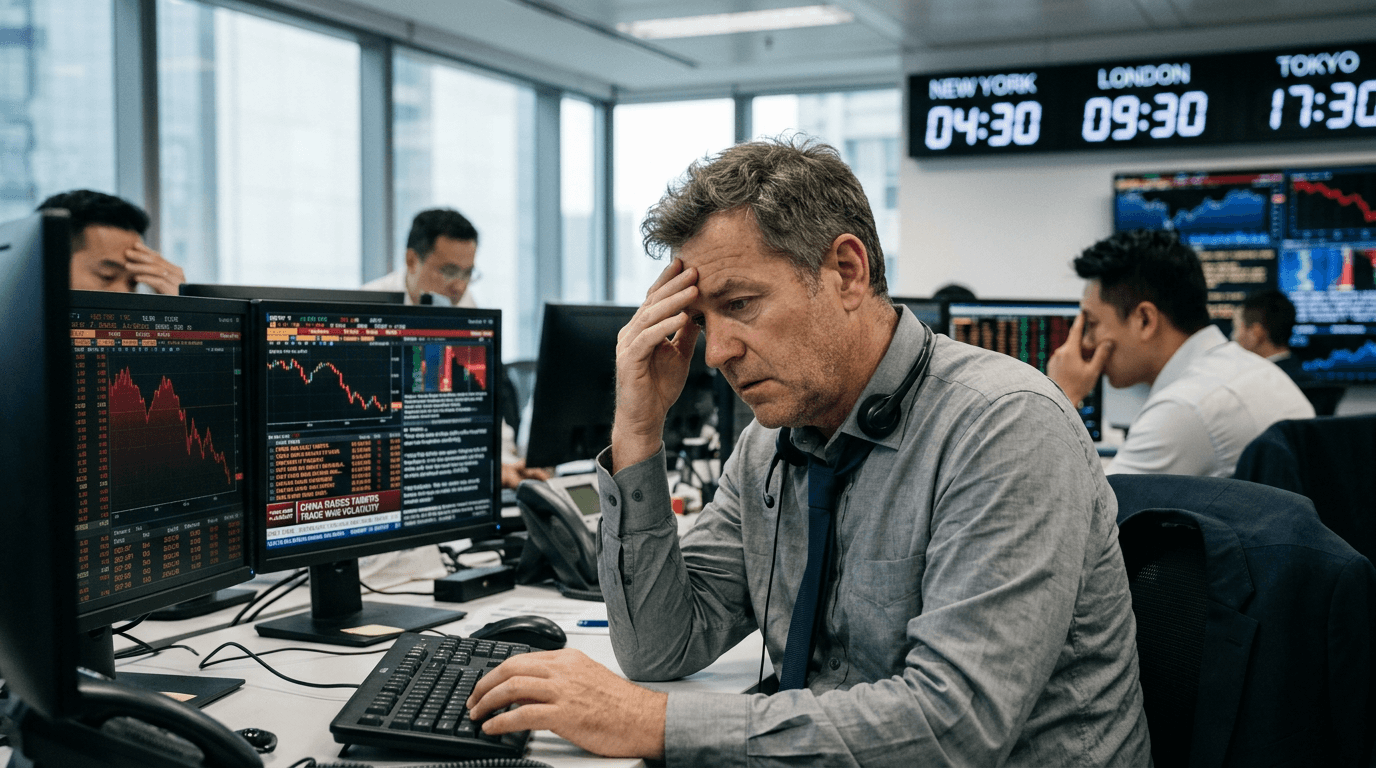
Markets have been reminded that the US–China trade war never truly went away. China’s latest decision to impose steep retaliatory tariffs of up to 125% on US-origin goods marks a fresh escalation in a long-running conflict and has already dented risk sentiment, lifting safe‑haven currencies and pressuring equities and commodities[4][5]. For traders, this is not just a political headline—it is a macro shock that can reshape trends across FX, indices, and industrial commodities.
Global Trade War Back In The Spotlight
To understand why markets are reacting so sharply, it helps to place this move in context. The US and China have been engaged in rolling tariff battles for years, with 2025 seeing a particularly aggressive phase of escalation[5]. After Washington imposed a 145% tariff on Chinese imports under a new reciprocal tariff regime, Beijing responded by lifting its own tariff rate on US goods first to 84%, and now up to 125% effective April 12[4][5].
These are not marginal adjustments. A 125% tariff more than doubles the landed cost of affected US goods entering China, on top of existing baseline tariffs[4]. Earlier rounds focused heavily on energy, agricultural, and industrial products; the latest action broadens the hit and reinforces the message that China is willing to match or exceed US measures on a “like-for-like” basis[1][4].
Crucially, tariffs are only part of the toolkit. China has also deployed export controls on critical minerals, expanded sanctions and “unreliable entity” lists for US firms, and pursued legal action at the WTO, creating a complex mix of tariff and non-tariff barriers[1][4]. That multi-pronged approach is one reason markets are treating the news as a material macro risk, not just a one-off headline.
WHAT CHINA’S 125% TARIFF MOVE ACTUALLY MEANS
At the most basic level, tariffs are a tax on trade. When China raises duties on US goods to as high as 125%, it:
- Increases import costs for Chinese buyers of US products.
- Reduces price competitiveness for US exporters in the Chinese market.
- Encourages substitution toward domestic or third‑country suppliers where possible.
Short term, the burden tends to be shared: US exporters may have to cut prices, Chinese importers may absorb some of the cost, and end‑users may see higher prices. Over time, trade flows often adjust as supply chains re-route to avoid tariffed routes[5].
The targeted nature of previous Chinese measures suggests that politically sensitive sectors—such as US agriculture and certain industrial goods—are likely to remain in the crosshairs[1][4]. That keeps pressure on regional US economies reliant on exports and raises uncertainty for multinational firms with China‑centric supply chains.
Equally important is the signaling effect. By warning that it will “ignore” future US tariff moves and hold Washington responsible for the damage, Beijing is indicating that it will no longer automatically mirror each incremental US action. That injects additional uncertainty: markets must now price not just the tariffs themselves, but also the risk that negotiations stall and a more durable decoupling gathers pace.
Market Reaction: Fx, Equities, Commodities
The immediate market reaction has followed a familiar risk‑off pattern. The headline has:
- Boosted demand for safe‑haven currencies like the US Dollar and Japanese Yen, as investors seek liquidity and perceived stability.
- Pressured pro‑cyclical FX such as the Australian Dollar and emerging‑market currencies, which are more exposed to global trade and commodity cycles.
- Weighed on global equity futures, particularly in export‑sensitive sectors and indices with heavy exposure to industrials and technology.
- Hit industrial commodities, including metals and energy benchmarks, on fears of slower global trade and manufacturing demand.
The mechanics are straightforward. A renewed tariff escalation between the world’s two largest economies threatens global growth, particularly trade‑driven sectors. Lower expected growth translates into weaker earnings expectations for companies tied to global supply chains and reduced demand for cyclical commodities. In FX, currencies of countries leveraged to Chinese and global demand—such as commodity exporters and EMs—tend to underperform when trade tensions spike.
For traders, this environment often sees:
- Wider intraday ranges as liquidity thins around headline risk.
- Stronger sensitivity to news flow, with markets reacting not just to official announcements but also leaks and rhetoric.
- Cross‑asset contagion, where moves in FX, rates, equities, and commodities reinforce each other.
What Traders Should Watch Next
This story will not end with the tariff headline. Several follow‑on themes deserve close monitoring:
1. Policy signaling from both sides Watch for speeches, social media posts, and formal statements from US and Chinese officials. Markets will be trying to gauge whether this is a peak in escalation before negotiations resume, or the start of a more prolonged breakdown in trade relations[5].
2. Retaliation beyond tariffs China has already used export controls, unreliable entity lists, and targeted import bans as leverage[1][4]. Any expansion of these tools—especially involving critical technologies or key commodities—could be as market‑moving as the tariffs themselves.
3. Corporate guidance and earnings As earnings seasons unfold, companies with significant US–China exposure may update guidance to reflect higher costs, rerouted supply chains, or demand uncertainty. Negative revisions in sectors like semiconductors, autos, industrial machinery, and agriculture would reinforce equity and credit market stress.
4. Data confirming real‑economy impact Trade volumes, manufacturing PMIs, export orders, and freight indicators will help confirm whether the tariff shock is translating into slower real activity. Markets often price the headline first and then adjust as hard data confirms or contradicts those fears.
Practical Takeaways For Simulated And Live Traders
Whether you are trading in a simulated environment or deploying real capital, a structured approach to this kind of headline shock is essential.
1. Map your exposure Identify which of your strategies are most sensitive to global growth and trade. For example:
- FX strategies long AUD, NZD, or EM currencies against USD or JPY may be vulnerable to further risk‑off moves.
- Equity index positions with heavy cyclical exposure (e.g., industrials, exporters) may face higher volatility.
- Long positions in industrial metals or energy tied to manufacturing demand could be at risk if trade‑related growth concerns deepen.
2. Reassess correlations During trade‑war episodes, traditional correlations can strengthen or flip. Safe‑haven currencies may move more tightly with equity volatility; commodity exporters may track Chinese equity indices more closely. Use your backtests and simulated environments to stress‑test portfolios under past trade‑war regimes.
3. Prioritize risk management over prediction You do not need to forecast the exact tariff path to trade this environment effectively. Focus on:
- Position sizing that assumes larger intraday swings.
- Clear stop‑loss levels and scenario planning for additional escalation.
- Avoiding concentration in a single theme (e.g., being “all‑in” on risk‑on or risk‑off).
4. Trade the reaction, not just the event Markets can overshoot on initial fear and then mean‑revert if subsequent news is less negative than expected. Short‑term traders may find opportunities fading extreme moves once liquidity stabilizes, while longer‑term macro traders may look to align with the new regime if a prolonged trade conflict appears likely.
Looking Ahead
China’s move to lift tariffs on US goods to as high as 125% is more than a bilateral skirmish; it is a reminder that geopolitical and trade risks remain a core driver of modern markets[4][5]. For traders, the priority is not guessing the politics but understanding how such shocks ripple across FX, equities, and commodities—and building robust strategies that can adapt.
In a world where a single announcement can shift risk sentiment globally, disciplined preparation, flexible positioning, and ongoing scenario analysis are as valuable as any individual trade idea. Trade wars may come and go, but the skills you build navigating them will compound over time.