
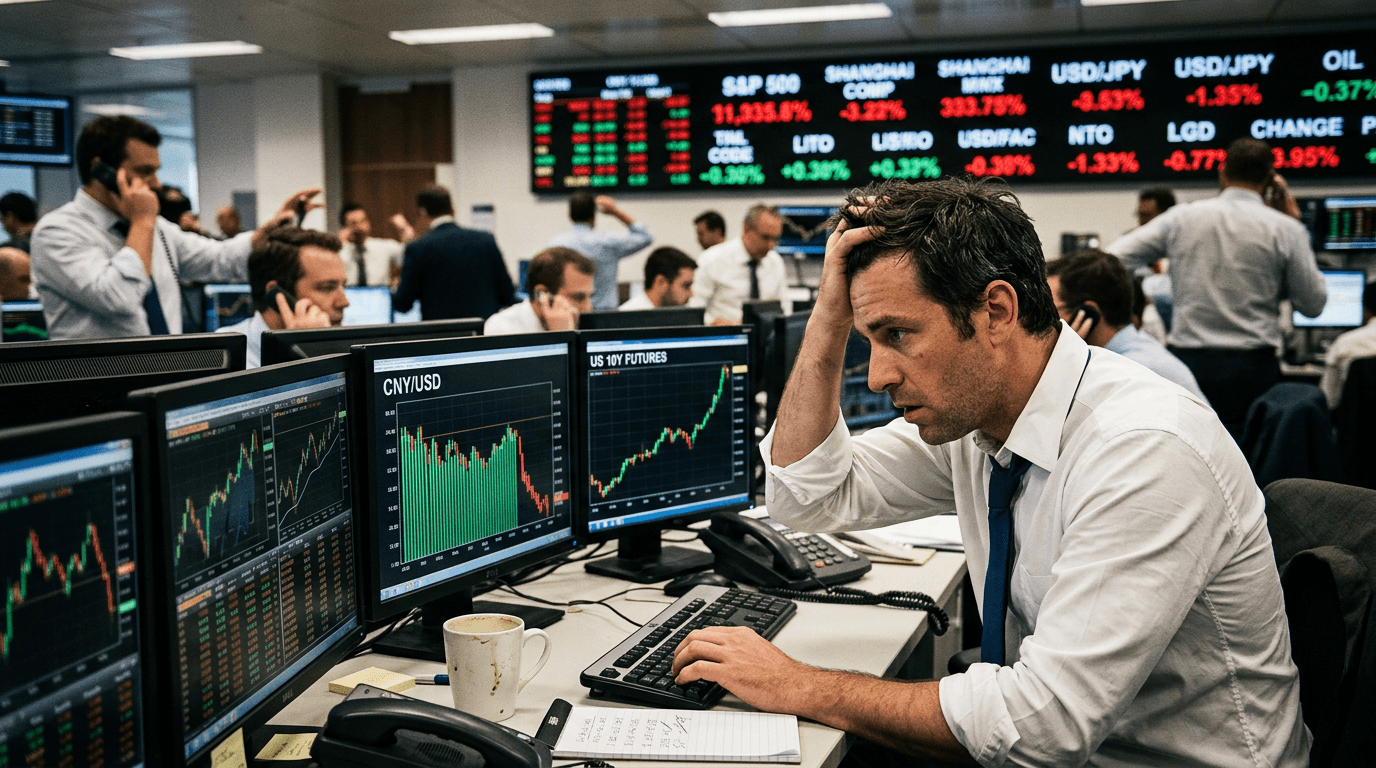
The latest salvo in the US–China trade dispute has moved well beyond routine tariff tinkering and into outright economic brinkmanship. With China announcing additional duties on selected US goods that can reach around 125% and US authorities confirming their own hikes on Chinese imports up to roughly 145%, the world’s two largest economies have effectively put a punitive tax on key flows of bilateral trade. The result: pressure on trade‑linked currencies, a bid for safe‑haven assets, and a more fragile backdrop for risk assets across FX and futures markets.
What Just Happened In The Tariff Battle
China’s move to impose additional tariffs that can climb to about 125% on targeted US imports represents a sharp escalation from already elevated trade barriers built up over previous rounds of the trade war.[1][6] Rather than broad-based across all products, such extreme rates are typically concentrated in sensitive or symbolic sectors—think advanced manufacturing, certain agricultural products, and politically important industrial goods—where each side wants to maximize leverage per dollar of trade affected.
On the other side, US authorities have confirmed fresh tariff hikes on Chinese imports that can reach around 145% in certain categories, pushing some products into de facto sanction territory rather than normal trade policy.[4][5] Historically, US tariffs on Chinese goods during earlier trade war peaks averaged in the 20–50% range and were already viewed as highly restrictive.[3] Today’s headline numbers more than double that intensity for the affected items, signalling that both governments are willing to absorb significant economic costs to gain bargaining power.
The rhetoric has hardened alongside the policy. Chinese officials have dismissed US tariff measures as economically irrational, while US policymakers frame the increases as necessary to address long‑standing concerns about unfair trade practices, industrial policy, and national security.[1][2] Whatever the politics, markets are reacting to one clear message: trade tensions are no longer a background risk—they are a central macro theme again.
Why This Hits Fx And Futures So Quickly
Tariffs of this magnitude matter for currencies because they directly affect expectations for growth, inflation, and capital flows. Higher tariffs tend to reduce trade volumes, hurt export‑oriented sectors, and raise input costs for manufacturers on both sides, which can depress business confidence and investment.[3] When that happens between the US and China, it spills over into global supply chains that run through Asia, Europe, and commodity‑exporting economies.
In FX, the immediate reaction often follows a classic “risk‑off” pattern. Investors seek perceived safe havens such as the US dollar, Japanese yen, and Swiss franc, while selling currencies closely tied to global trade and commodities—like the Australian and New Zealand dollars, and many Asian and emerging‑market currencies. Episodes during the earlier US–China trade war produced exactly this kind of rotation whenever new tariffs were announced or talks broke down.[3]
Futures markets react just as quickly. Equity index futures typically gap lower as traders price in weaker earnings for globally exposed companies and the risk of slower world growth. At the same time, government bond futures (such as US Treasuries) often rally as investors hedge with duration, and volatility futures tend to spike as uncertainty rises. These dynamics feed into cross‑asset correlations that active traders can either suffer from or exploit, depending on their preparation.
WINNERS, LOSERS, AND CROSS‑ASSET RIPPLE EFFECTS
While “everyone loses in a trade war” is broadly true at the macro level, markets still create relative winners and losers. Exporters heavily reliant on US–China flows—think industrials, semiconductors, select machinery, and certain agricultural names—are among the most vulnerable, both in equities and in sector‑linked futures. Higher tariffs can translate into tighter margins, weaker sales, and more cautious forward guidance.
Meanwhile, domestically focused companies and sectors less exposed to global trade can outperform on a relative basis, even in a risk‑off environment. For example, utilities, some consumer staples, and services sectors that rely primarily on home‑market demand may be more insulated from tariff shockwaves, and this can be reflected in relative moves between sector futures or equity baskets.
Commodities and commodity‑linked currencies sit at the crossroads. If tariffs dampen global manufacturing and trade volumes, demand for industrial commodities can weaken, weighing on related futures and on exporters’ FX. But safe‑haven demand for gold and, in some cases, for energy as a geopolitical hedge can offset this in specific contracts. For traders, understanding which assets are driven more by growth expectations versus pure risk sentiment is key to navigating the noise.
How Traders Can Navigate The Volatility
For active traders and those practicing in Simulated Finance environments like E8 Markets, tariff shocks are a live test of macro awareness, risk management discipline, and execution strategy. The first step is mapping out the transmission channels: from tariffs to growth expectations, from growth to earnings, and from earnings to asset prices. This helps you decide which markets to watch most closely—often CNH pairs, equity index futures, industrial commodities, and safe‑haven FX.
Position sizing becomes critical in these environments. Tariff headlines can hit at any time and trigger abrupt gaps that overwhelm tight stops. Rather than simply tightening stops, many experienced traders respond by reducing overall size, diversifying exposures across multiple uncorrelated instruments, or using options (where available) to define maximum downside while maintaining upside potential. In futures, this might mean shifting from directional bets to more market‑neutral relative‑value trades, such as long one index, short another.
Event‑driven planning also pays off. Traders can build scenarios in advance—escalation, de‑escalation, or stalemate—and outline in writing how they will respond in each case. In a SimFi setting, you can rehearse these playbooks without capital at risk, testing how your strategy behaves under sudden volatility spikes and widening spreads. The goal is to turn headline risk into a structured trading plan rather than an emotional reaction.
Key Risks To Watch From Here
The path from here is unlikely to be linear. Past episodes show that after a sharp escalation, both sides often leave room for partial rollbacks, exemptions, or negotiated pauses.[5][6] Markets will be highly sensitive to any hints of new talks, carve‑outs for specific industries, or temporary suspensions of the highest tariff rates. A single comment from a senior official can shift risk sentiment quickly, especially if positioning is crowded.
At the same time, there is a genuine risk that tariffs broaden further or spill into adjacent areas such as export controls, tech restrictions, or financial sanctions. That would turn a trade skirmish into a more complex economic confrontation, with deeper implications for global growth and asset valuations. For traders, staying flexible, keeping an eye on cross‑asset signals, and using simulated environments to refine strategies under stress can make the difference between being caught off guard and being ready to capitalize on the moves.