
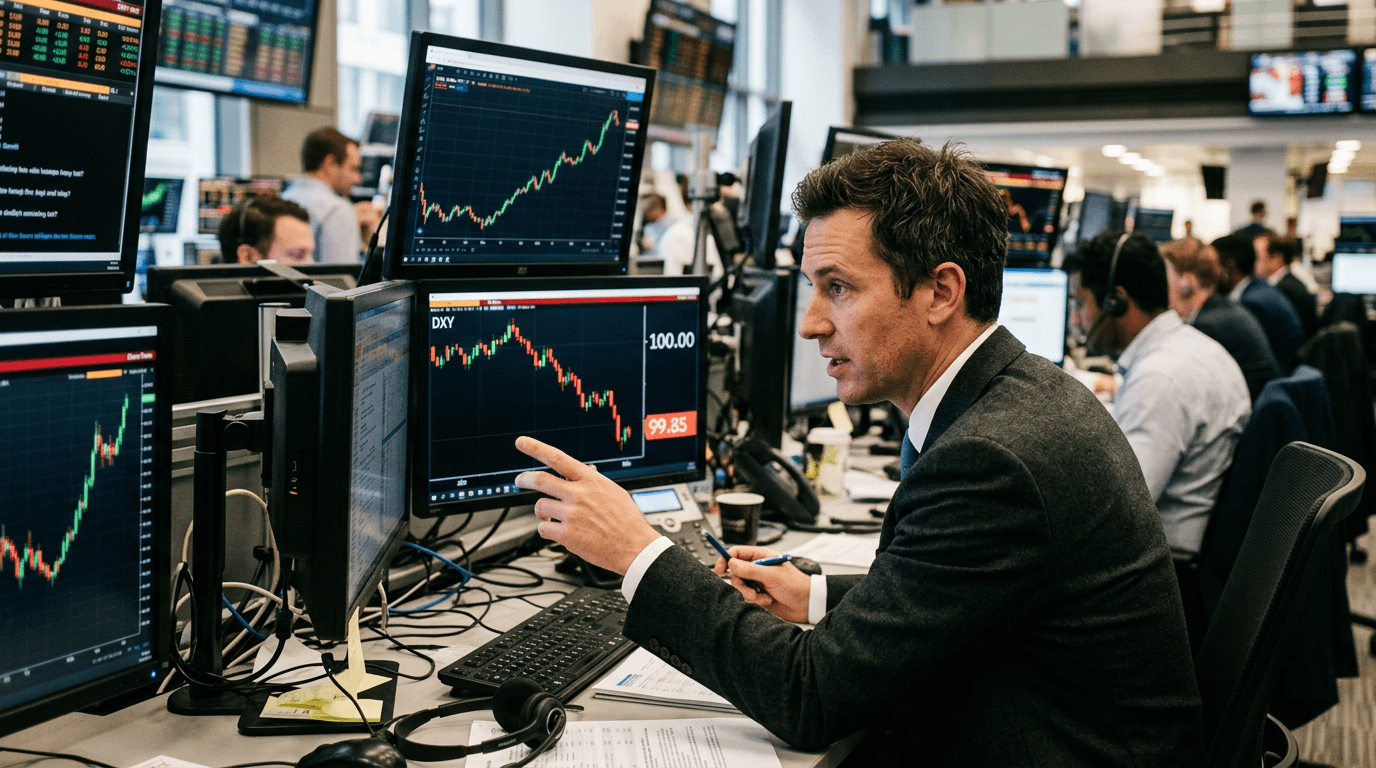
The US Dollar Index’s break below the psychologically important 100 level has jolted FX and futures markets, forcing traders to rethink how they position around interest rates, risk assets, and global growth. After a gap lower in dollar index futures and the first sub‑100 print since mid‑2023, the move has cascaded into sharp swings in EUR/USD, GBP/USD and yen crosses, with knock‑on effects across equity and commodity-linked contracts.[4][9]
WHAT JUST HAPPENED TO THE DOLLAR?
The U.S. Dollar Index (DXY) measures the dollar’s value against a basket of major currencies, including the euro, yen, pound, Canadian dollar, Swedish krona and Swiss franc.[8][10] When the index falls, it signals broad-based dollar weakness rather than a move against just one counterpart.[8][10]
Recent sessions saw the index slide for multiple days, testing the 100 area and then breaking decisively below it, a level that had held since mid‑2023.[4][9] In historical context, such moves are notable: since the index’s inception in the 1970s, declines of around 10% over a six‑month window have been rare, only appearing in a handful of episodes such as late 1985–1986 and the sharp downdraft that began in early 2025.[6][7]
This latest leg lower comes on the back of shifting expectations around the Federal Reserve’s rate path and relative growth prospects outside the U.S., echoing earlier periods when improving opportunities abroad and policy uncertainty at home helped drive sustained dollar weakness.[3][7] In short, this is not just a technical break; it reflects a broader macro repricing.
Key takeaway: The sub‑100 break is a signal that dollar weakness is broad-based and rooted in changing macro expectations, not just a one-off market shock.
Why The 100 Level Matters
Round numbers like 100 act as “psychological” levels and often mark important inflection points in trend and positioning. For the Dollar Index, the 100 area has repeatedly served as a bull‑bear dividing line, with moves above often associated with periods of U.S. policy tightening or risk aversion, and moves below linked to easier policy, stronger growth abroad, or greater risk appetite.[8][7]
When such a level breaks after an extended hold, several things tend to happen:
- Systematic strategies that rely on trend and momentum models accelerate selling as downside signals trigger.
- Discretionary macro and CTA traders reassess their core dollar-bull thesis, especially if the move coincides with changing Fed rhetoric or weaker U.S. data.
- Hedging flows shift, particularly for corporates and asset managers who had been positioned for a stronger dollar and now face FX translation effects on overseas earnings.
In previous downturns, including the sharp decline in the first half of 2025, strategists noted that the dollar’s weakness marked not just a cyclical correction but the potential end of a multi‑year structural bull phase that began around 2010.[7] A similar discussion is now resurfacing, with some analysts arguing the latest break could confirm a longer-term transition toward a more balanced, multi‑polar currency environment.[3][7]
Key takeaway: A decisive move below 100 can act as a regime-change signal, forcing long‑term dollar bulls to reassess structural assumptions and unwind crowded trades.
Impact On Major Fx Pairs
The most immediate expression of the Dollar Index’s slide is in major currency pairs. Because the euro carries the largest weight in the index, EUR/USD tends to be one of the first places where dollar weakness is visible.[8][10] A sub‑100 DXY typically coincides with EUR/USD pushing higher, sometimes toward prior resistance zones or multi‑year ranges.
GBP/USD has also been reacting, with sterling gaining as markets reprice the relative path of Bank of England vs. Fed policy and reassess the UK’s growth discount versus the U.S.[3] Yen crosses are particularly sensitive: when the dollar weakens and U.S. yields fall, the dollar-yen pair can retreat from elevated levels, while other yen crosses (like EUR/JPY and GBP/JPY) may move more violently as carry trades are unwound or rebalanced.[3][5]
Beyond the G10 space, a weaker dollar can be supportive for select emerging-market currencies and assets. Lower U.S. rates and a softer dollar reduce funding pressures for dollar‑denominated debt and can boost flows into higher‑yielding local markets, a dynamic often cited as beneficial for countries like India and others across Asia and Latin America.[5]
Key takeaway: Broad dollar weakness tends to lift EUR/USD and GBP/USD, reshape yen crosses, and can provide breathing room for parts of emerging markets, but the dispersion across currencies is high.
Ripple Effects Across Futures And Risk Assets
Because the dollar is the world’s primary invoicing currency and the unit in which most commodities are priced, large moves in DXY ripple across asset classes.[8] A weaker dollar generally supports commodity prices in non‑USD terms and can reinforce bullish sentiment in gold, industrial metals, and some energy contracts, especially when tied to expectations of easier monetary policy.[8]
In equity index futures, the latest dollar slide is driving repositioning in U.S. vs. international benchmarks. As the dollar weakens, unhedged foreign investors gain more from U.S. assets, while U.S.-based traders may find non‑U.S. indices more attractive on a currency-adjusted basis.[2][4] This can show up as relative outperformance in European and Asian equity futures, alongside sector rotation toward exporters that benefit from currency competitiveness.
Rate and currency futures are where the repricing is most visible. Traders are reassessing Fed expectations, fading aggressive tightening scenarios and instead pricing in earlier or deeper cuts, while simultaneously reevaluating the path of other central banks.[4][7] This creates opportunities—and risks—in short‑term interest rate futures, bond futures, and FX futures tied to the major pairs.
Key takeaway: The dollar’s break lower is not an FX-only story; it cascades through commodities, equity index futures, and rate markets as traders reprice policy and growth.
How Traders Can Navigate This New Fx Landscape
For traders, whether in live markets or simulated environments, a dollar regime shift is both a test and an opportunity. Several practical principles stand out:
1. Revisit your macro framework If your strategy assumes a structurally strong dollar, stress-test that assumption across timeframes. Consider scenarios where dollar weakness persists, and map out how that would affect your FX, equity, and commodity exposures.[7]
2. Focus on relative central bank paths The Dollar Index’s direction is heavily influenced by interest rate differentials. Track how markets are pricing the Fed versus the ECB, Bank of England, and Bank of Japan, and use those expectations to frame currency themes rather than trading levels in isolation.[3][7]
3. Watch correlations, not just charts In a regime shift, correlations between the dollar and risk assets can change. Over periods of pronounced dollar weakness, U.S. equities and commodities have sometimes behaved differently than in dollar bull phases, affecting diversification and hedging assumptions.[8][7]
4. Trade the narrative shifts, not just the break The move below 100 is a technical event, but the more durable opportunities often come from the evolving narrative: whether the market leans toward “soft landing and global growth” or “policy mistake and volatility.” Align your positioning with the prevailing macro story, while remaining ready to pivot as data and central bank communication evolve.[3][7]
For simulated traders, this environment is ideal for practicing cross‑asset thinking—linking FX, rates, and indices rather than treating each market in isolation. Building playbooks around different dollar scenarios can help develop discipline and risk management that translate directly into real-world trading.
Key takeaway: Treat the dollar’s break below 100 as a chance to refine macro thinking, stress-test strategies, and learn to trade across assets with a coherent, risk-aware framework.