
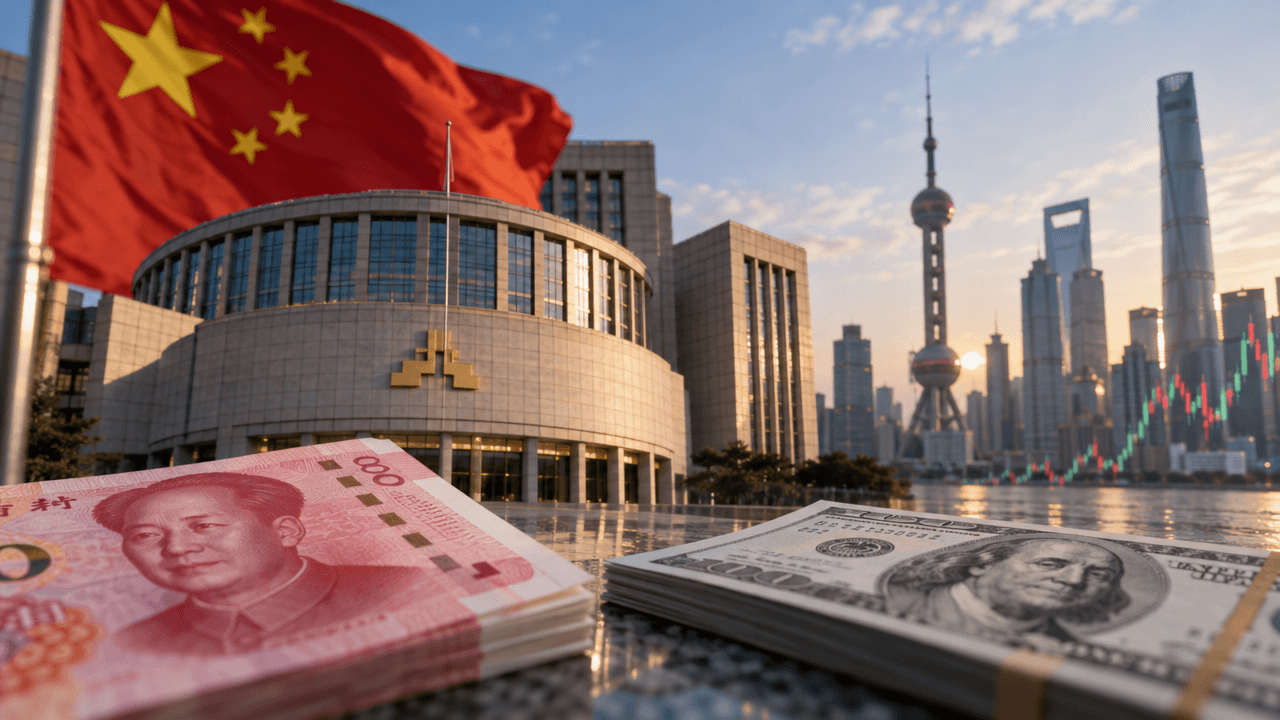
China’s yuan is back at the center of the global trade debate. The People’s Bank of China has rejected claims that the currency is undervalued and insisted that Beijing has neither the need nor the intention to weaken the yuan to gain an export advantage. The statement arrives as China faces renewed scrutiny from trade partners over its large trade surplus, manufacturing strength, and exchange-rate policies.
The market reaction was relatively measured. USD/CNY slipped by roughly 30 pips toward 6.70, suggesting that traders interpreted the announcement as a clarification of existing policy rather than a sudden change in the currency regime. At the same time, China’s foreign-exchange reserves declined to approximately $3.40 trillion at the end of September, compared with about $3.44 trillion a month earlier. [1][4]
What The Pboc Is Saying
The PBOC’s central argument is that China’s export performance reflects industrial competitiveness, supply-chain depth, productivity, and business investment rather than deliberate currency manipulation. In its policy paper, the central bank rejected the idea that isolated estimates of fair value can conclusively prove the yuan is undervalued.
The bank also argued that past currency movements do not support a simple relationship between a weaker yuan and stronger exports. Periods of yuan appreciation did not prevent China from expanding its trade position, while periods of weakness did not automatically increase the country’s share of global exports. The message is clear: exchange rates matter, but they are only one part of a much larger economic picture.
The PBOC said market forces play a decisive role in determining the yuan’s exchange rate. It also stated that it does not preset a specific exchange-rate target or intervene to control the currency’s long-term trend. However, China’s managed exchange-rate framework still gives policymakers tools to influence short-term market conditions, meaning traders will continue watching the daily fixing, liquidity operations, and official communication.
Why The Claim Matters
Accusations of yuan undervaluation are not merely academic. A cheaper currency can make a country’s exports more affordable overseas while increasing the domestic cost of imports. That can affect trade balances, factory competitiveness, inflation, and diplomatic relations.
European and other international officials have increasingly linked China’s trade imbalances to exchange-rate policy. Beijing’s response attempts to separate two issues: whether the yuan is fairly valued and whether China is using the currency as an active trade weapon.
Those questions are difficult to answer because valuation models produce different results. Purchasing-power comparisons, trade-weighted exchange rates, interest-rate differentials, capital flows, and productivity trends can all lead to different estimates of fair value. Some analysts continue to argue that the yuan is undervalued, while others emphasize that China’s export strength is primarily structural.
The PBOC also highlighted the growing scale of global foreign-exchange trading. Daily yuan trading volume has reportedly surpassed $800 billion, while total global foreign-exchange turnover is around $10 trillion. The bank’s argument is that such a deep and liquid market makes it difficult for any central bank to dictate long-term currency trends. [6]
Transparency Takes Center Stage
One of the most important elements of the announcement is China’s plan to begin reporting additional foreign-exchange operation data to the International Monetary Fund in 2027. The move responds to longstanding international demands for greater transparency around China’s currency management. [3][5]
The announcement does not necessarily mean that China is abandoning its managed exchange-rate system. Instead, it could give international observers more information about the scale, timing, and type of official foreign-exchange operations. The usefulness of the data will depend on its scope, frequency, and whether the information is made publicly available.
For markets, improved reporting could reduce uncertainty over whether changes in the yuan are being driven mainly by economic fundamentals, market positioning, or official intervention. Greater transparency may also help policymakers distinguish between legitimate concerns about competitiveness and claims based on incomplete information.
Reserves Offer A Second Signal
China’s foreign-exchange reserves fell by $38.1 billion in September to $3.4003 trillion, a decline of 1.11% from the end of August. [9] The figure was below some market expectations, but the monthly change should not automatically be interpreted as evidence of aggressive currency defense or capital flight.
Reserve levels can change because of currency valuation movements, shifts in the value of reserve assets, gold prices, and actual foreign-exchange transactions. A stronger U.S. dollar can reduce the dollar value of non-dollar assets when reserves are converted into U.S. dollars. Market prices can also affect the reported value of bonds and other holdings.
For traders, the key takeaway is to avoid reading one month of reserve data in isolation. A sustained decline accompanied by yuan weakness, falling capital inflows, or increased official support would carry a different message from a one-month adjustment driven largely by valuation effects.
What Traders Should Watch Next
USD/CNY near 6.70 will remain sensitive to several forces: U.S.-China interest-rate differences, changes in the dollar, Chinese economic data, trade negotiations, and signals from the PBOC. A stronger yuan could reinforce the central bank’s argument that it is not pursuing competitive depreciation. Conversely, sustained weakness would likely revive speculation about whether policymakers are tolerating or encouraging a softer currency.
Simulated Finance traders can use this event to practice scenario analysis rather than predicting a single direction. One scenario involves a stable yuan, where improved transparency and balanced PBOC communication limit volatility. Another involves renewed dollar strength, which could push USD/CNY higher even without a policy shift in Beijing. A third involves stronger global pressure over China’s trade surplus, increasing headline risk and short-term currency volatility.
The practical lesson is to distinguish policy statements from policy changes. The PBOC has defended the yuan’s valuation and promised more data, but it has not announced a new exchange-rate target. Traders should therefore monitor follow-through, reserve trends, fixing behavior, and economic fundamentals before treating the statement as a major directional signal.
China’s response is significant because it combines a defense of the yuan’s valuation with a commitment to greater international reporting. For now, the market appears to view the announcement as a signal of reassurance rather than a dramatic policy pivot. The longer-term impact will depend on whether the promised IMF data improves confidence and whether China’s exchange-rate behavior remains consistent with its claim that the yuan is determined by market forces.