
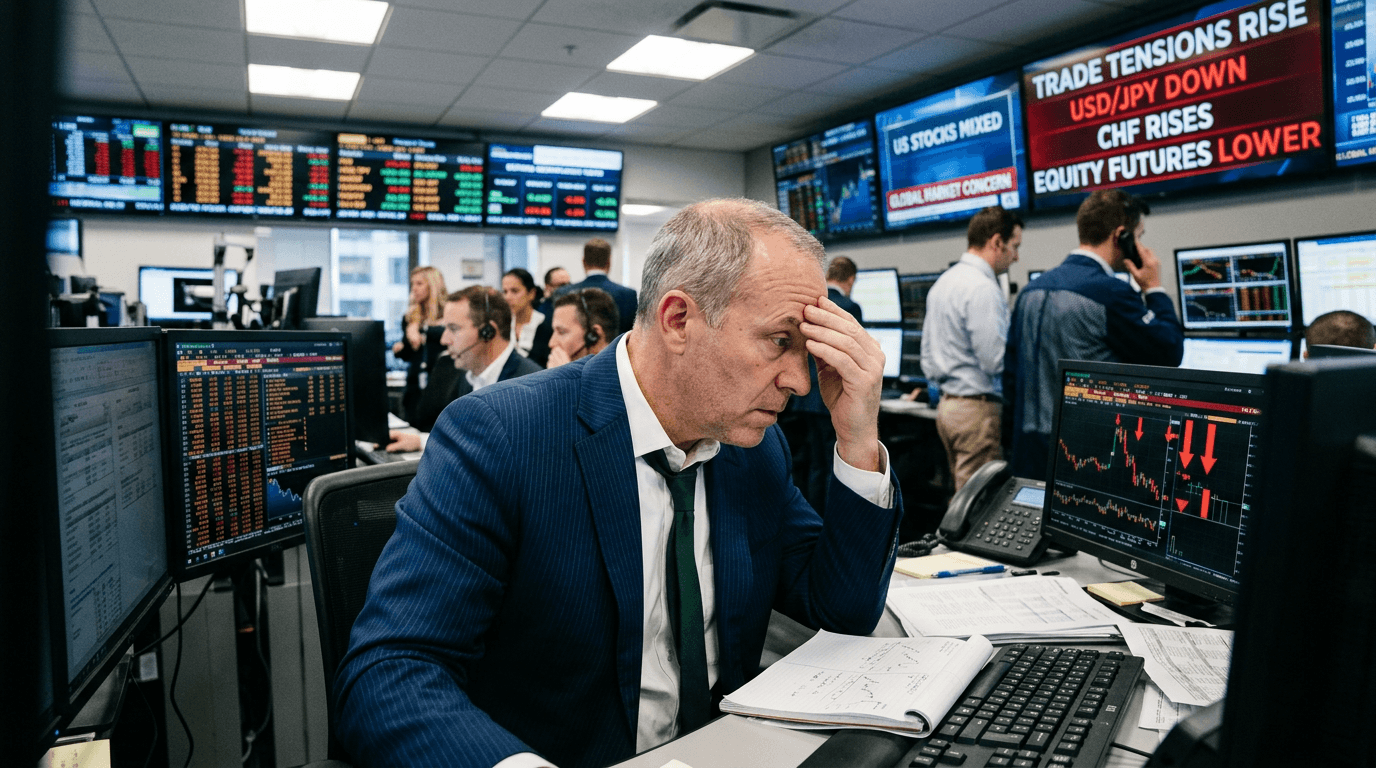
Escalating trade tensions between the world’s two largest economies are back at the center of global markets after China announced steep additional tariffs on selected US goods of up to 125%. The move marks a sharp intensification of the tariff front in the US‑China relationship and has quickly spilled over into risk sentiment, FX markets, and equity index futures. For traders, this is not just another headline—it is a structural shock that can reshape volatility regimes across asset classes.
The New Tariff Escalation
China’s decision to impose additional tariffs of up to 125% on US imports dramatically raises the cost of doing business for affected sectors and, in some cases, makes trade economically unviable.[6] At these levels, tariffs function less as a pricing adjustment and more as a barrier, effectively shutting out certain goods from the Chinese market.
The announcement is also accompanied by pointed political messaging: Chinese authorities have signaled they will ignore Washington if more duties are imposed and that the US should bear responsibility for the economic damage. This kind of rhetoric tends to harden negotiating positions on both sides, reducing the probability of a quick de‑escalation.
From a macro perspective, the tariffs operate as a tax on trade flows, potentially reshaping supply chains, corporate margins, and investment decisions. Even if the direct trade channel is concentrated in specific industries, the uncertainty they create can ripple through business confidence and capital spending far beyond the immediately targeted goods.
Markets are highly sensitive to changes in the trajectory of the US‑China relationship because past episodes of tariff escalation have coincided with higher volatility, weaker risk assets, and flight-to-safety flows.[6] The latest move fits neatly into that pattern, reinforcing the perception that the trade war has entered a new, more aggressive phase.
Why Tariff Shocks Fuel Risk Aversion
Tariffs raise effective costs, lower profitability, and can dampen growth expectations, but what really matters for markets in the short term is uncertainty. When investors cannot easily price future earnings or policy paths, they demand a higher risk premium—or simply step back until the picture clears.
In practice, this translates into “risk‑off” positioning. Equity exposure is trimmed, credit risk is reduced, and capital rotates into safer, more liquid assets. The renewed tariff escalation from China has already weighed on global risk sentiment, with equity index futures under pressure and volatility indicators ticking higher.
Another key channel is trade-sensitive sectors like autos, technology hardware, and industrials. These industries often sit at the intersection of global supply chains and political scrutiny, making them the first to be repriced when tariff headlines hit. Steep tariffs on US goods going into China can directly impact earnings expectations for multinational firms, amplifying equity market reaction.
Importantly, tariff shocks are rarely isolated events. They tend to cluster with other protectionist measures such as export controls, sanctions, and regulatory barriers. That clustering effect reinforces the perception of a more fragmented global economy, which in turn encourages investors to reassess long-term assumptions about growth and inflation.
For traders, the takeaway is clear: tariff announcements are not just trade news. They are volatility events that can reprice cross‑asset correlations, risk premia, and liquidity conditions in a matter of hours.
Fx Market Reaction: Jpy, Chf And Usd In Focus
The FX market often provides the clearest real‑time signal of how nervous investors are. In classic risk‑off episodes, safe‑haven currencies such as the Japanese yen (JPY) and Swiss franc (CHF) tend to strengthen as global capital seeks shelter in perceived stable markets with strong external balances and deep liquidity.
The latest Chinese tariff move has supported safe‑haven flows into JPY and CHF, consistent with previous phases of US‑China tensions. When risk aversion rises, leveraged positions in higher‑yielding or risk‑sensitive currencies are reduced, fueling demand for havens. That can push USD/JPY lower and EUR/CHF or USD/CHF down as traders unwind carry trades and hedge equity or credit exposure.
Interestingly, the US dollar can sometimes behave as a safe haven, but in the current episode it is facing competing forces. On one hand, the USD benefits from global demand for dollar liquidity and US Treasuries; on the other, being at the center of the dispute introduces policy and growth uncertainty that can weigh on sentiment toward US assets. The result can be a more nuanced reaction, with USD strength versus emerging market and commodity currencies but mixed performance against JPY and CHF.
FX volatility typically spikes around tariff headlines as options markets rapidly reprice event risk. Implied vol in JPY and CNH options often leads the move, reflecting their direct link to the policy shock. That increased volatility has implications for position sizing, stop placement, and strategy selection across FX pairs.
For traders, the key is to recognize that tariff-driven FX moves are often fast, sharp, and headline-sensitive. Intraday reversals can be frequent, especially if new statements from policymakers hit the tape, so disciplined risk management is essential.
Equity Futures And Cross-asset Flows
Equity index futures are among the first instruments to react when geopolitical or trade risks escalate. The announcement of tariffs up to 125% has put pressure on US and global equity futures as participants price in lower growth prospects and higher uncertainty around corporate earnings.
Sector rotation tends to accelerate in these environments. Trade‑exposed and cyclical sectors may underperform, while more defensive areas like utilities, healthcare, and consumer staples are relatively resilient. At the same time, quality and low‑volatility factors often attract inflows, reflecting investors’ preference for stable balance sheets and predictable cash flows during risk‑off regimes.
Cross‑asset flows also matter. Rising demand for safe‑haven FX and government bonds can coincide with outflows from equities and credit. For macro and multi‑asset traders, these relationships create opportunities to express views via relative value trades or hedges—for example, pairing short equity futures with long JPY exposure to capture correlated moves.
Volatility itself becomes an asset. Strategies that benefit from wider ranges and larger intraday swings, such as short‑term mean reversion or breakout trading, may find more opportunities, while longer‑term trend followers need to account for the likelihood of sharp counter‑trend moves driven by policy headlines.
How Traders Can Navigate Heightened Volatility
For both live and simulated finance traders, tariff-driven market stress is an important environment to understand and practice in. It combines macro narrative, political risk, and technical volatility, testing a broad set of skills from news interpretation to risk management.
Several practical takeaways stand out
First, stay anchored in the policy narrative. Track not only the tariff levels and targeted sectors, but also the tone of official communication. A shift from escalation to negotiation can reverse risk sentiment quickly; being aware of that shift early can be a competitive advantage.
Second, adjust volatility assumptions. Higher realized and implied volatility means that previous stop distances, position sizes, and intraday timeframes may no longer be appropriate. Recalibrating risk parameters to the new regime helps avoid forced liquidations from oversized positions.
Third, diversify the way you express views. Instead of concentrated bets on a single index or currency pair, consider using a mix of FX, equity futures, and, where relevant, volatility instruments to build more balanced exposure to the trade narrative.
Finally, treat simulated environments as a laboratory for stress scenarios. Platforms in the SimFi space allow traders to test how their strategies behave under trade‑war shocks without capital at risk, providing valuable insight before deploying risk in live markets.
As US‑China tensions reheat with tariffs climbing into triple digits, markets are reminding traders that geopolitics and macro policy remain powerful drivers of volatility. Those who can read the narrative, respect the risk, and adapt their playbook will be best positioned to navigate the turbulence—and potentially to find opportunity within it.