
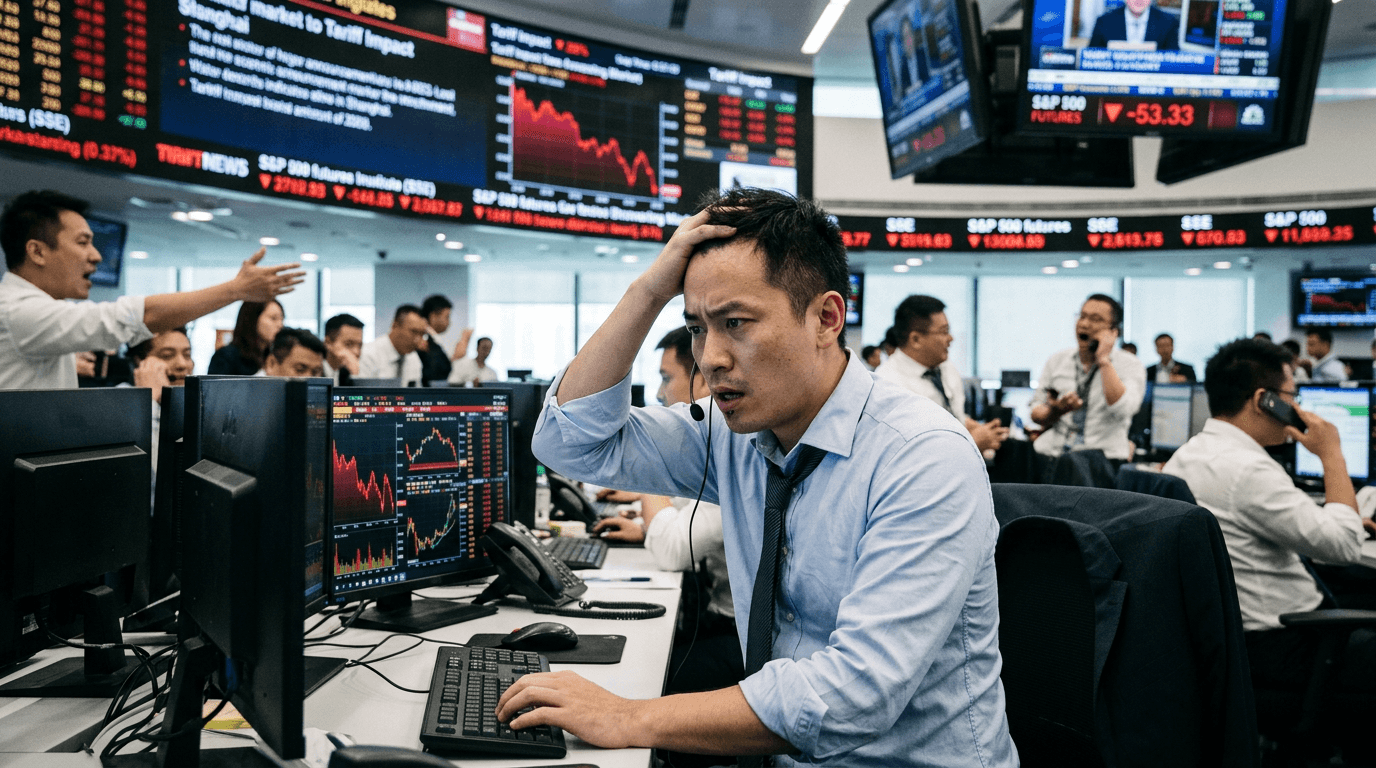
The announcement on April 11, 2025, sent shockwaves through global trading floors: China was raising its tariffs on US goods to an unprecedented 125%, effective just one day later on April 12. This wasn't a modest adjustment or a negotiating tactic—it was a dramatic escalation that signaled Beijing's willingness to push trade tensions to levels previously unseen in modern commerce. For traders and investors, particularly those navigating simulated finance environments, this moment crystallized a critical lesson: geopolitical and policy-driven market moves can unravel with stunning speed, creating both significant risks and tactical opportunities.
The Escalation Sequence That Rattled Markets
Understanding the full context of China's 125% tariff requires examining the rapid-fire policy sequence that preceded it. On April 4, 2025, baseline tariffs on Chinese goods stood at 34%. By April 10, the United States had escalated this to 145% under its reciprocal tariff framework. China initially responded on April 11 by raising its retaliatory tariffs to 84%, but that proved to be merely a holding pattern. Within 24 hours, Beijing announced the jump to 125%.
This compressed timeline is crucial for traders to understand. The escalation didn't follow the typical pattern of measured responses over weeks or months. Instead, within just eight days, tariff rates nearly quadrupled. This rapid succession of policy announcements compressed price discovery mechanisms that normally operate over longer periods, creating what market participants often call a "shock and awe" dynamic. For those tracking commodity markets, currency pairs, and equity indices, the speed of adjustment was genuinely disorienting.
WHY CHINA DREW A LINE AT 125%
The specific level of 125% wasn't arbitrary. China's Ministry of Finance explicitly stated that at current tariff levels, the Chinese market could no longer economically absorb US imports. The implication was stark: officials had calculated that tariffs at this level render US exports fundamentally uncompetitive in Chinese markets. In economic terms, they were signaling an effective end to bilateral trade in many categories of goods.
This messaging held additional significance. By publicly stating that the market could no longer absorb US goods, Chinese policymakers were broadcasting that future US tariff increases would be essentially meaningless from a trade standpoint. They were, in effect, drawing a line and suggesting that further escalation would be economically irrational. This rhetorical position—coupled with the concrete tariff implementation—represented a strategic communication attempt to deter further US action.
However, China's response extended beyond tariffs alone. Simultaneously, Beijing placed 11 US companies on its "unreliable entity list," citing alleged military-related technology cooperation with Taiwan. This multi-tool approach to retaliation demonstrated that policymakers were deploying both tariff-based and non-tariff barriers to reshape trade relationships. For traders, this underscored a crucial principle: trade restrictions rarely operate through a single mechanism. Understanding the full arsenal of policy tools matters.
Market Impact And Volatility Dynamics
The tariff announcement triggered immediate volatility across multiple asset classes. Emerging market currencies came under pressure as investors reconsidered exposure to trade-dependent economies. Asian equity indices experienced sharp downward moves as traders rushed to digest the implications for corporate earnings in export-oriented sectors. Commodity prices fluctuated as supply chain uncertainty increased.
The market reaction revealed something important about trader psychology: the 125% figure itself generated outsized responses beyond simple mathematics. A jump from 84% to 125% represents a roughly 50% increase in the tariff rate, yet the market reaction suggested traders were processing this as a fundamental regime change rather than an incremental adjustment. This distinction matters because it highlights how policy extremes trigger behavioral responses that transcend rational calculation.
Navigating The Diplomatic Ambiguity
Amid the aggressive tariff posture, China's State Council had released a white paper on April 9 signaling openness to diplomatic engagement with the US government. This created analytical complexity for traders. On one hand, China was implementing unprecedented tariffs. On the other hand, officials were leaving diplomatic doors ostensibly open. This duality suggested that while trade conflict was intensifying, the situation remained potentially fluid.
Key Takeaways For Traders And Investors
The 125% tariff announcement delivered several critical lessons. First, policy shocks can compress normal trading timelines significantly. Second, official rhetoric about market absorption thresholds provides genuine insight into policymaker thinking and potential future actions. Third, tariff-based retaliation often accompanies non-tariff barriers and targeted sanctions, requiring traders to monitor multiple policy dimensions simultaneously.
Finally, elevated tariff levels don't eliminate trading opportunities—they redistribute them. While broad-based trade flows may decline, hedging strategies, sector rotation plays, and currency positioning became increasingly valuable. For simulated finance participants, the event highlighted why scenario planning and rapid portfolio rebalancing capabilities matter when policy shifts accelerate.