
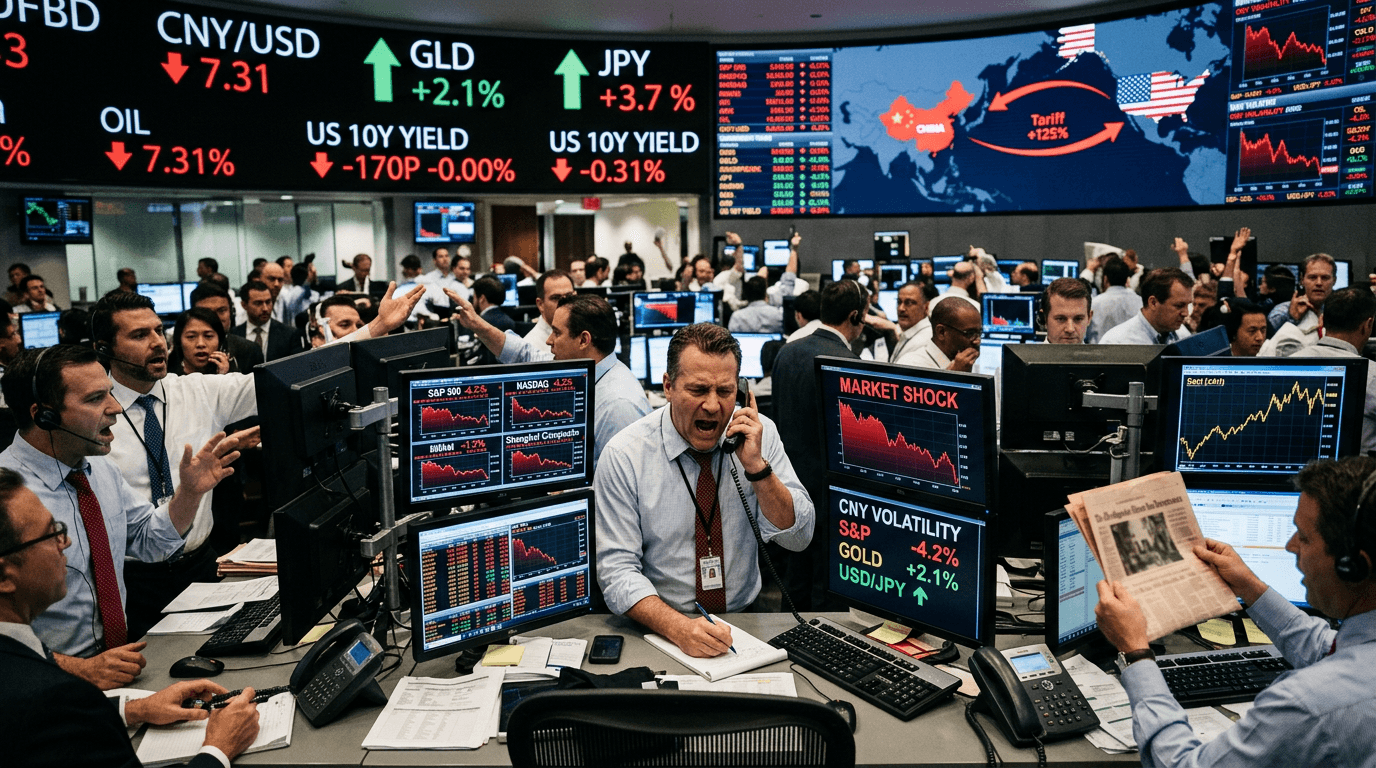
China’s latest announcement of steep additional tariffs on US goods, reaching levels of up to 125% on selected products from April 12, marks a fresh escalation in the long‑running trade conflict between the world’s two largest economies.[3][4] Beyond the political rhetoric, this move matters because it directly affects global trade flows, investor risk sentiment, and cross‑asset price dynamics in FX, equities, and commodities.
What Just Happened
Beijing has signalled that it will impose additional duties of up to 125% on a targeted basket of US imports, effectively making some American goods prohibitively expensive in the Chinese market.[3][4] Authorities have also warned that if Washington continues to raise or expand tariffs, China will “ignore” further US overtures, suggesting a harder line and a lower probability of near‑term compromise.
These measures are not across the board on every US export, but on strategic categories where China believes it has leverage—such as agricultural products, certain manufactured goods, and politically sensitive regions of US industry. By raising tariff ceilings to triple‑digit levels, Beijing is sending a clear signal: it is willing to absorb short‑term economic pain to push back against US trade pressure.
Where This Fits In The Broader Trade War
To understand the market impact, traders need to see this as another chapter in a much longer story. The US‑China trade dispute has evolved through multiple rounds of tit‑for‑tat tariffs since the late 2010s, with each side progressively widening coverage and raising rates. Earlier escalations saw US tariffs on Chinese goods climb as high as 145% on some categories, with China responding by lifting duties on selected US imports up to 125%.[3][4]
Even before this latest move, average tariff levels between the two economies were already elevated by historical standards. Estimates suggest that US tariffs on Chinese exports have risen to the high‑40% range on average, while China’s tariffs on US exports are above 30%, covering nearly all traded goods.[5][7] In that context, today’s announcement is less about the first shot and more about demonstrating that neither side is ready to de‑escalate meaningfully.
This continued hardening of positions raises the risk of a more durable fragmentation of global trade, supply chains, and technology flows—a theme markets are increasingly forced to price into long‑term valuations and risk premia.
RISK SENTIMENT AND SAFE‑HAVEN FLOWS
Trade tensions are, at their core, a shock to growth visibility and corporate profitability. When tariffs rise and rhetoric hardens, investors quickly reassess:
- Global growth expectations
- Earnings outlooks for export‑exposed companies
- The reliability of cross‑border supply chains
That reassessment typically triggers a “risk‑off” reaction: investors reduce exposure to risky assets and move capital into perceived safe havens. In FX, this often supports currencies like the Japanese yen and Swiss franc, and to some extent the US dollar, as traders look for liquidity and stability. In fixed income, demand for high‑grade government bonds tends to rise, pushing yields lower at the long end of the curve.
Commodities also reflect these shifts. Gold and other precious metals usually benefit from rising uncertainty and lower real yields, while industrial commodities tied closely to global manufacturing—such as copper or certain energy products—can come under pressure as markets price a weaker trade and production cycle.
For equity markets, the first response is often broad risk‑off selling, followed by more differentiated sector and regional moves as investors identify relative winners and losers in the new tariff landscape.
Impact Across Key Asset Classes
For traders—whether live or in a simulated environment—this kind of macro shock creates both risk and opportunity across multiple products.
FX • USDCNH (offshore yuan) tends to be a focal point. Rising trade tensions often put depreciation pressure on the yuan as investors anticipate slower Chinese growth and potential policy easing. • Export‑leveraged currencies in Asia–Pacific (such as the Korean won or, indirectly, the Australian and New Zealand dollars) can be hit as markets price weaker Chinese demand and more volatile regional trade flows. • Traditional safe havens like JPY and CHF can appreciate as global portfolios rebalance toward lower‑risk assets.
EQUITIES • Globally, index futures may see a volatility spike as investors hedge portfolios. US and Asian equity benchmarks tend to be most sensitive, given their direct exposure to the tariff fronts. • Sector‑wise, exporters, industrials, semiconductors, and global supply‑chain plays (logistics, shipping, select manufacturers) are typically more vulnerable. • Conversely, domestically focused sectors and defensive names (utilities, consumer staples, some healthcare names) can outperform in relative terms as investors rotate within equities rather than exiting entirely.
COMMODITIES • Industrial metals and energy may trade lower initially on concerns about slower trade and production, particularly if markets extrapolate these tariffs into a broader slowdown in global manufacturing. • Gold and, to a lesser extent, silver often benefit from safe‑haven demand, especially when trade tensions intersect with expectations of easier monetary policy or lower real yields. • Agricultural commodities can see idiosyncratic moves if the new tariffs are heavily concentrated in farm products, as has happened in previous rounds of US‑China trade friction.[3][4]
How Active And Simulated Traders Can Respond
In a high‑uncertainty macro environment, disciplined process matters more than prediction. For traders using a simulated finance (SimFi) platform, this kind of event is an ideal live case study in cross‑asset stress.
A few practical approaches
- Treat this as a volatility regime shift, not a one‑day headline. Test how your strategies perform when spreads widen, correlations change, and intraday ranges expand.
- Re‑examine correlation assumptions. In trade‑war episodes, relationships like equities vs bonds, or cyclical FX vs commodities, can deviate from their usual patterns. Simulating “correlation breakdown” scenarios is valuable risk training.
- Practice risk‑sizing and scenario planning. Build position‑sizing rules that explicitly account for event risk—such as tariff announcements, policy speeches, or retaliatory measures—and observe how your PnL distribution changes under different parameter sets.
- Back‑test previous trade‑war episodes. Historical tariff shocks provide a useful template: how did USDCNH behave, how quickly did equity indices stabilize, and which sectors led on the rebound?
By experimenting in a risk‑free SimFi environment first, traders can refine playbooks for handling real‑world macro shocks—identifying which setups fit their style and which risks they are uncomfortable carrying.
Key Takeaways For The Weeks Ahead
Looking forward, several themes are likely to dominate market thinking:
First, this is less about a single tariff line and more about the trajectory of the relationship. China’s willingness to push duties on certain US goods toward 125% and to signal it may disregard further US warnings suggests a more entrenched standoff.[3][4]
Second, markets will pay close attention to the US policy response. Any hint of additional US tariffs, export controls, or restrictions on technology and capital flows could trigger further volatility and repricing, particularly in sectors and currencies linked to the US‑China trade channel.
Third, macro data will be scrutinized for evidence of real‑economy impact—such as softer export orders, weaker manufacturing surveys, or revised corporate guidance from globally exposed firms. The more these tariffs show up in hard and soft data, the more durable the re‑rating of risk assets could become.
For traders, the core discipline is to respect volatility, avoid over‑concentration in any one trade linked to a single headline, and integrate macro awareness into strategy design. Simulated trading provides an effective way to stress‑test approaches, gain experience across asset classes, and build confidence in execution before risking real capital.