
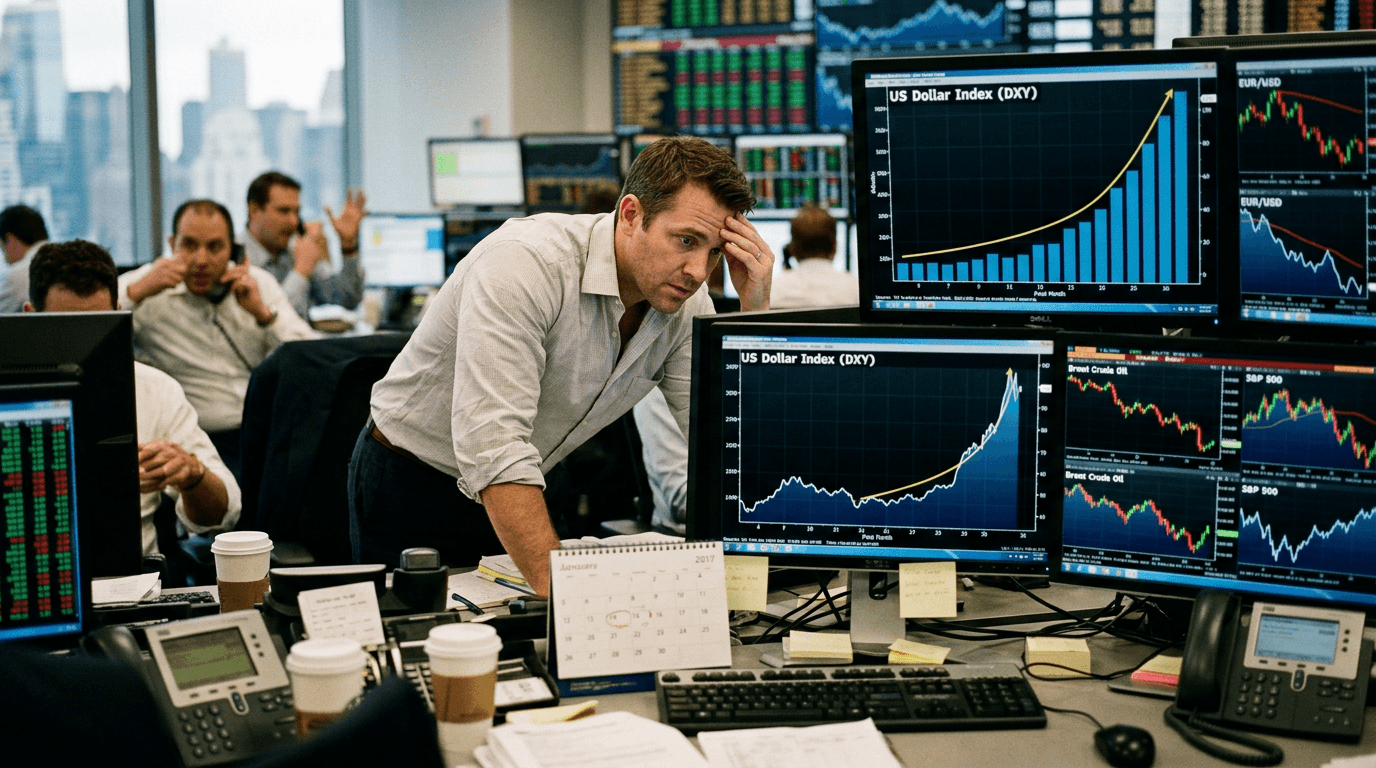
The US dollar index is quietly having a standout month. While day-to-day moves have been relatively subdued, the index is on track for its strongest monthly gain in nearly a year, signaling a decisive shift in global capital flows as markets brace for key US jobs data and rising geopolitical tensions in the Gulf. For traders, this is more than a headline—it's a live stress test of their macro understanding and risk management.
What The Dollar Index Is Telling Us
The US dollar index (often referred to as DXY or USDX) measures the value of the dollar against a basket of major currencies, including the euro, yen, pound, Canadian dollar, Swedish krona, and Swiss franc.[6][2] Because the euro carries the largest weight, the index is heavily influenced by EUR/USD, but it still offers a broad snapshot of the dollar’s global strength or weakness.[6]
In recent sessions, the index has traded relatively flat intraday but remains elevated on a monthly basis, reflecting consistent buying pressure rather than a single spike. Importantly, the dollar index is still below its highs from late 2022, when aggressive Federal Reserve tightening and energy market turmoil drove the dollar to multi-decade peaks.[5] That context matters: the current move is strong, but it is not yet extreme, leaving room for further adjustment if fundamentals justify it.
WHY THIS MONTH’S RALLY MATTERS
A strongest monthly gain in about a year is a signal that global investors are repricing both US and international macro risks in a meaningful way. Sustained dollar strength often reflects a combination of factors: relative growth outperformance in the US, expectations of higher-for-longer interest rates, and periods of elevated risk aversion that push capital into perceived safe havens.
For traders, it’s crucial to understand that a rising dollar index rarely happens in isolation. It tends to coincide with pressure on:
- Risk-sensitive currencies such as the Australian dollar, New Zealand dollar, and many emerging market currencies.
- Dollar-denominated commodities and assets, which become more expensive for non-US buyers.
- Global equity markets, particularly in regions where growth is more fragile or heavily exposed to external financing.
When the dollar delivers its best monthly performance in nearly a year, it signals that carry trades (borrowing in low-yield currencies to buy higher-yielding assets) may be under pressure, and funding conditions are tightening at the margin. That typically forces investors and traders to reassess leverage, hedging, and exposure to risk assets.
Jobs Data In The Spotlight
The immediate catalyst for the market’s focus is the upcoming US Nonfarm Payrolls (NFP) report, a central data point for understanding the health of the US labor market and, by extension, the likely path of Federal Reserve policy. Strong payrolls and solid wage growth generally support the case for tighter policy or a slower pace of easing, which tends to underpin the dollar through higher real yields and improved growth expectations.
Traders are essentially gaming three scenarios around the jobs data:
If the NFP report is stronger than expected, especially with firm wage growth, markets may push back expectations of rate cuts, driving yields higher and extending the dollar’s rally. In this environment, risk currencies can struggle, and funding conditions may tighten further.
If the data is roughly in line with consensus, the dollar may consolidate its gains, with volatility clustering around the release but without a clear directional break. Markets will then look to upcoming inflation readings and Fed communication for confirmation.
If the report disappoints significantly, especially with signs of weakening labor demand or cooling wages, the market could begin pricing a more dovish Fed path. That would typically pressure the dollar, support risk assets, and give oversold currencies some relief.
Ahead of the release, many participants reduce position size, widen stops, or hedge exposure using options. For traders in simulated environments, NFP days are a prime opportunity to practice high-volatility execution and scenario planning without the emotional pressure of real capital at risk.
Gulf Tensions And Safe-haven Flows
The other major driver of this month’s dollar strength is escalating tension between the US and Iran, alongside broader Gulf geopolitical risks. Whenever there is a credible threat to energy infrastructure, shipping lanes, or regional stability, global markets tend to rotate toward safe-haven assets. The US dollar, US Treasuries, and sometimes the Swiss franc and Japanese yen often benefit from this “flight to quality.”
Gulf tensions add a layer of complexity because they can simultaneously:
Increase perceived geopolitical risk, which supports the dollar as a defensive asset.
Influence oil prices, which can hurt oil-importing economies and their currencies while supporting certain producers.
Elevate volatility in emerging markets, particularly those with high external debt or significant dependence on energy flows.
When these geopolitical risks coincide with important US data releases, the result is often amplified volatility. A stronger dollar backed by both macro data expectations and safe-haven flows can exert significant pressure on risk currencies, commodity-linked FX, and leveraged positions in emerging markets.
What Traders Should Watch Next
With the dollar index set for its best monthly gain in almost a year, traders should pay close attention to both the drivers and the knock-on effects. Key practical takeaways include:
Monitor real yields and rate expectations: Changes in US real interest rates and futures pricing for Fed policy are critical to understanding whether the dollar’s strength has more room to run or is becoming stretched.
Watch cross-asset correlations: Dollar strength often interacts with equity volatility, credit spreads, and commodity prices. Understanding these relationships can help you avoid being blindsided by moves in markets you are not directly trading.
Respect event risk: NFP releases and geopolitical headlines can trigger sharp intraday moves and bid-ask spread widening. Plan your entries, exits, and risk limits in advance, and consider avoiding overly tight stops in illiquid conditions.
Focus on relative weakness and strength: Not all currencies respond equally to dollar moves. Identifying which pairs are structurally vulnerable (for example, high-deficit or high-debt economies) versus more resilient can sharpen your trade selection.
Using Simulated Finance To Navigate Dollar Volatility
Periods like this—where macro data, policy expectations, and geopolitics all converge—are where traders’ skills are truly tested. Simulated Finance (SimFi) platforms allow market participants to practice building and executing strategies under realistic market conditions without putting real capital at risk.
Traders can use SimFi environments to
Test different NFP scenarios and observe how the dollar index and major FX pairs react.
Develop and refine playbooks for trading around geopolitical headlines, including risk-off rotations and safe-haven flows.
Experiment with hedging and position-sizing frameworks that can be deployed in live markets when confidence is higher.
For both newer traders and experienced participants, treating the current dollar environment as a training ground is a smart way to convert complex macro developments into structured learning. The combination of strong monthly dollar performance, pivotal US jobs data, and Gulf tensions offers a rich set of scenarios to study, simulate, and ultimately trade with greater discipline.