
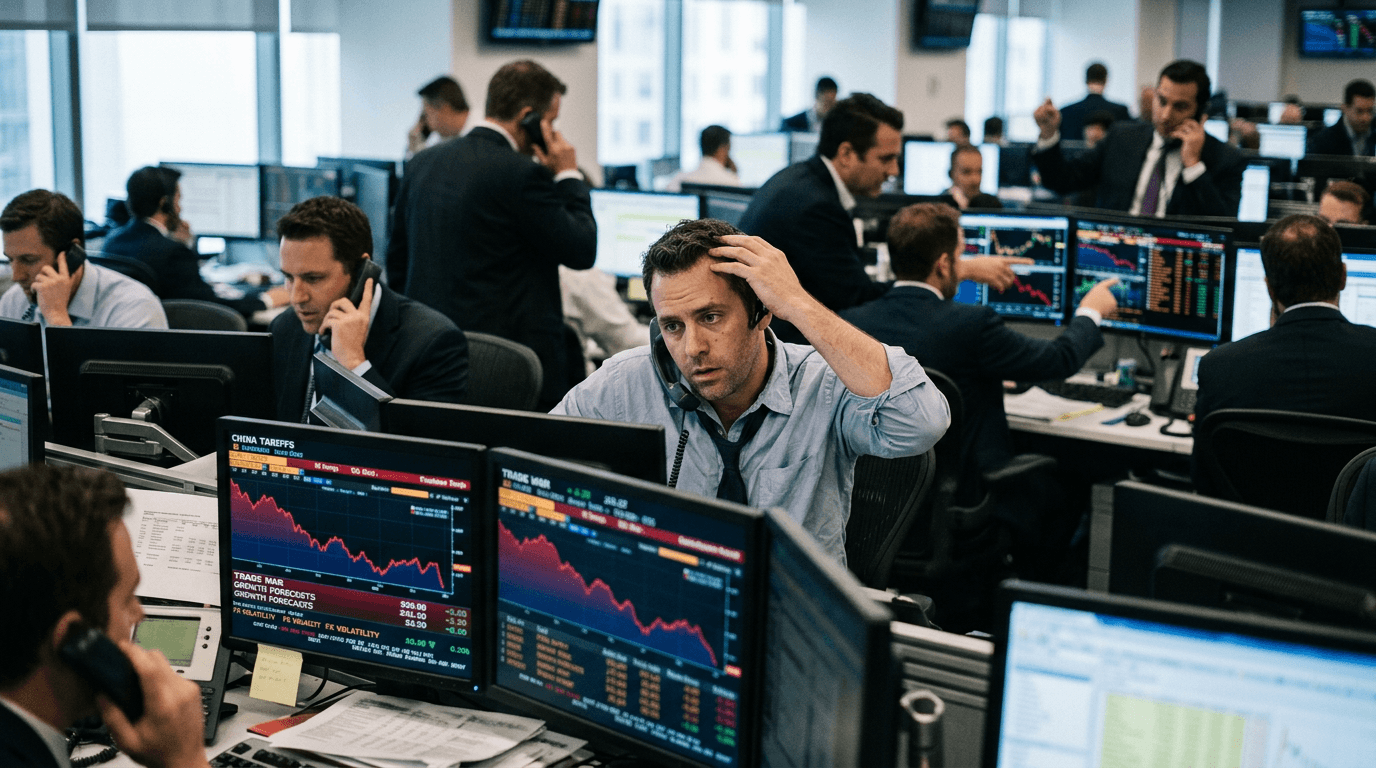
China’s latest move in the trade confrontation with the United States – announcing steep additional tariffs on certain US imports of up to 125% – has jolted global markets and reignited questions about how far the world’s two largest economies are prepared to go. Framed with unusually sharp rhetoric that Washington should bear responsibility for any economic damage, the announcement has raised fresh concerns about global growth, risk assets, and especially Asia-focused currencies and equities.[1][2]
WHAT JUST HAPPENED – AND WHY IT’S DIFFERENT THIS TIME
According to official statements and state media coverage, Beijing is raising tariffs on a range of US goods to levels as high as 125%, portraying the hikes as a direct response to what it calls “abnormally high” and politically motivated US tariffs.[1][2] In parallel commentary, Chinese officials have dismissed the US approach as lacking “practical economic significance” and warned that American exporters may effectively lose viable access to the Chinese market at current tariff levels.[1]
These new measures come on top of an already elevated tariff environment. Recent US actions have pushed average tariffs on Chinese exports sharply higher, with some strategic sectors like electric vehicles, semiconductors, and green technologies facing duty rates of 50–100% or more.[2][4] China has responded incrementally in prior rounds with its own additional tariffs, and the latest move to as much as 125% marks a clear escalation.[1][2]
What makes this particular step notable is not just the magnitude of the tariffs, but the explicit signaling that Beijing is prepared to absorb pain and shift trade flows rather than negotiate under pressure. That tone increases the risk that this is not a short-lived skirmish but part of a longer, structural decoupling in key sectors.
Why These Tariffs Matter For Global Growth
At a high level, tariffs act like a tax on cross-border commerce. They raise costs for importers, compress margins for exporters, and often feed into higher prices for end consumers. When tariffs are modest and targeted, economies can often absorb the shock. But when duties approach triple-digit levels across large swathes of trade, they begin to alter supply chains, investment decisions, and growth trajectories.
Recent analysis of US–China tariff dynamics shows that average US tariffs on Chinese goods have risen to levels multiple times their pre-trade-war norms, covering nearly all imports.[2][4] China’s own tariffs on US exports have also climbed materially, though from a lower starting point.[4] Each new ratchet higher reduces the economic space for mutually beneficial trade and pushes both sides toward import substitution and third-country sourcing.
Higher tariffs can weigh on global growth through several channels:
They disrupt trade flows in intermediate goods and components, complicating just-in-time supply chains that span Asia, Europe, and North America.
They increase uncertainty for corporates, discouraging long-term investment, especially in trade-intensive sectors like manufacturing, autos, and technology.
They may feed into tighter financial conditions if markets respond by demanding higher risk premia on equities and credit in exposed regions.
In an environment where global growth is already uneven and many central banks are trying to manage disinflation without triggering recessions, a renewed trade shock is particularly unwelcome.
Impact On Risk Assets And Asia Fx
The immediate market concern around China’s latest tariffs is less about the direct revenue effect and more about the signal they send on the future trajectory of US–China relations. For risk assets, the implications are nuanced but important.
Equities with high China or trade exposure – such as exporters in Korea, Taiwan, Japan, and Southeast Asia – are especially sensitive. These economies are deeply embedded in regional supply chains that ultimately serve US and Chinese end demand. If tariffs reduce final demand or cause abrupt shifts in sourcing, earnings volatility can rise across the region, not just in China itself.
Asia FX is typically one of the first places where trade tension risk gets priced. When investors worry about slower global trade and weaker Chinese demand, they often sell export-oriented currencies such as the Korean won (KRW), New Taiwan dollar (TWD), and, at times, the Australian dollar (AUD), while seeking safety in the US dollar, Japanese yen, or even the Swiss franc in global portfolios. Heightened tariff risk tends to:
Increase demand for USD funding and hedges, supporting the dollar against many Asian currencies.
Pressure the currencies of countries most tied to China’s industrial cycle and US tech demand.
Elevate implied volatility in FX options, particularly around trade-related headlines or policy events.
Risk assets more broadly – from emerging-market equities to high-yield credit – can also come under pressure if investors interpret the move as a sign of deeper geopolitical fragmentation. In that scenario, correlations between equities, FX, and commodities often rise, amplifying cross-asset volatility.
What Traders And Investors Should Watch
For traders in both live and simulated environments, this kind of policy shock is a reminder that macro and geopolitics can override micro fundamentals in the short term. Several indicators and themes deserve close attention:
Tariff scope and implementation details Which products face the 125% rates, how quickly they are implemented, and whether there are carve-outs or grace periods will matter for sector-level impacts.[1][2] Traders should watch for official lists, HS codes, and any subsequent clarifications that narrow or broaden the measures.
US response and escalation risk Markets will quickly reprice if Washington signals further reciprocal hikes or new non-tariff barriers. Previous episodes have shown that even the threat of additional action can move markets before any legal change takes effect.[2][4]
Corporate guidance and supply-chain shifts Earnings calls from globally exposed sectors – semiconductors, autos, machinery, luxury goods, and agriculture – often provide early color on real-economy impacts: redirected orders, inventory build-ups, or capex delays. These micro signals help validate or challenge the macro narrative.
Asia FX behavior around key levels Price action in currencies like KRW, TWD, CNH, and regional equity indices often gives a cleaner read on trade-growth sentiment than isolated news headlines. Sustained breaks of key technical levels or spikes in FX options volatility can flag that markets are moving from “headline noise” to a more structural repricing of risk.
For systematic or rules-based strategies, incorporating a “trade tension” regime filter – for example, using volatility, tariff news frequency, or measures of policy uncertainty – can help adapt position sizing and risk management when the macro backdrop shifts.
LONGER-TERM IMPLICATIONS: DECOUPLING OR NEGOTIATION?
Beyond the immediate market moves, the bigger question is whether this latest tariff step locks in a new phase of strategic economic separation or eventually leads back to negotiation. Tariff histories from earlier rounds of the US–China dispute suggest that periods of escalation have sometimes been followed by partial rollbacks or managed arrangements.[2][5] However, the direction of travel over multiple years has been toward higher average tariffs and broader coverage of trade.[2][4]
If both sides continue down this path, several longer-term trends may accelerate:
Rewiring of supply chains toward “friend-shoring” and regional blocs.
Greater emphasis on domestic industrial policy, subsidies, and resilience in strategic sectors like chips, batteries, and green tech.
A more fragmented global trading system, where companies and investors must navigate overlapping tariff regimes, export controls, and security-driven restrictions.
For growth, that likely means some loss of efficiency and higher costs in the near to medium term, even if certain countries or industries benefit as alternative production hubs. For markets, it reinforces the importance of integrating geopolitical analysis into portfolio construction, scenario planning, and risk controls.
For traders and investors, the takeaway is clear: treat trade policy as a core macro driver, not background noise. Episodes like China’s move to impose tariffs as high as 125% on US goods are not isolated shocks; they are part of a broader realignment that will shape volatility, relative performance, and opportunity sets across asset classes for years to come.[1][2]