
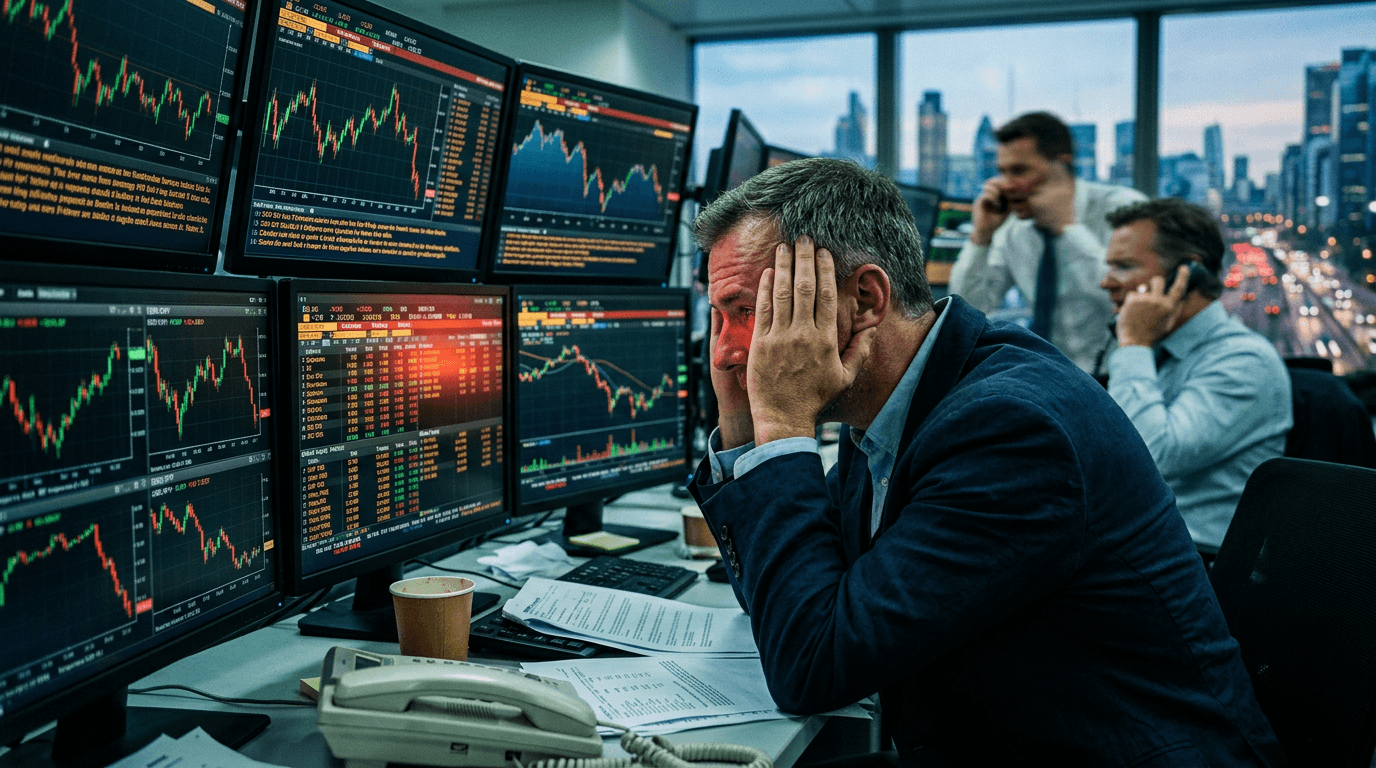
China’s decision to hike tariffs on a new list of US products, lifting combined duties on some items to as high as 125% from April 12, has jolted markets and revived memories of earlier phases of the US–China trade war.[3] Officials in Beijing have warned that Washington should bear responsibility for any economic damage, framing the move as a direct response to recent US tariff actions and a broader hardening of US trade policy toward China.[1][4] For traders, this is not just a political headline—it is a macro event with real implications for growth, risk sentiment, and cross‑asset volatility.
WHAT CHINA JUST DID – AND WHY IT MATTERS
The latest announcement adds extra tariff surcharges on selected US goods, pushing total duties (existing tariffs plus new measures) to as high as 125% in some cases.[3] Although the full product list is still being parsed by analysts, the focus appears to be on politically sensitive exports and sectors in which China has alternative supply options or domestic capacity.
This escalation comes on top of an already elevated tariff landscape between the world’s two largest economies. Following several rounds of US actions under Section 301 and reciprocal measures from Beijing, average US tariffs on Chinese exports have climbed to about 47.5%, while China’s average tariffs on US exports stand near 31.9%.[4] In 2025, for example, China imposed a broad 34% tariff on all US goods after the US raised duties on Chinese products, and also targeted American agriculture with additional levies.[1] The new 125% combined rate on some items is therefore less a starting point and more a new peak in a long-running dispute.
From a macro perspective, tariffs act like a tax on trade. They raise costs for importers and often for consumers, distort supply chains, and inject uncertainty into corporate decision‑making. When two systemically important economies escalate at the same time, the effect can spill well beyond bilateral trade flows into global growth expectations and financial markets.
How Tariff Escalation Hits Growth And Sentiment
There are three main channels through which these measures can weigh on global activity:
First, trade volumes. Higher tariffs typically reduce the profitability of cross‑border trade in the affected products, discouraging orders and disrupting established supply chains. During earlier stages of the US–China trade conflict, trade in targeted goods contracted sharply, and global trade growth underperformed global GDP as firms adjusted to new barriers.[2][4] A new round of tariffs raises the risk of another downshift in trade‑intensive sectors.
Second, business investment. When companies cannot predict future tariff rates or market access, they delay or scale back capital spending. Multinational firms faced with uncertain rules of the game become more cautious about building factories, expanding capacity, or committing to long‑term contracts. That weighs on productivity and growth, especially in manufacturing-heavy economies in Asia and Europe that are plugged into China‑ and US‑centric supply chains.
Third, confidence and risk appetite. Tariff headlines tend to amplify perceptions of geopolitical fragmentation. For global investors, that often translates into weaker risk sentiment, a preference for safe‑haven assets, and higher risk premia on equities and credit tied to export‑oriented sectors. Over time, repeated episodes of policy-driven shocks can structurally increase the “uncertainty tax” on the world economy.
Impact Across Asset Classes: Fx, Equities, And Commodities
Foreign exchange markets are often the first to react to trade shocks. When news like this breaks, Asian currencies with high trade exposure—such as the Korean won, Taiwan dollar, and, to a lesser extent, ASEAN currencies—tend to come under pressure as investors reprice export and growth risks. The Chinese yuan itself may face depreciation pressures if markets anticipate weaker Chinese export revenues or more accommodative policy to cushion growth.
In equities, the impact is usually concentrated in:
- Export‑oriented manufacturers with significant US–China revenue links
- China‑sensitive sectors such as semiconductors, autos, machinery, and luxury goods
- Logistics, shipping, and ports that sit in the middle of global trade flows
Investors also look at second‑round effects: if Chinese growth expectations soften, global cyclicals—from European industrials to emerging‑market suppliers of intermediate goods—may face headwinds.
Commodity markets are another key transmission channel. China is a major consumer of industrial metals and energy, so any perceived downside to its growth path tends to pressure prices for copper, iron ore, and, to a lesser degree, oil. On the agriculture side, Chinese retaliatory tariffs historically have targeted US farm exports such as soybeans, cotton, and meat.[2] Similar measures today can distort global agri‑trade flows, benefiting alternative exporters while hurting US producers and related companies.
WHAT TRADERS CAN LEARN – AND HOW TO POSITION IN A SIMULATED ENVIRONMENT
For traders—whether in live markets or on a SimFi platform—the latest tariff escalation is a reminder that macro and policy risk can reprice assets quickly, sometimes more than fundamentals alone would suggest. There are several practical lessons:
Focus on correlations, not just single names. Trade and growth shocks usually show up in clusters: Asian FX vs the US dollar, equity indices in export‑heavy markets, and China‑linked commodity futures often move together. Simulated trading is a good way to observe these relationships without capital at risk.
Revisit historical analogues. Back‑testing strategies against previous tariff episodes—such as the 2018–2019 US–China trade war or earlier 2025 hikes—can reveal how your approach behaves when volatility spikes and risk sentiment deteriorates.[1][4] Do your stop‑loss rules hold up? Does your position sizing adapt to higher uncertainty?
Plan for event risk. Tariff announcements rarely come in isolation. They are often followed by official statements, counter‑measures, and sometimes negotiations. In a simulated environment, practice building trade plans around key dates: announcement days, implementation days, and scheduled bilateral talks. That helps train the discipline of adjusting risk around known catalysts rather than trading purely on emotion.
Diversify scenario thinking. Instead of assuming a straight‑line escalation, build at least three scenarios: continued tit‑for‑tat tariffs, a negotiated pause or partial rollback, and a broader decoupling that spreads into technology, finance, or capital flows. Map out how each scenario might impact your watchlist across FX, equities, and commodities.
Key Risks, Opportunities, And What To Watch Next
The trajectory from here is not predetermined. On the risk side, there is always the possibility of further escalation—either in the breadth of products covered or the level of tariffs applied. The US has already used tools such as broad reciprocal tariffs and product‑specific measures targeting sectors like metals, semiconductors, and green technologies.[1] China, for its part, has shown it is willing to respond with its own broad‑based tariffs and targeted levies on sensitive US exports.[1][2] Each additional step risks reinforcing a negative feedback loop between trade, investment, and growth.
Yet there are also stabilizing forces. Both governments retain the option to suspend, reduce, or phase tariffs, as seen in prior decisions to delay or partially roll back measures when negotiations made progress.[1][5] Domestic economic considerations—such as the need to support growth, protect employment, and manage inflation—can create incentives to de‑escalate, especially if markets react sharply or key sectors feel the strain.
For traders, the opportunity lies in being prepared rather than predictive. Instead of trying to guess the exact outcome of US–China talks, focus on building robust strategies that can handle a range of macro environments. Use simulated trading to test how your portfolio responds when:
- Asian FX weakens and risk‑off flows boost the US dollar and safe‑haven assets
- China‑sensitive equities and commodities underperform global benchmarks
- Tariff headlines trigger intraday volatility spikes and gaps around market opens
By turning this latest tariff shock into a structured learning exercise—rather than a source of panic—you put yourself in a stronger position for when the next macro event hits.