
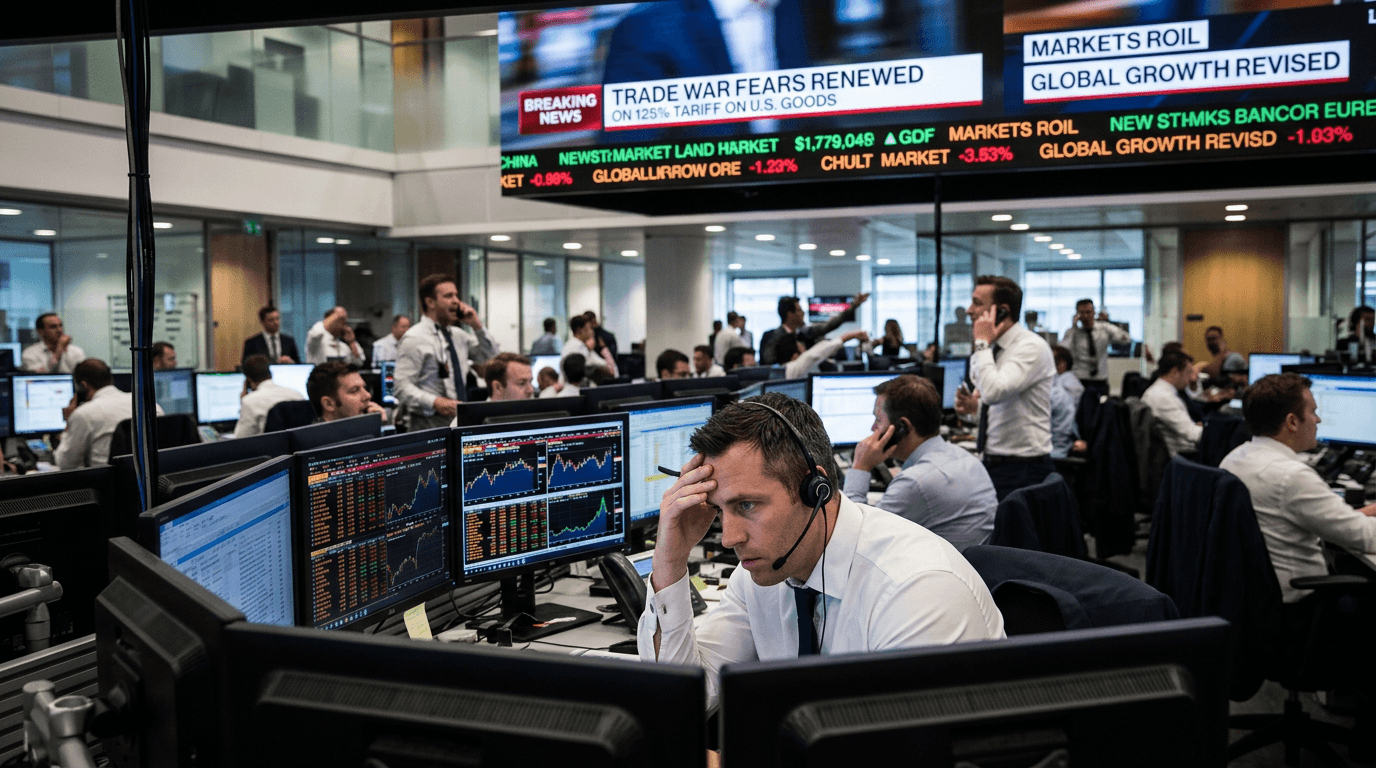
China’s decision to impose new tariffs of up to 125% on U.S. goods has jolted markets and reignited fears that the world’s two largest economies are sliding back into a full‑blown trade war.[1][2] Higher barriers on cross‑border trade were a key driver of global volatility in the last cycle, and this latest move immediately pushed investors toward safe‑haven assets while weighing on Asian currencies and equity futures.[1][5]
What China Just Announced
China’s finance ministry has raised tariffs on a broad set of American products from around 84% to as high as 125%, with the new measures taking effect on April 12.[1][2] Officials framed the move as a direct response to Washington’s earlier tariff hikes on Chinese imports, which now reach roughly 145% on some goods.[1][2][3]
In its statement, Beijing denounced U.S. policy as “economic bullying” and warned that continued escalation would be remembered as “a joke in the history of the world economy.”[1][2][5] Crucially, China signaled that if the U.S. imposes even more tariffs, it may simply ignore them on the grounds that current levels already leave “effectively no market for U.S. imports in China.”[2] At the same time, the Commerce Ministry indicated it would pursue additional action through the World Trade Organization, underscoring that this fight is playing out both politically and through formal trade channels.[1]
For traders and investors, the message is clear: tariff policy is being used as a strategic tool, and the risk of further surprises remains high.
WHY 125% TARIFFS MATTER
A tariff of 125% is not a marginal adjustment—it is designed to be prohibitive.[2][3] In practice, this level of duty can more than double the landed cost of affected U.S. goods, making them uncompetitive versus domestic Chinese alternatives or imports from non‑U.S. suppliers.
When tariffs reach these levels, several things tend to happen:
- Trade flows reroute: Chinese buyers look for substitute suppliers, whether in Asia, Europe, or emerging markets, reducing U.S. exporters’ market share.[2][8]
- Supply chains fragment: Multinationals rethink how and where they source inputs, assembly, and distribution to avoid tariff‑heavy lanes.[3][8]
- Corporate margins compress: Companies that cannot fully pass higher costs on to end‑customers face margin pressure and may cut investment or employment.
Historically, the U.S.–China tariff escalation in 2018–2019 contributed to weaker global trade volumes, slower manufacturing activity, and bouts of risk‑off sentiment across asset classes.[6] With both sides now ratcheting duties well beyond prior levels—125% on the U.S. side for China imports and parallel hikes on U.S. goods entering China—the potential for renewed drag on global growth is significant.[1][2][3]
Immediate Market Reaction
The announcement has already triggered classic “risk‑off” dynamics. Investors rotated into safe‑haven assets such as U.S. Treasuries, the dollar, the Japanese yen, and gold, while unwinding exposure to more cyclical plays.[1][5] Asian currencies came under pressure, reflecting concerns about export‑led growth and capital outflows, and equity futures in key markets fell as traders repriced earnings and macro risks.[1][5]
This reaction is not just about tariffs themselves—it is about uncertainty. Markets dislike open‑ended policy conflicts. When officials state they will “resolutely counter and fight to the end,” as China’s finance ministry did, participants begin to price in a prolonged standoff rather than a short‑term negotiating tactic.[1][2]
Volatility indicators typically rise in such environments, and correlations can shift quickly. Export‑sensitive sectors—such as semiconductors, industrial manufacturers, machinery, and agriculture—are particularly exposed, both in the U.S. and across Asia.[6][8] Meanwhile, domestic‑demand and defensive sectors (utilities, staples, healthcare) often outperform as investors seek shelter from trade‑related earnings shocks.
Global Growth And Supply Chain Risks
Beyond near‑term price action, the bigger question is how a renewed U.S.–China trade conflict reshapes the global growth outlook. Elevated tariffs raise transaction costs across the network of suppliers, assemblers, and distributors that underpin modern trade.[3][6]
Several structural risks stand out
- Investment hesitation: Corporates may delay capacity expansion or capex projects until there is clarity on tariff permanence, dampening growth in manufacturing hubs that rely on cross‑border demand.[6]
- Supply chain relocation: Firms accelerate “China plus one” strategies—diversifying production into other Asian economies or near‑shoring—creating winners and losers across regions.[3][8]
- Technology decoupling: Tariffs, when combined with export controls, can reinforce trends toward separate technological ecosystems, especially in chips and advanced manufacturing equipment.[4][8]
Interestingly, even as Beijing pushes tariffs higher, it has also begun to selectively exempt some critical imports from these duties, asking firms to identify goods they need tariff‑free.[8] Reports suggest possible exemptions for items ranging from aerospace parts to specific semiconductor categories, indicating that policymakers are trying to balance political signaling with domestic economic realities.[8] That tension—between strategic rivalry and economic interdependence—is a key theme traders should watch over the coming months.
How Traders Can Navigate A Renewed Trade Conflict
For market participants, the latest tariff escalation is both a risk and an opportunity. The key is to approach it with a structured framework rather than reactive headline trading.
A few practical takeaways
- Map exposure to trade‑sensitive assets: Identify which currencies (such as CNH, JPY, AUD), equity indices (China, Hong Kong, Korea, Taiwan, U.S. industrials and semiconductors), and commodities (soybeans, industrial metals) are most directly linked to U.S.–China trade flows.[6][8]
- Focus on scenarios, not single outcomes: Build trading plans around multiple paths—continued escalation, negotiated pause, or targeted exemptions—rather than trying to predict one “correct” future. Each scenario implies different moves in risk assets, safe havens, and volatility.
- Monitor policy language closely: Statements about “fighting to the end,” WTO filings, or conditional exemptions can all shift probability weights across scenarios.[1][2][8] Staying attuned to the tone and timing of official communication is as important as tracking the numbers.
Simulated Finance (SimFi) platforms are especially useful in this environment. They allow traders to stress‑test strategies in realistic market conditions driven by macro shocks like tariff announcements, without risking real capital. In a simulation, traders can:
- Practice trading around event risk—such as scheduled policy announcements or surprise headlines—using defined rules for position sizing and risk limits.
- Explore cross‑asset relationships, observing how FX, equities, rates, and commodities react to trade news over different time horizons.
- Refine discipline: Back‑test how systematic approaches (trend‑following, mean reversion, relative value) perform during periods of trade‑war volatility, and adjust risk management accordingly.
By using simulated environments to learn how markets respond to complex macro catalysts, traders can build confidence and resilience that carry over to live trading when conditions become similarly volatile.
Conclusion
China’s move to raise tariffs on U.S. goods up to 125% is more than a headline—it is a reminder that geopolitical and policy risks remain central drivers of modern markets.[1][2] The immediate reaction in safe‑havens, Asian currencies, and equity futures underscores how quickly sentiment can flip when the U.S.–China relationship deteriorates.[1][5]
Whether this escalation leads to a prolonged trade confrontation or ultimately pushes both sides back to the negotiating table, traders who treat tariff policy as a core macro variable—rather than a background noise—will be better positioned. By combining careful scenario analysis with practical training in simulated environments, market participants can navigate the renewed trade‑war landscape with greater clarity, discipline, and strategic edge.