
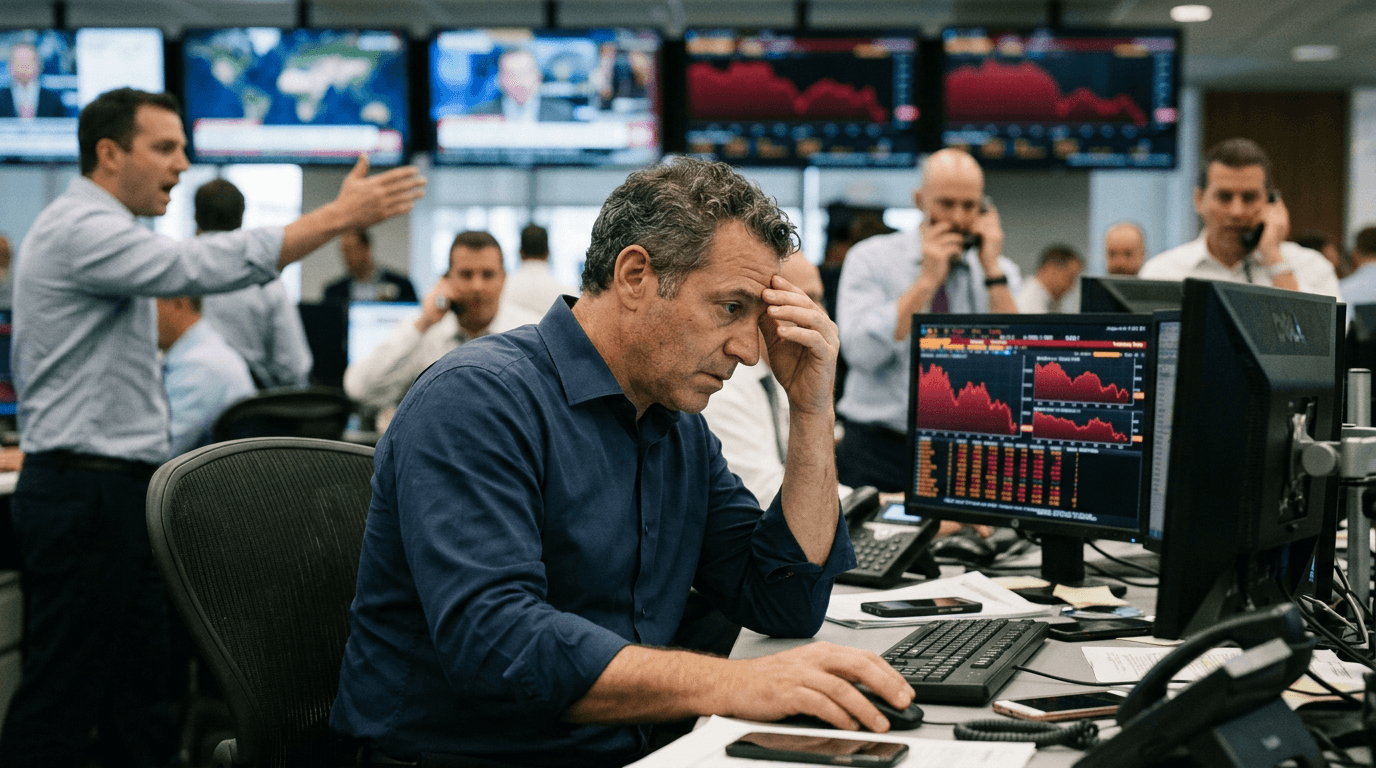
China’s latest tariff move has turned a simmering trade dispute with the United States into a full-blown escalation, sending shockwaves through FX and equity futures markets.[1][2] Beijing has announced additional tariffs on selected U.S. imports that can now reach up to 125%, on top of existing duties, and vowed to ignore further U.S. pressure.[1][2] With Washington already imposing tariffs on Chinese goods that total as high as 145%, investors are starting to reprice the risk of a prolonged trade war rather than a short-lived skirmish.[1][3] The immediate result has been weaker China-sensitive and emerging‑market currencies, softer U.S. and Asian equity index futures, and a spike in volatility as traders scramble to adjust.[1]
Markets Jolted By A New Tariff Shock
China’s State Council Tariff Commission has steadily ratcheted up duties on U.S. goods, shifting from targeted measures on agriculture, energy, and machinery to broad-based additional levies that cover virtually all U.S.-origin imports.[1] Earlier rounds included extra tariffs of 10–15% on products such as coal, LNG, crude oil, farm machinery, and large vehicles, layered on top of existing customs duties.[1] A subsequent 34% surcharge lifted the effective rate on many U.S. imports to around 84%, before the latest step raised that ceiling to as high as 125% in response to U.S. tariffs reaching 145% on Chinese exports.[1][2][3]
Crucially, these additional tariffs come with very limited exemptions or carve-outs.[1] Transitional relief for goods already in transit is narrowly defined, and the extra levies are generally not eligible for standard relief programs, making them difficult for exporters to sidestep.[1] For many U.S. producers—from farmers to industrial manufacturers—the Chinese market is now effectively priced out unless they absorb much lower margins or reroute trade through third countries.[1]
China has also backed the tariff measures with broader economic tools, adding U.S. firms to export control lists, naming more companies to an “Unreliable Entity List,” and restricting exports of critical minerals and rare earths.[1] Taken together, these steps extend the confrontation beyond tariffs into a wider contest over supply chains, technology, and strategic materials.[1] Markets are not just reacting to higher duties; they are responding to the risk of an enduring economic decoupling between the world’s two largest economies.
How Tariffs Transmit Into Fx And Equity Futures
The market reaction has followed a textbook “risk‑off” pattern.[1] China‑sensitive and broader emerging‑market currencies have come under pressure as investors price in weaker trade flows, softer growth, and potential capital outflows.[1] At the same time, demand has risen for traditional safe‑haven currencies, notably the U.S. dollar and Japanese yen, even though the U.S. is one of the main participants in the dispute.[1]
In equity markets, the first impact has appeared in futures.[1] U.S. equity index futures and Asian indices with high export and China exposure have traded lower as investors reassess earnings prospects and supply‑chain resilience.[1] Sectors heavily reliant on cross‑border manufacturing—autos, industrials, semiconductors, and global logistics—face the greatest uncertainty, as higher tariffs raise costs and complicate procurement.[1]
Volatility indices and options implied volatility have also ticked higher as traders rush to hedge portfolios or reduce leverage.[1] Wider bid–ask spreads and faster intraday swings are common around such policy shocks, particularly in index and FX futures.[1] For intraday and swing traders, this can be both a risk and an opportunity: larger moves increase potential reward but can quickly overwhelm poorly sized positions or tight stop‑losses.
The Macro Backdrop: Growth, Trade, And Earnings
From a macro perspective, the logic behind the market’s nervousness is straightforward: higher tariffs act as a tax on trade, raising costs, disrupting supply chains, and depressing volumes.[1] Analysts estimate that the current tariff structure could shave roughly 0.2% off global merchandise trade, which is meaningful in an already uneven growth environment.[1] While that number may sound small, the distribution of the shock matters—export‑dependent economies, global manufacturers, and commodity suppliers are likely to feel disproportionate pain.[1]
Corporate earnings are also at risk. Companies operating global supply chains face a choice between absorbing higher costs, passing them on to customers, or reconfiguring production networks.[1] None of these options is painless: margin compression, higher end‑prices, or capital‑intensive reshoring all weigh on profitability and investment plans. Over time, equity analysts may mark down earnings estimates for firms with heavy China‑U.S. linkages, reinforcing pressure on related indices.
Importantly, trade policy is inherently political and therefore difficult to model with traditional economic tools.[1] Timelines depend on negotiations, domestic politics, and geopolitical calculations rather than purely economic cost‑benefit analysis.[1] For markets, that means headline risk can remain elevated even when underlying macro data appear stable, leading to episodes of abrupt repricing when new measures or statements hit the tape.
HOW TRADERS CAN NAVIGATE TRADE‑WAR VOLATILITY
For active traders, this environment demands a shift from single‑asset thinking to cross‑asset awareness.[1] Tariff shocks rarely move just one market; they ripple through FX, equity indices, commodities, and rates simultaneously.[1] For example, a scenario of higher tariffs and weaker global trade might involve a stronger JPY, weaker EM FX, softer industrial metals, and underperformance in export‑heavy equity indices all at once.[1] Understanding these relationships is essential for building coherent trade ideas and managing portfolio risk.
Another key lesson is that correlations are not stable in periods of policy stress.[1] Relationships that hold in calm markets—such as a steady inverse correlation between the dollar and U.S. equities, or between yields and growth stocks—can break down when geopolitical headlines dominate.[1] Using historical episodes of trade tension as case studies, traders can stress‑test strategies to see how cross‑asset correlations behaved when tariff news drove the tape. Simulated trading environments and SimFi platforms are particularly useful for replaying such regimes without risking real capital.
Risk management also needs to be adapted to event‑driven volatility.[1] Wider intraday ranges and faster moves justify more conservative position sizing, wider stop‑loss levels calibrated to current volatility, and clearer rules for cutting risk around key announcement windows.[1] Futures markets, where margin calls can materialize quickly, demand special attention to leverage and liquidity conditions.
Finally, scenario thinking is more robust than point forecasts when dealing with trade policy.[1] Instead of trying to predict the next headline, traders can map out a small set of plausible paths—further escalation, a negotiated truce, or a partial sector‑by‑sector deal—and ask how each would affect their positions across FX, equity, and commodity markets.[1] Portfolios can then be structured to avoid being overly exposed to any single outcome, and hedges can be put in place for tail‑risk scenarios such as a full breakdown in negotiations.
For both discretionary and systematic traders, the latest China tariff move is a reminder that policy risk is now a central feature of the macro landscape, not a tail event.[1] Those who treat it as a recurring regime—studying its cross‑asset impacts, rehearsing responses in a simulated environment, and embedding scenario analysis into their process—will be better positioned to navigate the next headline shock, whenever it arrives.