
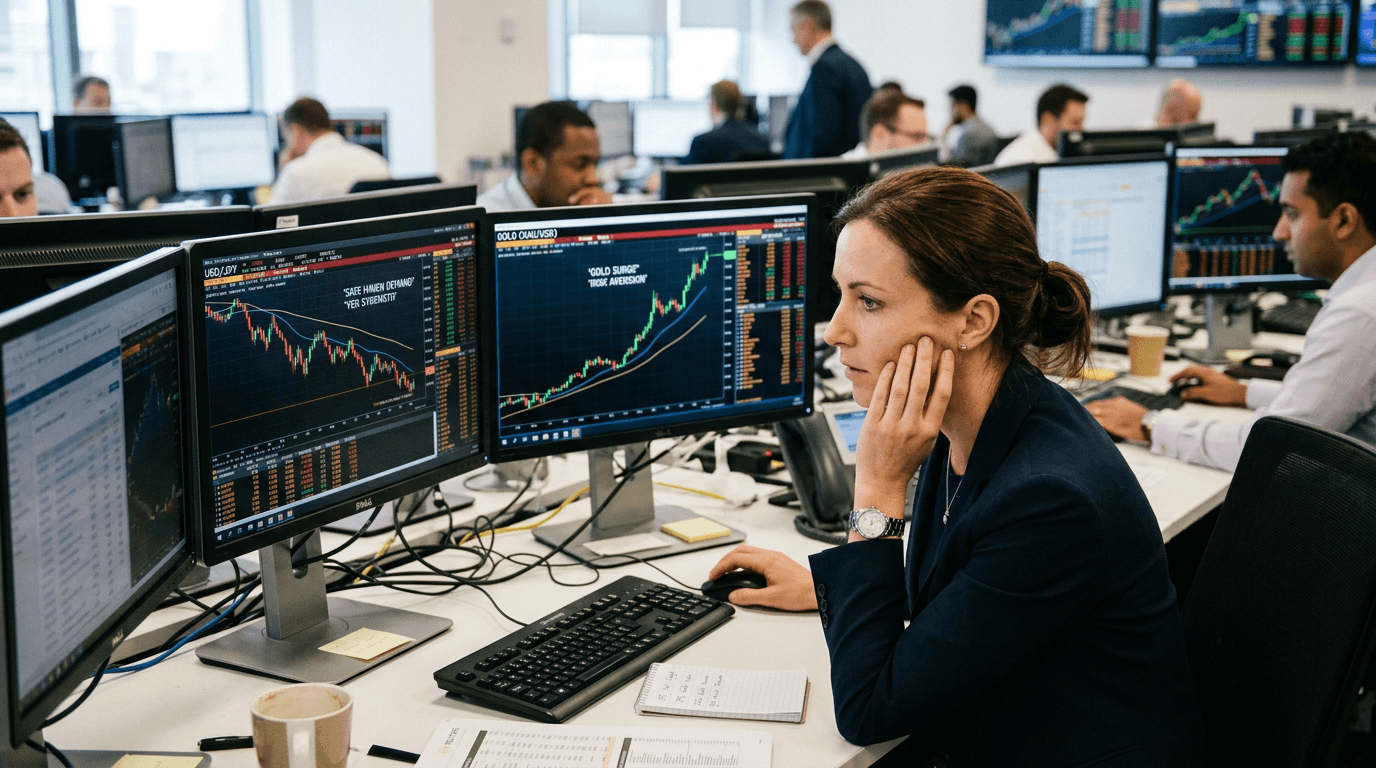
Safe-haven assets are back in the spotlight as investors grapple with fresh Middle East tensions and renewed US‑China trade frictions that have rattled global risk sentiment. Rising geopolitical risk, choppy oil prices, and worries about global growth are pushing capital toward traditional shelters like the Japanese yen and gold, helping both stabilize even as equities and higher‑beta currencies wobble.[1][3] For active traders, this environment is both a risk and an opportunity: correlations are shifting, volatility is elevated, and safe‑haven flows are once again driving the narrative across FX and commodities.[3][5]
Understanding Safe-haven Flows
Safe-haven assets are instruments that tend to hold or increase their value during periods of market stress or uncertainty, as investors seek to preserve capital rather than chase returns.[5] Classic examples include the Japanese yen, the Swiss franc, high‑quality government bonds, and gold, although their performance can vary depending on the macro backdrop.[2][5]
In practice, safe-haven flows are often driven less by headlines themselves and more by how those headlines alter expectations for growth, inflation, and central bank policy. Conflict in the Middle East raises fears of supply disruptions and energy price spikes, which can feed into inflation and weigh on global demand.[3] At the same time, renewed tariff threats between the US and China revive memories of prior trade wars, when higher barriers weighed on global manufacturing and investment.
It is also important to recognize that “safe haven” is a behavior, not a guarantee. In some recent episodes of Middle East turmoil, traditional shelters like Treasuries and gold actually sold off alongside risk assets, while the US dollar emerged as the key beneficiary.[1][2][6] This underscores a critical point for traders: safe-haven status is conditional on the macro regime, positioning, and policy expectations, not static over time.[2][6]
Why Yen And Gold Are Back In Focus
Against the latest backdrop of geopolitical stress and trade frictions, both the yen and gold have drawn renewed demand as investors trim risk and rebalance portfolios.[1][3] The yen benefits from its longstanding status as a funding currency in carry trades; when risk sentiment deteriorates, investors often unwind these trades by buying back yen, pushing the currency higher.[5] Japan’s large net external asset position further reinforces its haven reputation, as capital tends to repatriate in moments of global stress.
Gold, meanwhile, remains a barometer of fear and uncertainty. Empirical research shows that gold’s correlation with equities often falls or turns negative during periods of market turmoil, making it an effective diversifier when stock markets stumble.[3] In earlier waves of Middle East tension, gold has broken higher from multi‑week ranges as traders rushed into the metal on the back of risk aversion, shifting rate expectations, and moves in the US dollar and real yields.[3][7]
What makes the current episode notable is that yen and gold have found support even in a mixed environment, where the dollar has at times also attracted safe‑haven demand and bond markets have not provided a straightforward hedge.[1][2][6] This reflects a more fragmented “safety map,” where investors are diversifying their defensive positioning across currencies, commodities, and selective fixed income rather than relying on a single asset class.[6]
Geopolitics, Oil, And Risk Sentiment
The Middle East remains a critical node for global energy supply, so any escalation in regional tensions tends to reverberate quickly through oil markets.[1][3] Sharp swings in crude prices feed into inflation expectations and corporate cost structures, which can weigh on equity valuations and increase volatility across assets. When oil jumps on supply fears, risk‑sensitive currencies tied to global growth can come under pressure, while havens like the yen and gold often benefit as investors seek protection against both geopolitical and inflation risks.[3][7]
At the same time, renewed talk of higher tariffs between the US and China injects a different kind of uncertainty. Trade frictions threaten global supply chains and export‑oriented sectors, especially in Asia and Europe, reinforcing a cautious stance toward cyclical assets. During previous tariff cycles, markets often saw a pattern where equity indices weakened, commodity currencies like AUD and NZD struggled, and safe‑haven currencies and gold outperformed on a relative basis.[5]
Layered on top of this is the central‑bank dimension. When geopolitical shocks coincide with concerns about growth and inflation, traders quickly reassess the path of rate hikes or cuts. In recent conflicts, expectations for US policy have swung from multiple cuts to renewed hikes as inflation risks resurfaced, helping the dollar at the expense of some other havens.[1][2][6] The interaction between Fed pricing, yields, and risk sentiment is crucial for gold: lower real yields and a softer dollar tend to amplify safe‑haven gold rallies, while rising yields can cap or reverse them even when geopolitical risks remain elevated.[3]
What This Means For Traders
For traders operating in both live and simulated environments, the current episode is a reminder that macro drivers can flip market regimes quickly. When safe‑haven flows are in play, correlations you rely on in calmer periods may break down, and technical levels can be tested or breached more violently than usual.[3][4]
In FX, watch yen crosses such as USD/JPY and EUR/JPY as barometers of global risk appetite. Persistent buying of yen on dips, even without major domestic news from Japan, can signal broader de‑risking under the surface. Similarly, sustained strength in gold relative to other commodities, or a breakout above established resistance levels, often reflects a shift toward capital preservation and hedging demand.[3][7]
Risk management deserves particular attention. Safe‑haven episodes are typically accompanied by elevated volatility, wider bid‑ask spreads, and faster intraday swings. This makes trade location and position sizing critical: chasing late moves in gold or yen after a headline spike can be costly if the news flow moderates, while patiently waiting for retests of key technical zones can offer better reward‑to‑risk setups.[3]
Key Takeaways For Simulated Traders
For traders using a simulated finance (SimFi) environment, periods like this are ideal laboratories for stress‑testing strategies without putting real capital at risk. You can:
- Practice trading safe‑haven breakouts and reversals in gold, focusing on how the metal behaves around prior resistance and support when geopolitical headlines hit.[3]
- Test how your FX strategies perform when risk sentiment flips, paying attention to yen and dollar behavior versus higher‑beta currencies.
- Build scenario plans around escalation and de‑escalation: map how you expect gold, yen, equities, and oil to react if tensions worsen versus if diplomacy cools the situation, then compare your plan to actual market behavior.[3][4]
- Refine your risk rules, including volatility‑adjusted position sizing and wider but more thoughtfully placed stops, to handle the faster moves typical of safe‑haven flows.
By treating the current mix of Middle East tensions and US‑China trade frictions as a live case study, you can deepen your understanding of how safe‑haven dynamics really work in practice. Whether you are trading gold breakouts, yen reversals, or cross‑asset correlations, this is a moment to focus on process: reading the macro narrative, integrating it with technical levels, and executing with disciplined risk management. In a world where “nowhere to hide” headlines appear more often than they used to, building skill in navigating safe‑haven flows is becoming an essential part of every trader’s toolkit.[2][3][6]