
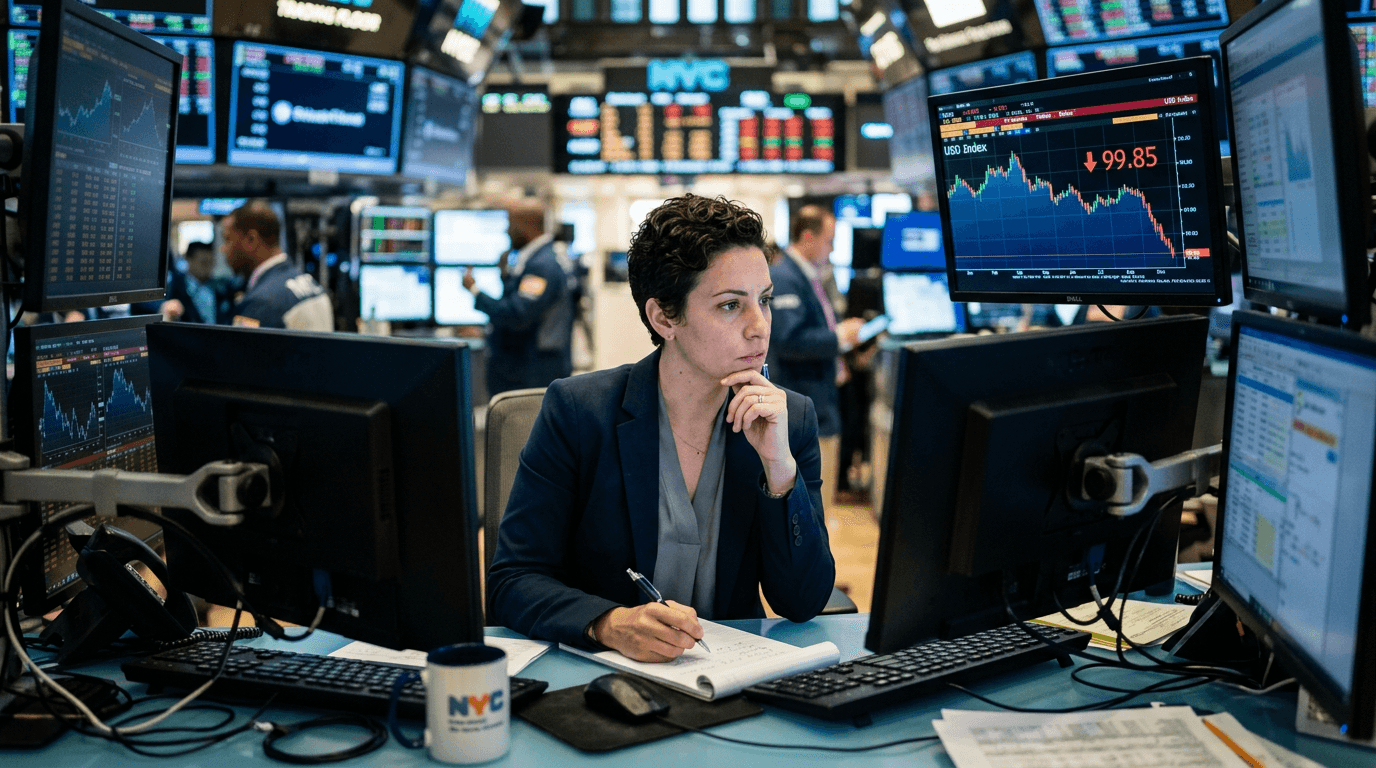
Few levels in global FX carry as much psychological weight as the 100 line on the U.S. Dollar Index, and breaking below it is a loud signal that the “strong dollar, higher-for-longer” narrative is being challenged across markets.[1] As dollar index futures gap lower in Asian trade, investors are rapidly repricing the Federal Reserve path and reacting to fresh U.S.–China tariff headlines, unleashing broad dollar selling, elevated volatility, and outsized moves in major currency pairs.[1][2]
What The Dollar Index Break Means
The U.S. Dollar Index (often quoted as DXY) tracks the dollar’s value against a basket of major currencies, with the euro, yen and pound making up the bulk of the weighting.[6][10] When the index falls, it signals that the dollar is weakening relative to that basket, which immediately affects everything from EUR/USD and GBP/USD to commodity-linked and emerging‑market currencies.[6][10]
The 100 level matters for both technical and psychological reasons. It has acted as a key pivot zone in recent years, and breaking below it tells traders that the market is no longer willing to pay the same premium for dollar exposure that prevailed under the “higher-for-longer” rate regime.[1] Instead, capital is rotating into currencies backed by relatively more hawkish central banks and into assets that benefit from a weaker dollar, such as commodities and select emerging‑market equities.[1][5]
Markets Reassess The Fed Narrative
The latest leg of the dollar selloff is rooted in a rapid reassessment of the Federal Reserve’s policy trajectory.[1] Recent Fed minutes and speeches have been interpreted as less hawkish, with officials emphasizing data dependence and appearing more open to the idea that policy may already be restrictive enough.[1] That has prompted traders to trim expectations for additional rate hikes and to bring forward scenarios for eventual easing.
When markets believe the peak in U.S. rates is in, the rate‑differential advantage that supported the dollar for much of the past cycle starts to erode.[1] Investors who previously sought the safety and yield of dollar assets begin reallocating toward higher‑yielding alternatives or regions with more supportive growth dynamics.[1] The result is visible in the broad pressure on USD across major FX pairs and the outperformance of EUR, GBP and high‑beta currencies that tend to do well when risk appetite improves.[1][2]
Importantly, this reassessment can be fluid. A single upside surprise in inflation or a more hawkish press conference could swing expectations back toward a tighter Fed stance, potentially stabilizing the dollar or even triggering a sharp short‑covering rally.[1] That uncertainty is part of what keeps volatility elevated into the end of the week.[2]
Tariff Shock And The Global Risk Landscape
The policy story is not just about interest rates. Renewed U.S.–China tariff headlines are adding another layer of complexity to the dollar narrative.[2][5] Trade tensions tend to be dollar‑positive when they trigger safe‑haven flows, but they can also undermine confidence in U.S. policy, disrupt global supply chains, and pressure growth-sensitive assets.
This time, tariffs are arriving in a market already sensitive to the idea of slower global growth and shifting central bank stances. The combination of a less‑hawkish Fed and tariff uncertainty is encouraging some investors to diversify away from the dollar, particularly into currencies and markets perceived to be less directly exposed to the bilateral dispute.[1][5] Commodity exporters and select emerging markets can benefit if tariffs reshape trade flows in their favor, especially against a backdrop of a cheaper dollar that makes their exports more competitive.[5]
However, tariff shocks can be highly path‑dependent. Escalation that hits global demand hard could reverse risk‑on positioning and revive demand for defensive dollar assets. Traders need to map out multiple scenarios and understand how different combinations of Fed guidance and trade headlines could affect correlations across FX, equities and commodities.[1]
What A Weaker Dollar Means Across Asset Classes
A sustained move below 100 on the dollar index has ripple effects far beyond FX charts.[1] In rates markets, an ebbing dollar bull trend often coincides with expectations for lower real yields and a gentler policy stance, which can support the front end of non‑U.S. curves where central banks remain relatively hawkish.[1]
In commodities, a weaker dollar typically reduces the cost of dollar‑denominated contracts for non‑U.S. buyers, supporting demand for gold, oil, and industrial metals.[10] Gold, in particular, tends to attract flows when investors simultaneously worry about policy uncertainty and seek a hedge against currency debasement and geopolitical risk.[2]
Equities and credit feel the impact as well. U.S. multinationals can benefit from currency translation effects—foreign earnings are worth more in a weaker dollar—while emerging‑market corporates may see relief on dollar‑denominated debt burdens.[5][10] At the same time, sharp FX moves can challenge hedging strategies and funding models, making risk management more complex across portfolios.[1]
Practical Strategies For Traders In A Weaker Usd Regime
For discretionary and systematic traders alike, the opportunity in a weaker‑dollar environment lies less in predicting the next 50 points on DXY and more in understanding how shifts in rate expectations and tariffs reshape relative value.[1] Several practical approaches stand out:
One is to lean into the theme by favoring non‑USD assets where the macro backdrop is supportive—going long select G10 currencies with still‑hawkish central banks, or building exposure to commodity‑linked currencies that benefit from both yield and global demand recovery.[1]
Another is to focus on cross‑currency trades that isolate rate differentials, such as pairing a central bank that is likely to stay restrictive against one seen moving more quickly toward easing.[1] This reduces direct exposure to the dollar while still expressing a view on policy divergence.
Risk management is critical. Elevated volatility into major data and policy events means position sizing, staged entries, and clear invalidation levels matter more than ever. Traders should be wary of over‑relying on a single psychological level like 100 as a “hard line in the sand,” and instead respect that regimes can change quickly as new information arrives.[1]
Using Simulated Finance To Navigate Dollar Shifts
Dollar regime changes—whether from policy repricing or tariff shocks—are exactly the kind of environment where simulated finance (SimFi) can add real value. Because moves around key levels like 100 are often accompanied by gaps, whipsaws and correlation breakdowns, they provide rich case studies for strategy testing and skill development.[1]
In a simulated trading environment, you can stress‑test your FX and multi‑asset strategies across different dollar scenarios: a gradual grind lower with ongoing tariff noise; a sharp reversal on hawkish Fed commentary; or a prolonged weak‑dollar phase that boosts carry trades and high‑beta currencies.[1][5] This allows you to refine entries, exits, and risk protocols without putting real capital at risk.
You can also experiment with cross‑asset positioning—linking FX trades to views on gold, equities or rates—to see how your portfolio behaves when correlations shift in a weaker‑dollar world.[1] The goal is not to “solve” the dollar, but to become more resilient and adaptable as policy and trade narratives evolve.
Looking Ahead: Volatility Is The New Normal
The break below 100 on the U.S. Dollar Index underscores a broader theme: markets are transitioning from a simple strong‑dollar, higher‑for‑longer story to a more nuanced, data‑driven and geopolitically sensitive regime.[1][2] As the Fed path and tariff outlook continue to be reassessed, traders should expect elevated FX volatility and more frequent regime shifts, rather than a smooth trend.
In that environment, edge comes from preparation, scenario planning, and disciplined execution. By understanding why the dollar is weakening, how tariff shocks intersect with policy, and how these forces propagate across asset classes, traders can turn a headline‑driven selloff into a structured opportunity set—both in live markets and in simulated environments designed to mirror this new normal.[1][5]