
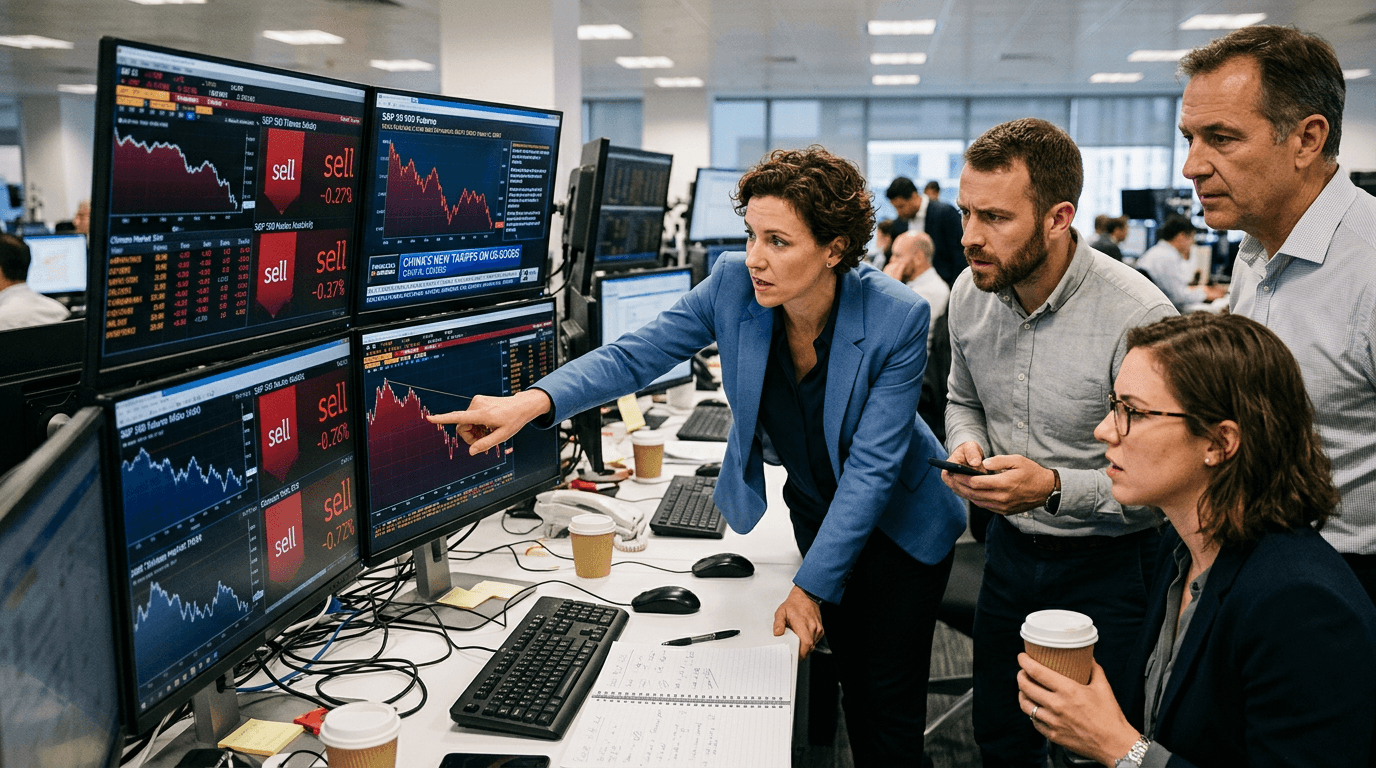
China’s decision to hike tariffs on a broad range of US goods to levels as high as 125% marks a sharp escalation in the ongoing trade confrontation between the world’s two largest economies[1][4]. In official comments, Beijing framed the move as a direct response to earlier US tariff increases and warned that if Washington continues to raise duties, China will simply “disregard” further measures[1]. For markets already uneasy about slower global growth and fractured supply chains, this latest step has reinforced a strong risk-off tone: risk assets are under pressure, while classic safe havens are drawing renewed interest.
WHAT’S BEHIND CHINA’S 125% TARIFFS
At its core, a tariff is a tax on imports, intended either to protect domestic industries or to exert political leverage in negotiations. China has raised duties on many US products from roughly 84% to about 125%, deliberately targeting sectors where US exporters rely heavily on Chinese demand[1][4]. The practical message from Beijing is clear: at these levels, “there is effectively no market for U.S. imports in China”[1]. That turns previously profitable trade flows into near non-starters and forces both buyers and sellers to rethink sourcing, pricing, and long‑term strategy.
This move also fits a broader pattern of reciprocal actions. The US had already pushed its own tariff burden on Chinese goods to around 145% in aggregate, combining earlier measures with new reciprocal hikes[1][2]. By pushing back at a similar magnitude, China signals it is willing to absorb short‑term pain to gain negotiating leverage, even if that means higher input costs, some domestic shortages, and more complicated supply chains.
Why Markets Are In Risk-off Mode
“Risk-off” describes periods when investors step back from assets seen as volatile or cyclical—like equities, high-yield credit, and emerging-market currencies—and rotate into safer, more liquid instruments such as government bonds, gold, and the Japanese yen. Trade shocks are classic triggers for this behavior. Higher tariffs act like a tax on global commerce, compressing margins, discouraging investment, and raising uncertainty about future earnings and growth.
In this case, the rhetoric is as important as the numbers. China’s warning that it will ignore further US tariff increases if Washington escalates again signals that the dispute is no longer just about relative price levels; it is about political resolve[1]. When both sides emphasize their willingness to “fight to the end”[1][8], markets hear a reduced probability of quick compromise and a higher risk of prolonged friction. That uncertainty is what drives volatility spikes, wider credit spreads, and flight-to-safety flows.
Winners And Losers Across Asset Classes
The first and most obvious losers are directly exposed exporters. US companies that relied on China as a key end market now face prohibitive costs and may see order cancellations, delayed shipments, or forced price cuts to remain competitive. On the Chinese side, firms dependent on US components or technology face higher import prices, tighter margins, or the need to find alternative suppliers—often at lower quality or higher risk.
Across asset classes, the picture is more nuanced:
Equities: Global equity indices typically sell off on announcements of sudden, large tariff hikes, with cyclical sectors like industrials, autos, and semiconductors hit hardest. Companies with diversified supply chains and strong domestic demand tend to hold up better, but valuation multiples can compress across the board.
Currencies: Safe-haven currencies like the Japanese yen and Swiss franc often appreciate as investors reduce exposure to higher‑beta FX such as emerging‑market currencies. The US dollar can benefit from safe-haven flows, but trade‑related uncertainty may cap gains if investors anticipate slower US growth.
Fixed income: Government bond yields generally decline as investors seek safety, boosting prices for benchmark Treasuries and other high‑quality sovereign debt. Credit markets may see spreads widen, especially for lower‑rated issuers that are more sensitive to growth shocks.
Commodities: Industrial commodities tied to manufacturing and construction demand—such as copper—can weaken on growth concerns, while gold often benefits from heightened geopolitical and policy uncertainty.
Key Signals Traders Should Watch
For traders and investors, the headline tariff rate is only one piece of the puzzle. Several additional signals will shape how this story evolves:
Policy sequencing: Watch whether either side pairs tariffs with other measures like export controls, investment restrictions, or technology bans. China has so far avoided broad new export controls in this latest move, leaving itself room for targeted escalation or compromise[1].
Exemptions and carve‑outs: Even amid steep tariffs, both countries have used exemptions to mitigate damage in critical sectors—such as sensitive technology, healthcare inputs, and key industrial components[7][8]. Any expansion or contraction of these carve‑outs provides clues about which industries policymakers are most determined to protect.
Negotiation tone: Shifts in language—from combative to conciliatory, or vice versa—often precede changes in market pricing. Recent episodes have shown that even modest signs of flexibility, like temporary tariff reductions or short‑term suspensions, can spur relief rallies[6][8].
Macro data: Trade volumes, business confidence surveys, manufacturing PMIs, and earnings guidance all help quantify whether tariffs are translating into real economic stress. Markets will be quick to re‑price if data confirm a sharper slowdown than currently expected.
Navigating A Risk-off Regime With Simulated Markets
For active traders, a sudden change in risk tone presents both danger and opportunity. Volatility increases, correlations shift, and traditional relationships—such as equities down while gold and Treasuries rally—can strengthen or briefly break as liquidity conditions change. Without a clear framework, it is easy to over‑react to headlines or under‑estimate how quickly positions can move against you.
This is where simulated finance (SimFi) environments become particularly valuable. By testing strategies against stress scenarios—such as a rapid sequence of tariff announcements, risk‑off rotations, and currency shocks—traders can see how their systems behave without putting real capital at risk. You can:
- Model portfolio performance under higher volatility and wider bid‑ask spreads
- Explore hedging tactics using safe‑haven assets or options
- Examine how leverage and margin requirements might change in a risk‑off regime
- Practice disciplined risk management: cutting losses, resizing positions, and avoiding emotionally driven trades
The goal is not to predict every policy headline, but to build resilience. In a world where tariff decisions can push duties above 100% and take entire export markets effectively offline overnight[1][4], the ability to stress‑test and adapt is as important as the ability to analyze the news itself.
As the tariff confrontation between China and the US intensifies, markets are sending a clear message: policy uncertainty is now a central driver of price action, not a background noise. Traders who understand the mechanics of tariffs, monitor key signals, and systematically rehearse their responses in simulated environments will be better positioned to navigate whatever the next chapter of this trade story brings.