
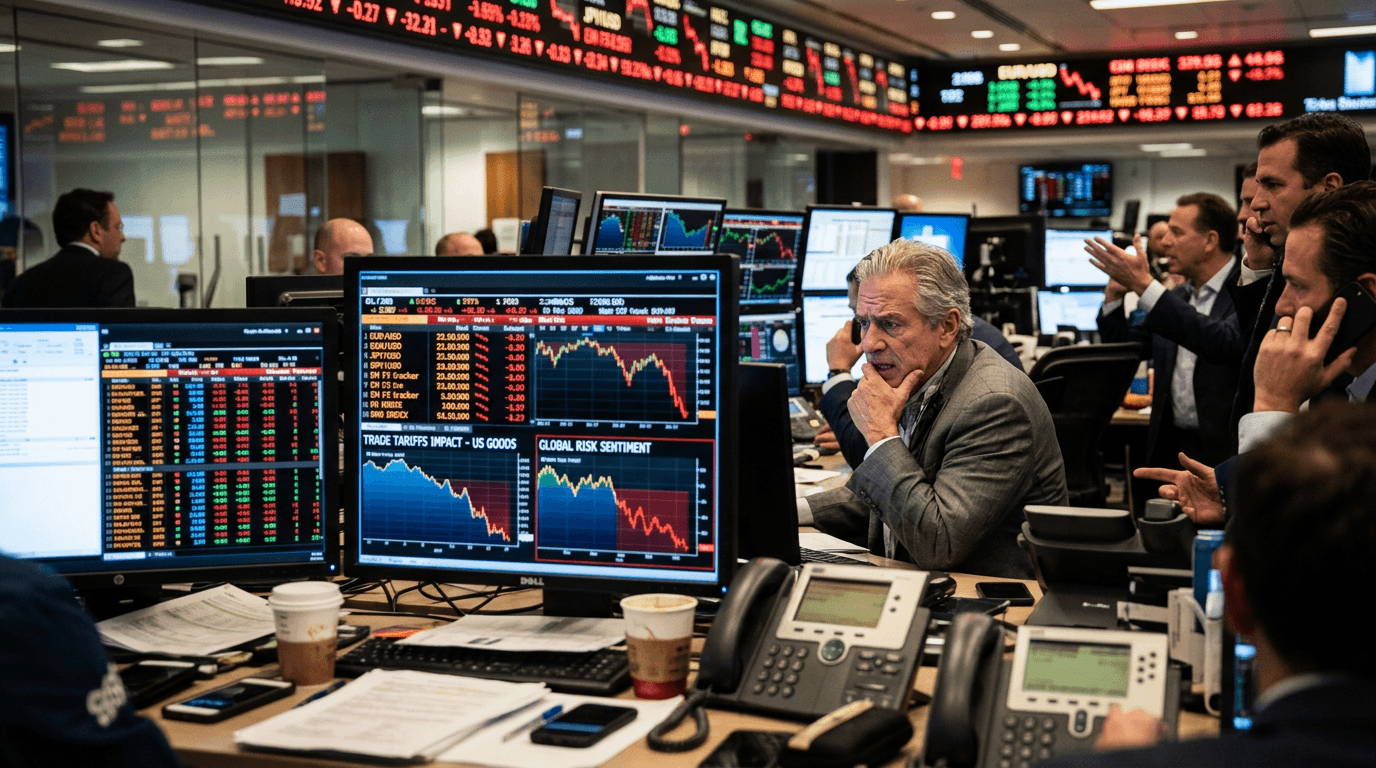
China’s decision to raise tariffs on a broad range of U.S. goods to as high as 125% from April 12 marks a sharp escalation in the long-running trade confrontation between the world’s two largest economies[10][8]. This move arrives at a time when the U.S. dollar index has already slipped below key technical levels, adding macro uncertainty just as global markets were looking for stability. For traders, the combination of higher trade barriers, shifting capital flows, and a softer dollar backdrop creates a complex environment for risk assets, FX, and safe-haven positioning.
WHAT CHINA’S 125% TARIFF MOVE SIGNALS
The jump in China’s tariff rates to 125% on certain U.S. imports is both an economic measure and a political signal[10][8]. Historically, average Chinese tariffs on U.S. exports during the trade war were closer to one-third of import value, making the new ceiling a notable step-up from earlier phases of the dispute[7][8]. While headline rates sound extreme, China has already begun crafting exemption lists for specific U.S. products, quietly notifying firms that some items can bypass the full 125% levy[13]. That mix of aggressive headline tariffs and targeted carve-outs suggests Beijing wants leverage and flexibility: pressure on U.S. exporters without fully disrupting inputs critical to Chinese industry[10][13].
From a macro perspective, tariffs at this scale are consistent with the broader trajectory of the U.S.–China trade war, which has seen both sides steadily increase average tariff levels over several years[7][8][14]. Research on past rounds of tariffs shows that higher barriers have reduced bilateral trade volumes and forced supply chains to reroute via third countries, raising costs and uncertainty for businesses and investors[14]. China’s latest move therefore reinforces the structural message: the trade relationship is unlikely to return to its pre‑trade‑war status quo anytime soon[11][14].
PRESSURE ON THE U.S. DOLLAR AND GLOBAL FX
Tariffs influence the U.S. dollar through trade flows, portfolio allocation, and confidence in the dollar-centric global system[5]. When major trading partners face steep barriers, they have an incentive to diversify both their export markets and their reserve holdings, reducing their marginal demand for dollar assets over time[5]. Policy research has highlighted that tariffs and associated uncertainty can dampen foreign appetite for U.S. securities, particularly if they coincide with broader geopolitical tensions[5][11]. Combined with the recent slip in the U.S. dollar index below key levels, this environment can tilt investors toward a more cautious stance on the USD, especially against currencies of surplus economies and safe havens.
China’s tariffs have already contributed to a notable decline in U.S.–China trade volumes, with estimates suggesting bilateral trade fell by more than 25% by the end of 2025[11][14]. As trade shrinks, the recycling of export proceeds back into U.S. assets diminishes, softening one traditional support for the dollar[5][11]. At the same time, episodes such as China’s near-halting of purchases of certain U.S. exports in 2025 underscore how trade policy can quickly translate into lower dollar turnover in specific sectors[6][11]. These dynamics, layered on top of cyclical factors like interest-rate expectations, help explain why the USD can weaken even in the face of domestic economic resilience.
Ripple Effects In Risk Assets And Safe-haven Flows
Equity and FX markets rarely react only to the direct impact of tariffs; they also price in second‑order effects on growth, margins, and supply chains[14]. Previous waves of U.S.–China tariffs have been associated with periods of underperformance in globally exposed equities, as companies faced higher input costs, weaker demand, and policy uncertainty[7][14]. Emerging market currencies, particularly those closely tied to global trade or commodity cycles, have often traded with higher volatility during tariff escalations as investors reassessed growth prospects and funding conditions[11][14]. China’s move to 125% tariffs adds another potential shock to this framework, especially for economies linked to U.S.–China trade corridors.
Safe-haven assets tend to benefit when tariff headlines raise the risk of slower global growth or financial-market stress. During earlier trade-war episodes, assets such as the Japanese yen and Swiss franc, as well as U.S. Treasuries and high‑quality investment‑grade bonds, saw periodic inflows as investors reduced exposure to cyclical equities and high‑beta EM FX[8][11][14]. With the new 125% tariffs and the dollar index losing some altitude, the balance between “USD as safe haven” and “USD as trade-war casualty” becomes more nuanced. If investors increasingly see tariffs as undermining the dollar’s long‑term appeal, flows into non‑USD safe havens and real assets could intensify, especially in the event of further policy shocks[5][11].
What Traders Should Watch Now
For active traders and SimFi participants, the key is not just reacting to the headline, but mapping how it filters through different asset classes and time horizons. Short term, tariff announcements can trigger sharp moves in trade‑sensitive equities, industrial metals, and high‑beta currencies, often in thin liquidity conditions. Medium term, the more durable drivers tend to be changes in earnings expectations, corporate guidance, and revisions to global growth forecasts. Longer term, what matters most is whether trade policy shifts alter the structural role of the USD and the configuration of global supply chains.
Several practical focal points stand out
1) Monitor correlations between the USD, risk assets, and safe havens. If the dollar weakens while equities also come under pressure, look for which currencies or assets are absorbing safe‑haven demand.
2) Track earnings and guidance from companies with high exposure to U.S.–China trade. Their commentary can reveal how quickly tariffs are biting into margins or forcing supply‑chain changes.
3) Watch policy communication from both Washington and Beijing. Even small signals of potential exemptions, phased implementation, or negotiation channels can temper market stress, while hardline rhetoric can amplify it.
4) Incorporate scenario analysis into trading plans. Simulated environments are well suited for testing how portfolios behave under combinations of weaker USD, higher equity volatility, and shifting EM FX correlations, without putting real capital at risk.
Using Simulated Finance To Navigate Policy Shocks
Simulated Finance platforms allow traders to rehearse their playbook for trade‑war‑style events before they unfold in live markets. By building scenarios around higher Chinese tariffs, softer USD, and risk‑off rotations, traders can observe how equity indices, major FX pairs, and commodities interact under stress. This kind of testing helps refine key decisions: when to hedge dollar exposure, how to size positions in EM FX, and where to deploy safe‑haven trades as volatility spikes.
In practice, traders can design specific simulations tied to news such as China’s 125% tariff move, layering in different assumptions about growth, central bank responses, and corporate earnings. Running these scenarios repeatedly builds intuition for cross‑asset behavior—how quickly risk assets sell off, whether USD weakness is broad or selective, and which sectors prove most resilient. Over time, that discipline can improve real‑world risk management, ensuring that when the next policy shock arrives, traders are guided by tested strategies rather than ad‑hoc reactions.
Conclusion
China’s decision to ramp tariffs on U.S. goods to 125% reinforces that trade tensions remain a central driver of global markets, not a residual risk from the past[10][8][14]. The move adds pressure on an already softening U.S. dollar, complicates the outlook for risk assets, and reopens the question of how safe‑haven flows will be distributed across currencies and asset classes[5][11][14]. For traders, the challenge is to move beyond the headline and focus on structure: how policy choices shift flows, correlations, and volatility regimes. Those who use tools like simulated trading to stress‑test strategies across different tariff and FX environments will be better positioned to navigate this phase of the U.S.–China relationship, whatever the next round of policy surprises brings.