
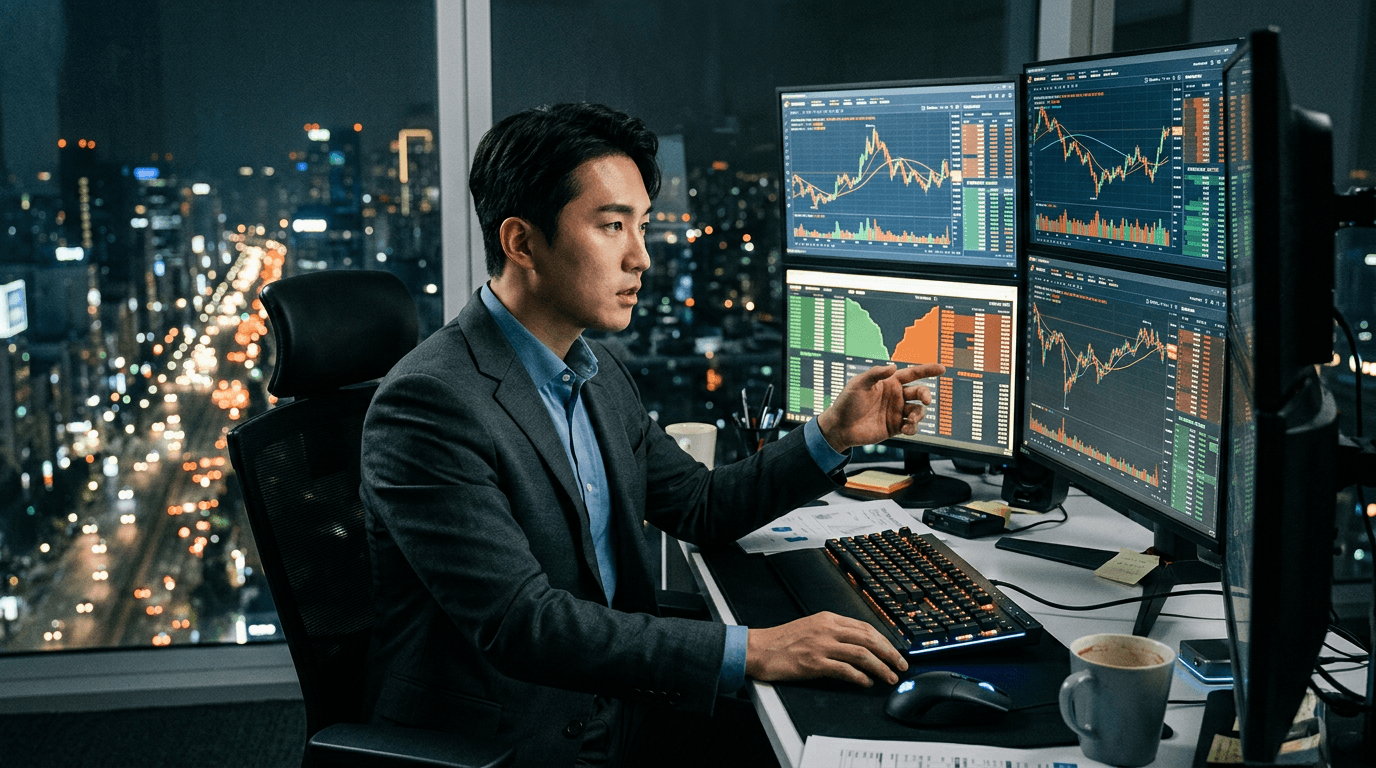
South Korea’s decision to launch 24‑hour trading in the won marks one of the most significant FX market reforms in Asia in years, aimed squarely at boosting liquidity, attracting global capital and strengthening its case for “developed‑market” status in major indices.[1][4] For traders and investors, this move reshapes how, when and where they can access Korean assets – and opens new opportunities, as well as new risks, in KRW‑denominated strategies.[4]
Background: Why Korea Is Opening Up Its Fx Market
For decades, South Korea ran a tightly controlled currency market, with limited trading hours and strict rules on offshore participation, in part due to scars from the 1997 Asian financial crisis.[5][6] More recently, policymakers began gradually extending trading to capture global flows, pushing the close out to 2 a.m. local time to intersect with the London session.[4]
The latest reform goes much further: authorities have introduced a 24‑hour onshore spot dollar‑won trading system that runs continuously from 6 a.m. on Monday to 6 a.m. on Saturday.[1][2] The change is explicitly tied to Korea’s ambition to be upgraded to developed‑market status in the MSCI global index, which places heavy weight on FX convertibility and accessibility for international investors.[1]
A developed‑market label can have material consequences. Inclusion in major developed‑market benchmarks typically drives benchmark‑tracking funds and asset managers to increase allocations, which in turn raises demand for both local equities and FX. By making the won tradeable around the clock, Korea is signalling that it wants to be treated like other major currencies such as the euro, yen or British pound in global portfolios.[1][4]
WHAT 24‑HOUR WON TRADING ACTUALLY LOOKS LIKE
Under the new system, dollar‑won trading onshore now operates almost continuously during the working week, closing only over the weekend.[1][2] Trading runs from early Monday morning to early Saturday morning, and remains open even on public holidays except for weekends and New Year’s Day.[2] This dramatically closes the gap between Korea’s FX market and the 24/5 norm seen in most major currency centers.
To support the shift, regulators have introduced parallel reforms that allow offshore investors to more easily hold and trade won, including permits for foreign institutions, an offshore won settlement system and an overdraft policy designed to smooth funding and reduce settlement risk.[4] These steps aim to ensure that global banks and asset managers can participate in KRW markets without being constrained by local operational frictions or time zones.[4]
Importantly, this is an onshore spot market reform, meaning the primary liquidity pool for dollar‑won now operates under Korean regulation but is accessible to global players in real time. As offshore participation grows, Korea’s FX framework will more closely resemble other developed markets, where onshore and offshore liquidity are tightly linked.
How The Shift Could Change Liquidity And Fx Strategies
Round‑the‑clock trading is ultimately about liquidity – the ability to transact at tight spreads, in size, whenever market‑moving information hits. By making the won “always on” during the week, Korea is aiming to improve price discovery, compress bid‑ask spreads and reduce the risk of sharp gaps when news breaks outside former trading hours.[1][4]
Officials expect increased offshore participation in KRW pairs, with more global banks, hedge funds and asset managers actively trading the currency across Asia, Europe and U.S. sessions.[4] Over time, deeper liquidity could help elevate KRW’s role in regional FX dynamics, with more investors using it in relative value trades against the yen, yuan or Singapore dollar, rather than treating it solely as a directional bet on Korea’s economy.
One area where the new regime may have a visible impact is carry‑trade flows, where investors borrow in low‑yield currencies to invest in higher‑yielding ones. With the won having recently dropped to a 17‑year low and ranking as the worst‑performing major Asian currency in the first half of the year, global funds are closely watching Korea’s rates, growth and policy trajectory.[5] Around‑the‑clock trading offers them more flexibility to adjust positions as global risk sentiment swings, which can in turn reshape regional carry and hedging strategies.[4]
That said, market structure changes take time. The won’s 24‑hour trading debut reportedly passed with below‑average volume, suggesting participants are still testing systems, staffing models and risk limits rather than immediately scaling up activity.[6][7] For traders, that means the transition period may feature bouts of thin liquidity and asymmetric pricing until the new framework is fully adopted.
Risks, Oversight And Why Officials Are Nervous
While the move is framed as a leap toward global integration, it is unfolding at what officials describe as a “fraught moment” for Korea’s currency.[3][5] Deep inside a government complex in Sejong, a room nicknamed “the box” has become the monitoring hub where finance ministry officials watch every tick in the won, scrutinizing price swings and trading volumes to judge when intervention may be needed.[5]
Memories of the 1997 crisis still loom large, and policymakers are acutely aware that wider participation and longer hours can also mean more exposure to global shocks.[5][6] Dealers have voiced concerns about the operational strain of staffing trading desks around the clock, as well as the risk of liquidity gaps and outsized volatility when major events hit during what used to be off‑hours.[4]
Regulators’ response has been to pair greater openness with safeguards: the offshore settlement system and overdraft policy aim to reduce disruption from funding mismatches, and authorities stand ready to step in if disorderly moves emerge.[4][5] For active traders, this backdrop underscores the importance of monitoring both macro data and policy communication closely. Korea’s FX authorities are unlikely to adopt a fully hands‑off approach, particularly if speculative flows drive sharp, rapid moves in the won.
What This Means For Active And Simulated Traders
For discretionary and systematic FX traders, 24‑hour won trading broadens the opportunity set – but also raises the bar for risk management. KRW can now react in real time to U.S. data, Federal Reserve decisions, geopolitical headlines or Chinese growth surprises, without waiting for the traditional Korean market open. That creates more potential entry and exit points, as well as more chances for slippage if liquidity is patchy in the early stages of the regime.
For simulated finance platforms and strategy testing, the change is particularly interesting. With Korea’s FX market operating across all major time zones, traders can design and backtest strategies that span Asia, Europe and U.S. sessions in KRW pairs, analyzing how the currency responds to cross‑market flows, equity moves and global macro events. Scenario‑based practice – for example, stress‑testing KRW exposure around surprise central bank decisions or risk‑off episodes – becomes more realistic when the underlying market trades continuously.
Practical takeaways for traders include: tracking how spreads and depth evolve across different times of day; starting with modest position sizes while market microstructure stabilizes; incorporating Korea’s intervention risk into strategy design; and comparing KRW’s behavior to peer currencies to identify relative value opportunities. As offshore participation grows, data on volumes and volatility by session will become a key input for both live and simulated trading frameworks.
Korea’s push for 24‑hour won trading is not just a technical tweak; it is a strategic move to redefine the country’s place in global markets. Whether it succeeds in delivering deeper liquidity and a developed‑market upgrade will depend on how quickly global investors embrace the new framework – and how effectively officials balance openness with stability. For traders willing to engage with the evolving structure, the won is poised to become a more central, and more tradable, part of the Asian FX landscape.