
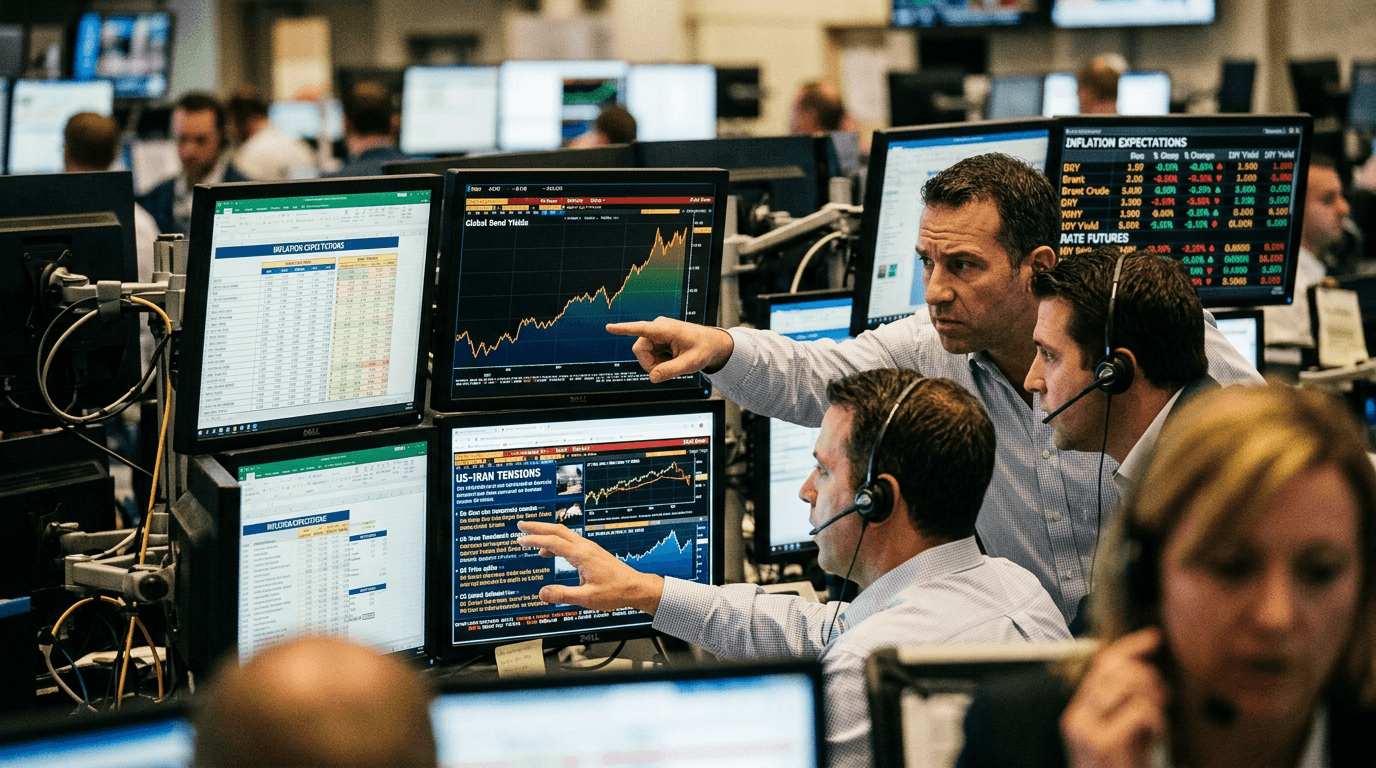
Global government bond yields are hovering near their highest levels in weeks, underscoring how quickly geopolitical tension can ripple through rates, currencies, and risk sentiment worldwide[6][15]. Mounting anxiety over U.S.–Iran relations and broader conflict in the Middle East is amplifying inflation fears, pushing investors to reassess both term premiums and the trajectory of central bank policy[10][11]. For traders, this environment is a live case study in how macro shocks translate into market pricing across bonds, FX, and derivatives.
Global Bond Yields At Multi-week Highs
After a prolonged period of elevated but range‑bound rates, global yields have broken higher and are now holding close to peaks last seen many years ago[6][15]. In major markets, 10‑year government bond yields have shifted into new, higher trading ranges, with U.S. Treasuries spending more time above 4.5% and long bonds above 5%[15][11]. Similar dynamics are visible across the UK, euro area and Japan, where benchmark yields have risen to levels not seen since the early 2010s or even late 1990s in some long maturities[11][8].
On a global basis, the average yield on high‑grade sovereign debt tracked by broad indices has climbed to its highest level since the 2008 financial crisis[11]. That move reflects a combination of higher real rates, persistent inflation, and a structurally larger term premium – the extra compensation investors demand for holding longer‑dated bonds amid heightened uncertainty[6][19]. For bond holders, these yield levels translate into meaningful mark‑to‑market drawdowns; for new buyers, they offer the most attractive carry in over a decade[11][15].
This latest push toward multi‑week highs has not come in isolation. It follows an earlier wave of selling in government bonds from the U.S. to Japan, Germany and Australia, as markets repriced the likelihood that inflation could stay above target for longer[12]. The renewed tensions involving U.S.–Iran relations have reinforced those concerns by reviving risks around oil supply disruptions and energy‑driven price pressures[10][11].
Geopolitical Risk, Oil And Inflation Expectations
Historically, severe geopolitical shocks can produce a classic “flight to quality” into safe‑haven government bonds, driving yields lower. What makes the current episode different is that the risk catalyst – conflict in the Middle East involving major energy producers – is inflationary rather than purely growth‑negative[10][11]. As investors weigh the prospect of higher oil prices and renewed supply‑side shocks, they are demanding more yield to hold duration, not less[10][12].
Recent episodes of Middle East conflict have already pushed borrowing costs sharply higher across the big bond markets[10]. Two‑year yields in the U.S., UK and Germany have posted some of their largest weekly increases in years, signaling a shift in expectations for central bank policy paths[10]. At the same time, longer‑dated yields have risen on fears that inflation may prove more entrenched, requiring tighter policy for longer and justifying a fatter term premium[6][11].
In parallel, oil‑linked inflation narratives have intensified. As energy benchmarks have moved higher, markets have become wary that headline inflation could reaccelerate or at least decelerate more slowly, delaying the timeline for broad‑based rate cuts[11][12]. This constellation of risks – geopolitical escalation, energy supply uncertainty, and stickier inflation – is precisely the kind of environment in which both risk premia and term premia tend to widen.
Fx And Rate Futures: How Flows Are Shifting
Higher global yields and rising geopolitical risk are feeding directly into FX pricing. When U.S. yields rise relative to peers and investors seek safety in dollar assets, the dollar tends to gain support against risk‑sensitive currencies such as emerging‑market FX and cyclical majors like AUD or CAD. That pattern has re‑emerged as Treasuries trade near the top of their recent yield ranges and global investors reassess their hedging and funding strategies[3][15].
Rate futures and bond futures markets are also reacting. In the U.S. and Europe, short‑end contracts have been repricing the odds of near‑term rate cuts, pushing implied policy expectations toward “higher for longer” as inflation and oil risks are reassessed[10][15]. Long‑bond futures, meanwhile, have been under pressure as investors hedge duration risk and adjust portfolios for higher yield environments, contributing to a broad selloff in sovereign debt from G7 economies to Asia‑Pacific markets[8][12].
For FX traders, this backdrop reinforces several core relationships: yield differentials matter, geopolitical risk can be dollar‑positive, and risk‑off moves do not always mean lower yields when the shock is inflationary rather than deflationary. For rates traders, the message is that the front end of the curve is highly sensitive to policy repricing, while the long end incorporates evolving views on inflation, fiscal sustainability, and geopolitical uncertainty[10][19].
What This Means For Traders And Simulated Finance
For active traders and those using simulated finance platforms, the current environment is rich with learning opportunities. Elevated volatility in global bonds, combined with shifting FX trends and rate futures repricing, offers a practical laboratory for testing macro‑driven trading strategies without real capital at risk.
Several themes stand out
First, understanding the yield curve is essential. When two‑year yields spike faster than ten‑year yields, markets are signaling a shift in expectations for near‑term central bank moves, whereas parallel moves across the curve often reflect broader changes in risk and term premia[10][19]. Simulated trading can help participants practice reading these signals and mapping them into directional and relative‑value trades.
Second, geopolitics and commodities must be integrated into macro analysis. The recent bond selloff tied to rising oil prices and Middle East tensions shows how quickly cross‑asset relationships can flip, with bonds, FX and energy markets moving together[10][11][12]. Building scenarios around different paths for U.S.–Iran relations, oil supply, and inflation can sharpen risk management skills.
Third, risk‑sensitive currencies and higher‑beta assets (such as equities and high‑yield credit) often respond faster to shifts in global risk sentiment than core sovereigns. Watching how spreads and FX volatility evolve relative to moves in benchmark yields can improve timing and position sizing.
Practical Takeaways For Navigating High Yields
In a world where global bond yields sit near multi‑week – and in many cases multi‑year – highs, traders and investors can focus on a few practical principles[6][11][15]:
Prioritize macro context. Yields are not moving in a vacuum; they are responding to a combination of geopolitical risk, energy prices, inflation data, and central bank communication[10][11][12]. Any strategy built around bonds, FX or rates derivatives should start with a clear macro thesis.
Respect duration and leverage. Higher yields mean larger price moves for a given change in rates, particularly on long‑dated bonds. Simulated environments are ideal for learning how duration, convexity and leverage interact before scaling up in real markets.
Watch correlations. In inflation‑driven risk episodes, the traditional “bonds up, stocks down” safe‑haven dynamic can break. Rising yields can occur alongside equity volatility and FX stress when inflation is the core concern. Monitoring changing cross‑asset correlations can help avoid over‑reliance on outdated playbooks.
Finally, remain flexible. Market narratives can shift quickly if geopolitical tensions ease or if economic data surprise on the downside. The same global bond market that is currently dominated by inflation fears could pivot back to growth concerns, reversing yield moves and FX trends. Developing and testing adaptive strategies in a simulated setting prepares traders to respond to these shifts in real time.