
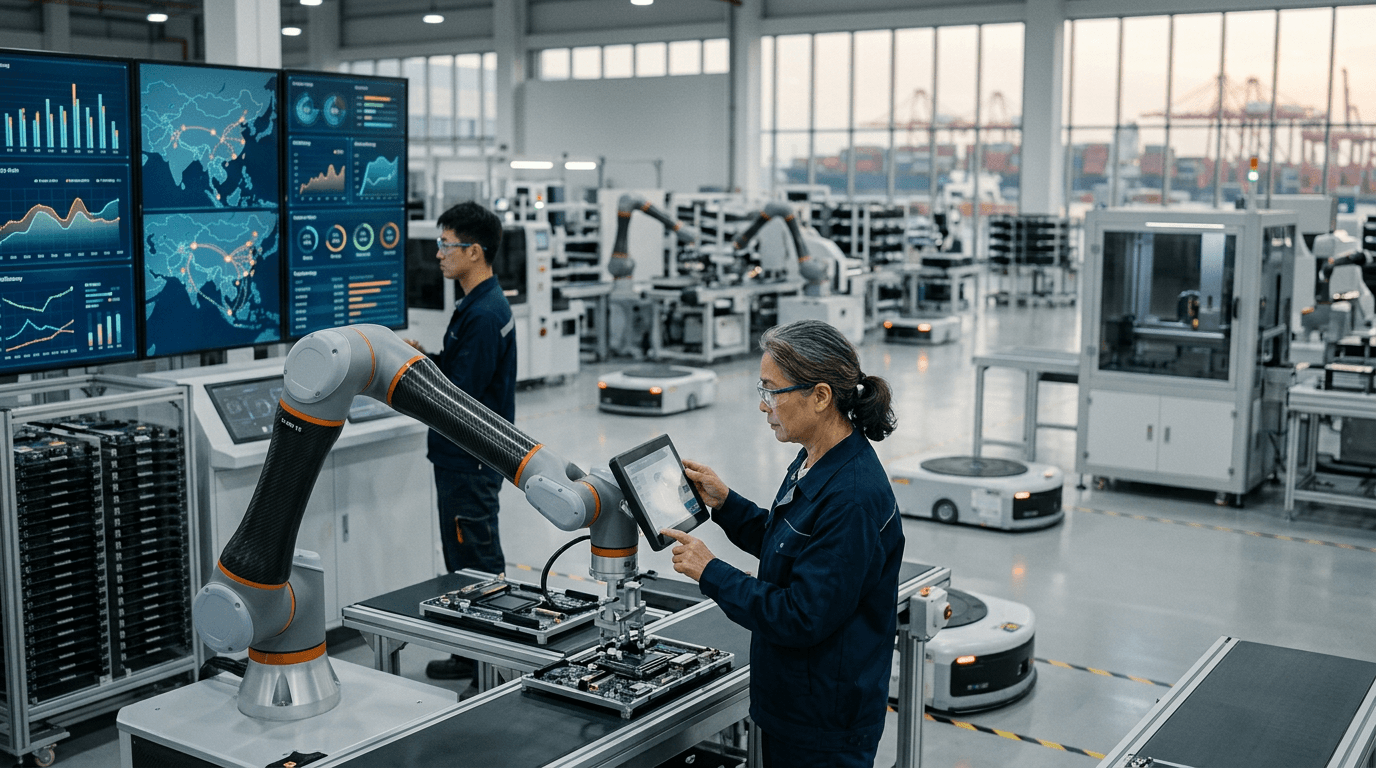
China's decisive shift towards artificial intelligence and a focus on technological self-reliance heralds a critical transformation in its economic strategy. This change comes at a time of regional instability and significant demographic challenges, as outlined in the newly announced 15th Five-Year Plan (2026-2030). This plan marks a recalibration of China's priorities, with impacts reaching far beyond its borders, reshaping global supply chains and trade relationships, and altering the competitive dynamics for businesses across Asia. As regional disruptions increase energy costs and policy uncertainty affects emerging markets, understanding China's tech-centric agenda becomes crucial for investors, traders, and businesses navigating today's complex market landscape.
China's Industrial Transformation: From Innovation To Implementation
China's strategic evolution now emphasizes swiftly deploying existing technologies over purely pursuing innovation. The previous 14th Five-Year Plan prioritized "innovation-driven development," but the 15th Plan shifts focus to industrial enhancement. This new direction acknowledges that converting research breakthroughs into commercial applications and enhancing manufacturing efficiency offers more immediate value than striving for cutting-edge technological supremacy. The plan aims to integrate AI and robotics throughout the manufacturing value chain, from consumer goods to specialized equipment, fostering what officials call "new quality productive forces."
This approach strategically addresses China's demographic challenge of an aging population, which threatens economic growth precisely when expansion is crucial. Unlike the traditional development model where nations move up the value chain by shedding lower-value industries, China plans to excel in both spheres. The strategy positions China as the leading producer of both advanced robotics and consumer goods, using AI-driven manufacturing to mitigate labor shortages while retaining export competitiveness. For global supply chains reliant on Chinese manufacturing, this industrial reorganization presents both opportunities and challenges.
Ai As A National Imperative: Focusing On Breadth
China's AI strategy diverges from Western models that concentrate on pioneering artificial general intelligence. Instead, Beijing focuses on broad AI deployment across industrial processes, supply-chain management, and services tailored to the aging population. The plan emphasizes China gaining an edge in AI applications, viewing AI as a practical tool for enhancing productivity economy-wide, rather than an abstract technological frontier. This application-focused approach leverages China's inherent advantages in scale, state capacity, and energy infrastructure.
Government-supported pilot testing platforms, including a national AI application pilot, aim to bridge the gap between research and commercial implementation. These initiatives are designed to expedite the progression from laboratory to production. The integration of advanced models like DeepSeek with manufacturing modernization fosters feedback loops that may amplify China's competitive edge over time. For the trading markets, this heralds a significant boost in China's economic productivity, evolving gradually rather than through sudden breakthroughs.
Technological Self-sufficiency And Supply Chain Resilience
The 15th Five-Year Plan identifies critical industrial domains for national security, such as AI, drones, and biotechnology. This focus drives substantial domestic investment in historically weak sectors, notably advanced semiconductors, industrial machinery, and core software. Beijing plans "extraordinary measures" to achieve breakthroughs in areas where Western technological controls currently limit Chinese capabilities. The plan allocates resources through awards, subsidies, and revamped selection mechanisms to encourage innovative projects.
This pursuit of self-reliance reflects lessons from US-led trade restrictions and technology embargoes. By building redundancies across critical supply chains, China seeks to shield itself from external pressures while remaining attractive to non-US markets. The emphasis on venture capital and innovation driven by companies suggests Beijing recognizes that state efforts alone cannot match market dynamics. Nonetheless, the combination of government infrastructure, strategic funding, and regulatory support creates a distinct Chinese innovation ecosystem that Western counterparts find challenging to replicate.
Regional Repercussions And Market Influences
China's tech pivot occurs against a backdrop of regional energy inflation due to disruptions in the Hormuz Strait and broader policy normalization across Asian markets. The capital intensity of AI-driven manufacturing modernization competes with other growth priorities, potentially exacerbating regional financial pressures. Countries in Asia face tough decisions regarding technology partnerships, supply-chain strategies, and alignment with China's emerging industrial vision.
For traders and investors, China's 15th Five-Year Plan marks a medium-term economic turning point with immediate implications for portfolios. Industries reliant on Chinese manufacturing confront both the risk of disruption from rapid automation and the cost of delayed adaptation. Technology exporters encounter a Chinese market increasingly focused on self-sufficiency. Energy markets may experience volatility as China balances green technology development with short-term fossil fuel needs for industrial transition.
Key Takeaways For Market Participants
Investors should closely watch the implementation of the AI application pilot base and company involvement in technology innovation initiatives. Supply-chain managers need to assess exposure to disruption from China's accelerating automation. Technology vendors face a shrinking window for market entry before self-sufficiency initiatives gain momentum. Regional energy prices and trade dynamics will increasingly mirror China's industrial shift, presenting hedging challenges and opportunities for astute market participants.
NEWSIMPACTSCORE: 7