
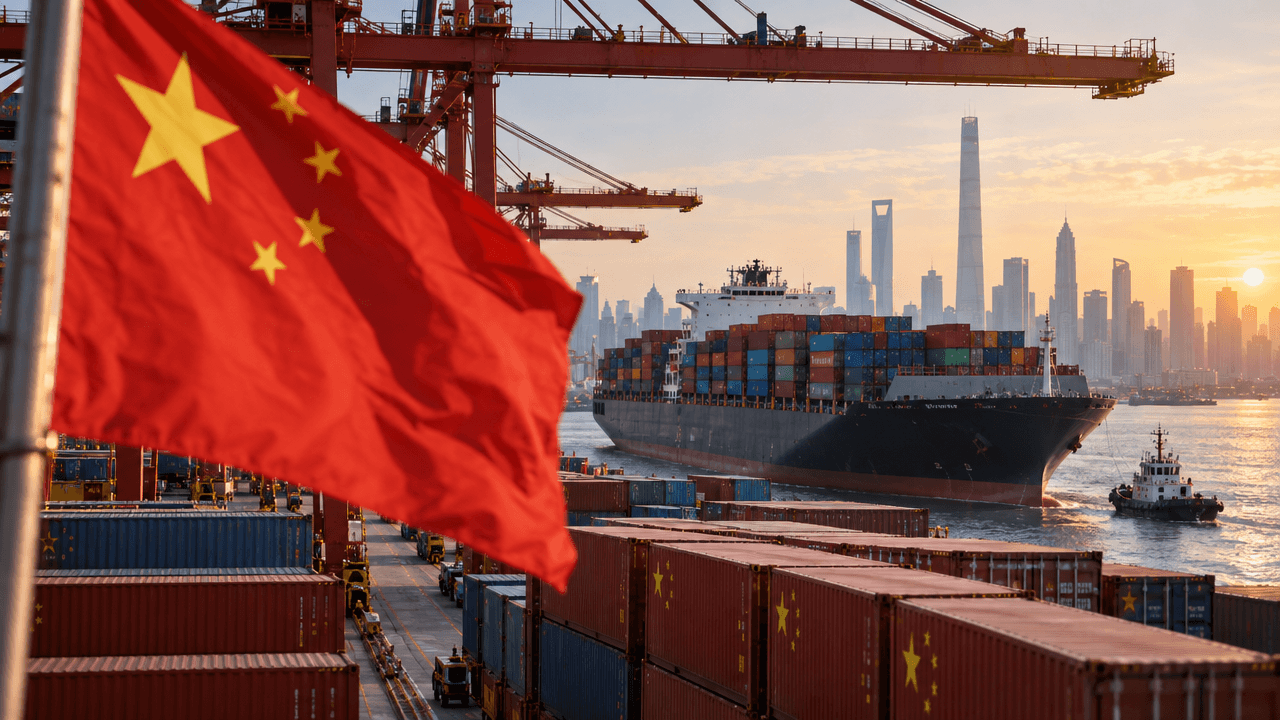
China’s export growth accelerated sharply in September, highlighting the strength of its manufacturing sector while deepening concerns about global trade imbalances. Exports rose 36.3% from a year earlier, the fastest pace since February and far above the 25% increase recorded in August. Imports also climbed 31%, but the gap between goods sold abroad and products purchased from overseas widened significantly. [5]
The result was a monthly trade surplus of approximately $133.5 billion, up from $119.1 billion in August. China’s cumulative surplus reached $938 billion during the first nine months of the year, putting the country on course to exceed its previous full-year record of roughly $1.19 trillion. [2]
For financial markets, the figures matter well beyond China’s ports. A larger surplus means more goods flowing into overseas economies, greater pressure on competing manufacturers, and renewed debate over currencies, subsidies, industrial policy, and tariffs.
Export Momentum Signals Industrial Strength
The export surge reflects China’s continued ability to produce and sell manufactured goods at enormous scale. Strong overseas demand for advanced technology products, automobiles, electrical equipment, and other industrial goods has helped offset concerns about softer domestic consumption. [13]
This combination is important. When domestic demand is not strong enough to absorb factory output, producers may rely more heavily on foreign buyers. Competitive pricing, extensive supply chains, improving technology, and government support can then allow exporters to gain market share in other countries.
China’s export performance also suggests that global demand has not weakened uniformly. Companies and consumers continue to purchase products tied to transportation, electronics, energy infrastructure, and technology investment. Chinese manufacturers are particularly influential in sectors such as electric vehicles, batteries, solar equipment, machinery, and components.
However, strong exports do not necessarily mean that China’s broader economy is fully balanced. A country can be highly competitive internationally while still facing weak household spending, property-sector difficulties, or uneven domestic investment. The trade data therefore point to a powerful external sector, but not automatically to broad-based economic strength.
Why The Surplus Matters
A trade surplus is not inherently negative. It can reflect productive industries, competitive companies, and strong foreign demand. The concern arises when one country’s surplus becomes persistently large relative to the deficits of its trading partners.
China’s 2025 trade surplus was already close to $1.2 trillion, equivalent to about 6% of its economic output according to reporting cited by Reuters. A still larger surplus in 2026 is likely to intensify arguments that global demand and production are becoming excessively concentrated. [10]
For other economies, a wave of competitively priced imports can benefit consumers and businesses by lowering costs. Manufacturers, however, may face declining market share, reduced pricing power, and pressure to cut employment or investment. Governments may respond with tariffs, subsidies for domestic producers, import restrictions, or investigations into unfair competition.
The European Union has been especially vocal about the trade imbalance, with policymakers calling for a stronger yuan and expressing concern about a potential new wave of Chinese exports. These tensions have been described by some analysts as a possible “China Shock 2.0.” [10]
Currency Markets Under Pressure
Exchange rates are central to the trade debate. A weaker currency can make a country’s exports cheaper for foreign buyers while making imports more expensive at home. Policymakers in the United States and Europe have therefore questioned whether the yuan’s level is contributing to China’s export advantage.
China rejects the claim that it deliberately weakens the yuan to gain a competitive edge. The People’s Bank of China has said it does not set a long-term exchange-rate target and supports flexibility in both directions. The yuan has also appreciated against the U.S. dollar during 2026, complicating the argument that currency depreciation alone explains the export surge. [10]
For traders, the key point is that currency pressure can emerge even when a currency is not falling sharply. A large trade surplus increases foreign demand for a country’s goods and may support its currency, while political pressure can push policymakers toward exchange-rate adjustments or stronger domestic demand.
Competing currencies may also come under pressure if investors expect local manufacturers to lose ground against Chinese imports. Economies heavily exposed to industrial exports could see weaker growth expectations, softer interest-rate outlooks, or declining demand for their currencies.
What Markets Should Watch Next
The immediate question is whether September’s performance represents a lasting trend or a temporary acceleration. Traders should monitor future export data, new orders, shipping volumes, and company guidance for evidence of continued overseas demand.
The composition of exports is equally important. Growth in high-value technology products may generate more political resistance than growth in lower-margin goods. Electric vehicles, batteries, semiconductors, solar equipment, and artificial-intelligence-related products are likely to receive particular attention from trade officials.
Investors should also watch the response from the United States, the European Union, and other major economies. Tariff announcements, anti-subsidy investigations, export controls, and domestic manufacturing incentives could create volatility across currencies, industrial stocks, commodities, and transportation companies.
In SimFi trading, this is a useful example of why a single economic release should be connected to broader market themes. A stronger Chinese export number can influence the yuan, Asian currencies, European manufacturers, commodity demand, bond yields, and expectations for trade policy at the same time.
The Bigger Market Lesson
China’s accelerating exports demonstrate how economic data can create both winners and losers across markets. Importers may benefit from lower-cost goods, while competing producers face margin pressure. Consumers may enjoy cheaper products, while policymakers worry about dependence on foreign supply chains.
The record-scale surplus also raises a strategic question: can global growth remain stable when production and consumption are distributed so unevenly? China has indicated that it wants to increase domestic demand and move toward a more balanced growth model. The export figures suggest that this transition remains incomplete.
For traders, the practical takeaway is to treat trade data as more than a headline about exports. It is a signal about industrial competitiveness, currency dynamics, interest-rate expectations, corporate margins, and geopolitical risk. If China’s surplus continues expanding, market participants should expect trade policy and exchange rates to become increasingly important drivers of volatility.