
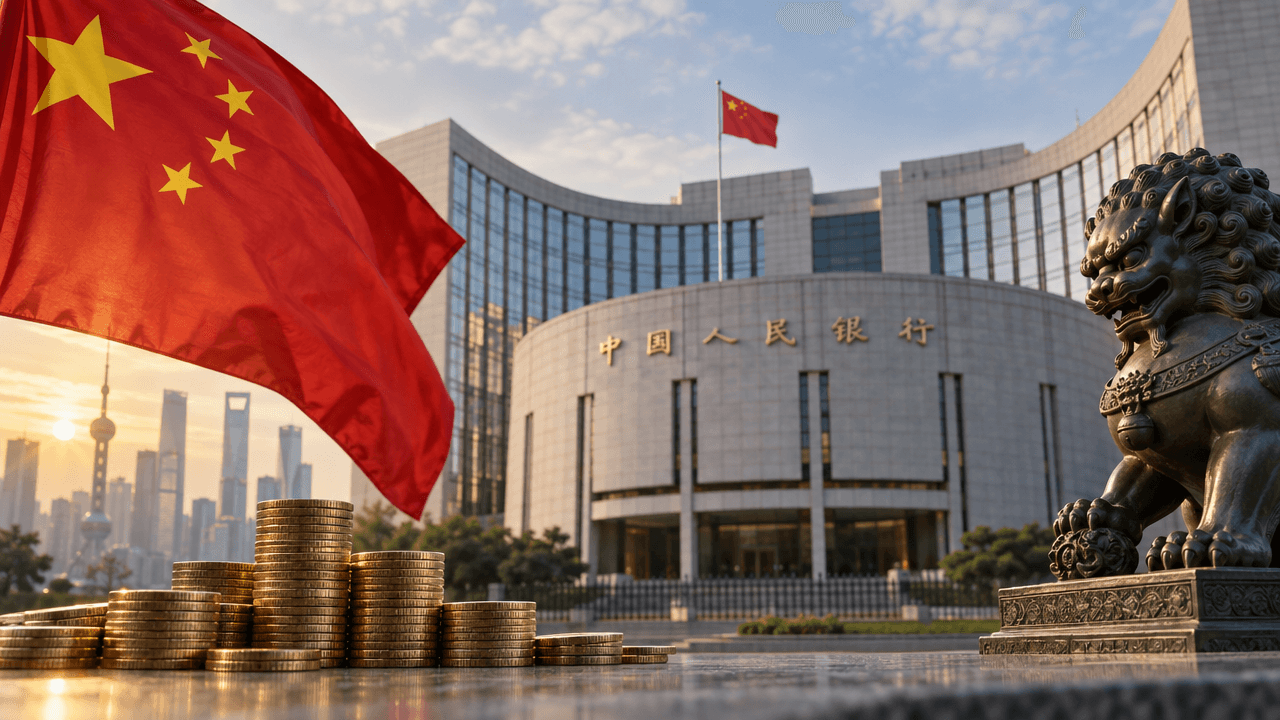
China’s latest liquidity injection is a reminder that central banks can move markets without changing headline policy rates. By adding cash through reverse repurchase operations while holding the 7‑day policy rate steady at 1.40%, the People’s Bank of China (PBoC) is signaling “support, not stimulus” to regional markets and global traders watching Asia closely.[1][2][6]
Global Context: What The Pboc Just Did
The PBoC has injected around 32 billion yuan into the financial system via 7‑day reverse repos at a fixed rate of 1.40%, the current short‑term policy anchor.[1][2] Reverse repos are short‑term loans from the central bank to commercial banks, collateralized by bonds, designed to smooth daily liquidity without necessarily changing the stance of monetary policy.[2][6] By keeping the rate unchanged, the PBoC is reinforcing its existing policy framework while fine‑tuning liquidity conditions.[2][6][13]
This operation fits a pattern seen through 2025–2026, where the 7‑day reverse repo rate has been held at a record low of 1.40% and used as China’s de facto primary policy rate.[2][6][8] Volumes have fluctuated—ranging from modest injections of a few billion yuan to larger operations exceeding 160 billion yuan or more—depending on tax payment schedules, bond issuance, and quarter‑end funding needs.[3][8][13] The latest 32 billion yuan move is meaningful, but clearly calibrated rather than aggressive.[1][6]
Understanding Reverse Repos: Plumbing Vs Policy Easing
For active traders, the key distinction is between “plumbing” and “policy.” Reverse repo injections at an unchanged rate are largely about keeping interbank funding markets stable, ensuring that short‑term cash rates trade close to the policy anchor.[6][12][13] When liquidity is tight, the PBoC supplies funds; when cash is abundant, it can drain liquidity by allowing repos to mature without replacement.[2][13]
True easing typically shows up not just in volumes but in the price of money—through cuts in the 7‑day reverse repo rate, the Medium‑Term Lending Facility (MLF) rate, or bank reserve requirement ratios.[6][7][8] By contrast, keeping the 1.40% rate unchanged while injecting funds signals that the PBoC is managing short‑term liquidity rather than trying to engineer a broad credit acceleration.[6][13][14] This nuance matters for traders assessing whether China is entering a new stimulus phase or simply stabilizing financial conditions.
Over the past year, the PBoC has even introduced an overnight reverse repo tool at 1.25%, sitting 15 basis points below the 7‑day rate to give finer control at month‑end and around key funding dates.[5][6][12] Yet the central bank has been careful to keep the 1.40% 7‑day rate visible as the main policy signal, reinforcing the idea that operational tweaks do not equal a strategic shift.[6][12]
IMPACT ON CNH/CNY AND ASIAN FX
Stable liquidity at a steady policy rate tends to support the yuan by reducing funding stress and anchoring expectations around China’s short‑term interest rate curve.[1][2][6] With the 7‑day reverse repo rate pinned at 1.40% and liquidity injections calibrated rather than aggressive, traders generally interpret the backdrop as constructive for CNH/CNY stability rather than a precursor to sharp depreciation.[2][6][8]
For Asian FX, this matters in several ways. A steady yuan often reduces volatility across regional currencies, especially those closely linked to China through trade and supply chains, such as KRW and SGD.[1][6] It also influences carry trade dynamics: if China keeps front‑end rates low but stable, the relative appeal of borrowing in CNY or CNH to fund higher‑yield positions in other markets becomes more predictable.[2][8]
In practice, this environment favors range‑bound strategies in CNH/CNY and relative value trades between Asian currency pairs, rather than aggressive directional bets on large yuan moves.[1][6] SimFi traders can use this backdrop to experiment with mean‑reversion models, volatility selling strategies, or calendar spreads that assume policy stability but allow for tactical swings driven by data or headlines.
Bonds, Commodities, And Regional Risk Sentiment
Local bond markets tend to welcome liquidity support, especially when it lowers the risk of abrupt spikes in interbank rates.[6][12][13] If cash conditions are smooth and the policy rate is clearly signposted, government bond yields often drift lower or stabilize, improving financing conditions for corporates and supporting credit spreads.[8][12][13] The latest operation reinforces that the PBoC will act to keep front‑end funding orderly without delivering a full‑scale easing campaign.[1][6]
Commodities tied to Chinese demand—such as iron ore, copper, and energy products—also respond to signals about liquidity and growth expectations. While a single 32 billion yuan injection is modest, the broader pattern of consistent liquidity support at low rates helps sustain the narrative of “gradual stabilization” rather than contraction.[1][6][8] This can underpin sentiment in regional equity indices and commodity futures, even if price moves remain contained.
For futures traders across Asia, the takeaway is that China is providing a floor under short‑term funding stress, which reduces tail‑risk around sudden funding squeezes or forced deleveraging.[6][13] That, in turn, encourages more normal risk‑taking in equity index futures, bond futures, and commodity exposures, though the absence of outright easing caps the upside for reflation trades.[6][8]
How Simulated Traders Can Turn This Into Action
On a SimFi platform, this type of macro event is ideal for testing how liquidity operations translate into cross‑asset behavior without the real‑world cost of mistakes. Traders can build scenarios where the PBoC varies reverse repo volumes while keeping the 1.40% rate unchanged, and observe the resulting impact on CNH/CNY spot, Asian FX crosses, and front‑end bond yields.[1][2][13]
Practical simulations might include
1) Range‑bound CNH/CNY strategies that assume policy stability but incorporate occasional volatility spikes on macro data. 2) Cross‑currency carry trades funded in CNH/CNY, calibrated to the low but stable 1.40% anchor.[2][8] 3) Multi‑asset portfolios where Asian equity index futures, local bonds, and key commodities respond differently to incremental liquidity changes.
A key learning objective is to distinguish between “liquidity smoothing” and genuine policy shifts. By back‑testing historical periods of reverse repo injections at an unchanged rate versus periods of rate cuts, traders can quantify how much price action typically comes from volume changes alone.[6][8][13] This sharpens macro intuition and improves real‑world readiness.
Key Takeaways For Active Market Participants
First, size matters—but only in context. A 32 billion yuan injection is supportive, but it is modest relative to peak operations and should be viewed as part of a continuing pattern of calibrated liquidity management.[1][3][13]
Second, the rate is the signal. As long as the 7‑day reverse repo rate remains at 1.40%, the PBoC is reaffirming its current stance rather than launching a new easing cycle.[2][6][8]
Third, stability favors relative value and range‑bound strategies. CNH/CNY, Asian FX, and regional futures markets are more likely to trade within defined ranges, with opportunities in spreads and volatility strategies rather than outright directional bets.[1][6]
Finally, simulated trading is a powerful way to internalize how central bank operations affect markets. By turning these liquidity events into structured scenarios, traders can build repeatable frameworks for reacting to future PBoC decisions with more confidence and discipline.
Conclusion: Watch Flows As Closely As Rates
China’s latest liquidity injection via reverse repos, executed at a steady 1.40% policy rate, underscores a central bank that is attentive to market plumbing while cautious about broader easing.[1][2][6] For traders across FX, bonds, and commodities, the message is subtle but important: expect support for funding stability and regional sentiment, not a sudden wave of stimulus‑driven volatility.[1][6][8] In both live and simulated environments, success hinges on reading that nuance—tracking the interplay between rates, volumes, and asset prices—and adjusting strategy to a world where central banks move markets as much through operations as through headlines.