
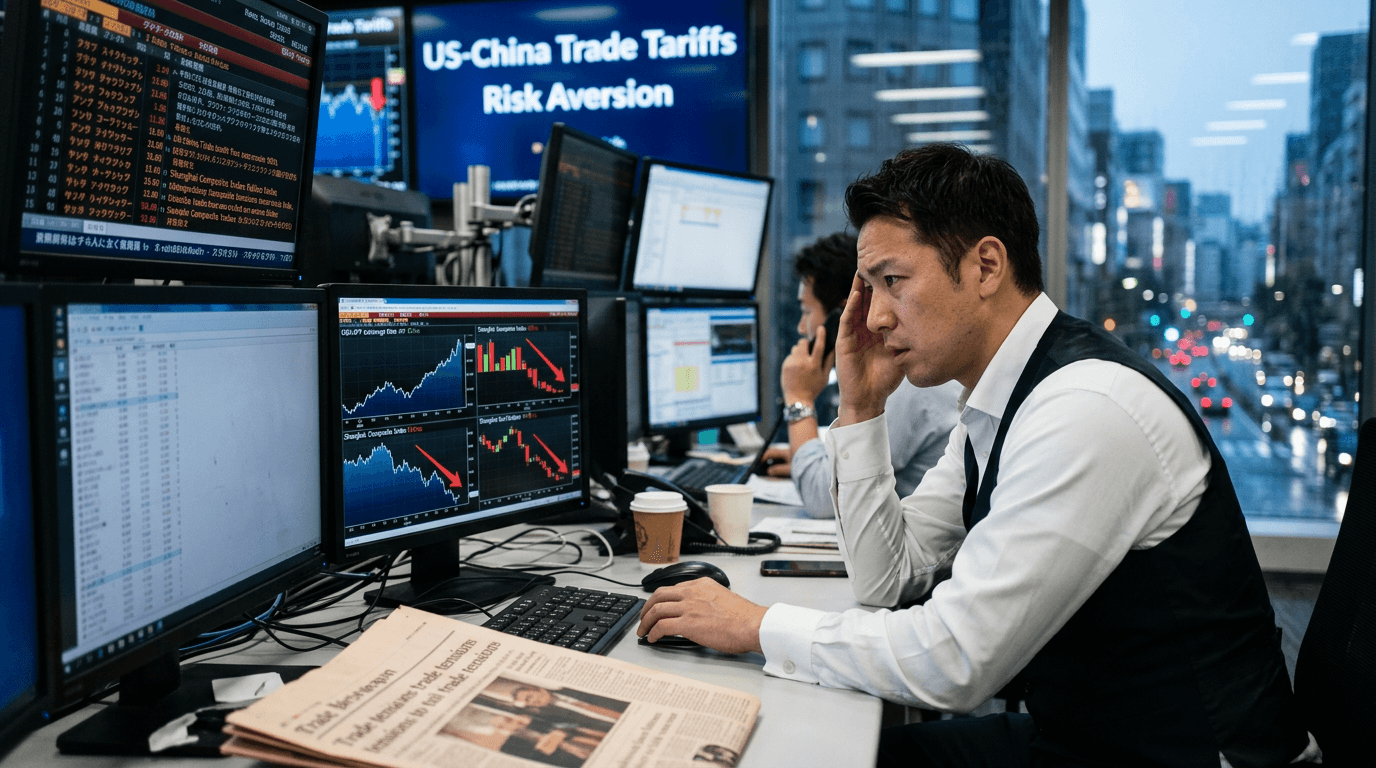
China’s announcement of steep additional tariffs on U.S. goods, reportedly rising as high as 125%, is more than another headline in a long-running dispute—it is a fresh escalation in the U.S.–China trade war that is already reshaping global capital flows and investor behavior.[4] By explicitly vowing to ignore further U.S. tariff pressure and hold Washington responsible for economic fallout, Beijing has signaled a hardened stance that markets cannot ignore.
WHAT JUST HAPPENED – AND WHY IT MATTERS
The latest move sees China layering new duties on U.S. products, taking tariffs on some categories to levels approaching 125%, in line with the broader trajectory of the trade war.[4] These are not incremental tweaks at the margin; they amount to punitive rates designed to both inflict economic pain and send a political message.
In parallel, the U.S. has pursued its own aggressive tariff path, with some Chinese goods now facing combined rates of around 145% under various Section 301 and “reciprocal” measures, even though the average tariff level is lower.[3][4][5] The result is that nearly all bilateral trade between the world’s two largest economies is now taxed at historically elevated rates, with both sides using tariffs as a central policy tool rather than a temporary bargaining chip.[4][5]
For global trade, independent estimates suggest these escalations are shaving measurable fractions off merchandise volumes—on the order of 0.2% of global trade in some forecasts—which may sound modest but compounds over time and across supply chains.[4] For markets, the more immediate impact is not the exact tariff rate, but the renewed sense that the U.S.–China relationship is drifting further away from stability and predictability.
Risk-off Reaction: Fx, Equities, Commodities
The market’s initial response has followed a familiar “risk-off” playbook. Risk-sensitive currencies and equity futures have come under pressure, while traditional safe havens like the U.S. dollar and Japanese yen have found support.[2] This pattern reflects investors quickly re-pricing:
- Higher geopolitical and policy risk
- Slower global growth prospects
- The possibility of further retaliatory moves
In FX, higher tariffs and escalating rhetoric typically hurt:
- Pro‑cyclical currencies tied to global trade and commodities (AUD, NZD, NOK, many EM FX)
- Currencies of countries heavily exposed to the U.S.–China supply chain
At the same time, the dollar benefits from its reserve-currency status and deep Treasury market, while the yen often gains as investors unwind carry trades and seek safety.
Equity index futures usually sell off first in trade-sensitive sectors:
- Industrials and capital goods, due to global supply chains and export exposure
- Semiconductors and tech hardware, given their role in U.S.–China competition
- Autos and machinery, which are highly tariff-exposed and globally integrated
Commodities face two layers of headline risk. On the one hand, tariffs and slower trade reduce demand expectations for energy and industrial metals. On the other, targeted commodity tariffs (such as on agricultural products or critical minerals) can distort flows and create regional price dislocations. For emerging markets, the combination of weaker export prospects, stronger dollar, and tighter financial conditions tends to pressure EM FX and local assets simultaneously.
How Tariff Shocks Filter Into The Real Economy
Although markets react instantly, the economic impact of tariff shocks plays out in stages:
1. Pricing and margins Importers must decide whether to absorb the tariff in margins, pass it through to prices, or reconfigure their sourcing. Higher tariffs of 100%+ on targeted goods leave far less room for gradual adjustment—many trades simply become uneconomic.
2. Supply-chain shifts Firms accelerate efforts to “de-risk” supply chains by moving production or assembly to third countries, or sourcing components from alternative partners. This process was already underway after earlier tariff rounds and is likely to intensify.[3][4][5]
3. Investment and hiring Elevated uncertainty about future policy—especially when both sides use tariffs as leverage—tends to depress capital expenditure and hiring in export-oriented sectors. Companies may delay factory expansions, new product launches, or major cross-border investments.
4. Consumer and business sentiment Even before tariffs fully pass through to prices, headline risk and market volatility can weigh on confidence. If equity markets sell off or credit spreads widen, financial conditions tighten and growth expectations fall.
In aggregate, research on previous phases of the U.S.–China trade war shows a clear pattern of higher tariffs, lower trade volumes, and reallocated supply chains, with the burden shared among producers, consumers, and intermediaries.[4][5][7] The latest escalation reinforces that trade policy is now a structural, not cyclical, risk factor for global markets.
A TRADER’S PLAYBOOK: NAVIGATING TRADE-WAR AND RISK-OFF FLOWS
For active traders and those using Simulated Finance (SimFi) environments, tariff headlines like these are ideal case studies in macro‑driven volatility. Several practical angles matter:
• Scenario testing Use a simulated environment to model different paths: a contained escalation, a broader tit‑for‑tat cycle, or an eventual negotiated pause. For each scenario, map expected impacts on equity indices, FX pairs, and commodities sensitive to U.S.–China trade.
• FX positioning Consider how safe-haven demand and growth fears may affect USD, JPY, CHF, and EM FX. Backtest strategies such as long JPY vs. high-yielding EM currencies during phases of rising trade tension.
• Sector and factor rotation Examine how prior trade-war episodes affected cyclical vs. defensive sectors, value vs. growth, and small vs. large caps. SimFi platforms allow you to test rotations into more defensive exposures during escalation phases and back into cyclicals when tensions ease.
• Event and headline risk management Tariff news is often binary and sudden. Practice position sizing, use of stop-loss orders, and volatility-based risk limits around key events (press conferences, policy announcements, high-level talks). Simulated trading can help refine reactions without real capital at risk.
• Correlation breakdowns In periods of stress, correlations across assets can spike, reducing diversification benefits. Backtesting across earlier trade-war milestones can show where seemingly unrelated assets started moving together, helping you design more robust portfolios.
Key Risks To Watch From Here
With tariffs already at or near 125% on some U.S. goods entering China and even higher on some Chinese exports to the U.S., the marginal impact of each additional percentage point is less about economics and more about signaling.[3][4][5] The key forward-looking risks include:
• Further escalation Additional rounds of tariffs, expansion to new sectors, or non-tariff barriers (export controls, investment restrictions) would deepen uncertainty and extend the risk-off phase.
• Policy spillovers Central banks may have to weigh weaker trade and growth against any inflationary impact from tariffs. For example, if tariffs lift import prices while slowing demand, policy choices become more complex.
• Supply chain realignment A faster shift of manufacturing and assembly away from China–U.S. corridors toward third countries could create winners and losers across Asia, Europe, and Latin America.
• Domestic political constraints Both Washington and Beijing face domestic audiences and strategic objectives that limit their ability to back down quickly. Markets will watch for any sign that either side is willing to trade tariffs for concessions.
For traders, this environment underscores the importance of treating geopolitical and trade policy as ongoing macro drivers rather than one-off shocks. SimFi tools are particularly useful here: you can build and test rules that respond to changes in volatility, correlations, and macro indicators, not just price alone.
Ultimately, China’s latest tariff salvo is a reminder that the U.S.–China trade war is entering another active phase, with implications that radiate across currencies, equity indices, commodities, and emerging markets. Whether you trade live or train in a simulated environment, integrating trade-war dynamics into your framework is no longer optional—it is part of understanding how global markets truly move.