
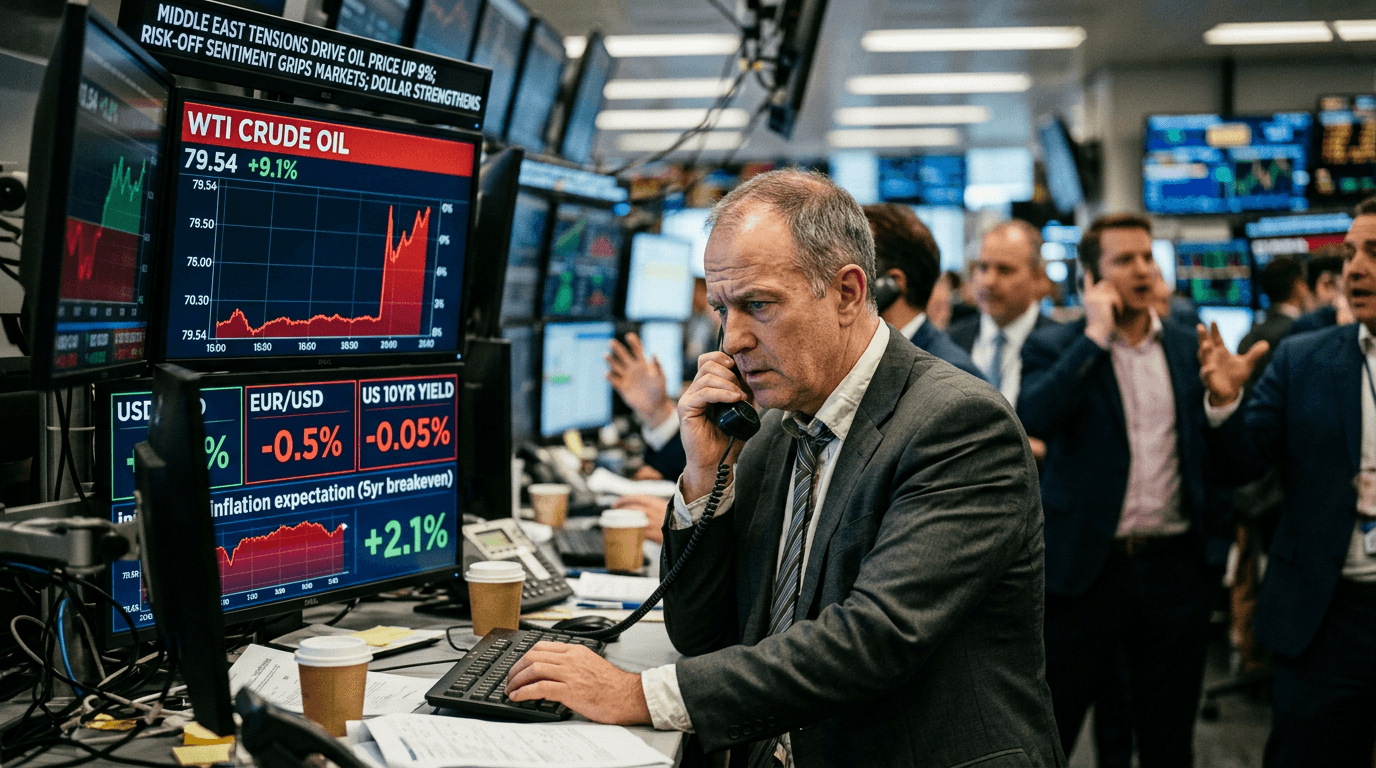
Oil’s latest surge is a textbook example of how geopolitics can instantly reshape global markets. Crude futures jumped roughly 9%, with West Texas Intermediate (WTI) pushing above the $79–81 range and Brent moving into the mid‑$80s as the U.S.–Iran conflict intensified and disrupted energy flows through the Middle East[1][7][13]. The result has been a swift risk‑off rotation: investors crowding into the dollar and safe‑haven assets, repricing inflation expectations higher, and nudging rate‑hike odds back onto the table.
Market Snapshot: Oil Spikes, Risk-off Takes Hold
The immediate catalyst for the move was a series of U.S. and Israeli strikes on Iranian targets and Iran’s retaliatory attacks, which shut down oil and gas operations across parts of the Middle East and disrupted shipping through the Strait of Hormuz[1][9][13]. Brent crude futures briefly surged more than 10–13%, trading above $80–82 per barrel in early activity before settling slightly lower[1][7][13]. WTI followed with an 8–12% jump, marking one of the largest single‑session moves in recent years[6][9][13].
Equity indices and stock index futures reacted in typical fashion for a geopolitical shock with clear macro consequences: risk assets were sold, implied volatility rose, and investors rotated toward cash, short‑term government paper, and commodities perceived as hedges. While the concentration of headlines is in energy, the underlying driver is broader—markets are rapidly repricing the probability of a more persistent supply shock and the knock‑on effects on growth and inflation[8][11].
For traders, the key takeaway is that this is not just an “oil story.” The move in crude is the visible tip of a larger repositioning across FX, rates, and index futures driven by reassessed macro risk rather than just speculative commodity flows.
WHY THE US–IRAN CONFLICT HITS ENERGY MARKETS SO HARD
To understand the scale of the reaction, it helps to look at the geography. The Strait of Hormuz, a narrow chokepoint between the Persian Gulf and the Gulf of Oman, normally carries around 20% of the world’s energy supply[12]. Satellite data and shipping reports now show traffic through the Strait has nearly come to a standstill amid attacks on vessels and military blockades[9][12][13]. When that corridor is compromised, a large chunk of global crude and LNG exports is effectively trapped.
Since the war with Iran began, analysts estimate that Persian Gulf producers have been forced to trim production by millions of barrels per day, removing a sizeable share of global supply and driving prices sharply higher[4][8]. In previous episodes, like earlier phases of the conflict, Brent has already climbed from the low‑$70s toward triple‑digit levels, at times gaining more than 50% from pre‑war prices[2][3]. Recent research from major banks and consultancies suggests that if disruptions in Hormuz persist for three to four weeks, Brent could spike above $100, with some scenarios pointing even higher[1][7][8].
This supply shock has a direct consumer angle. Analysts warn U.S. gasoline prices—the world’s largest single demand center—could easily push above $3 per gallon as crude stays elevated[1][8]. That kind of move filters quickly into inflation data and, importantly, into household inflation expectations, which central banks track closely.
Fx And Futures: How Risk-off Is Rippling Through Asset Classes
Energy traders were first to react, but the shock has rapidly propagated through FX and futures markets. In periods of geopolitical stress with clear commodity and inflation implications, the typical pattern is a bid for the U.S. dollar as both a safe haven and as the currency of choice for pricing global energy trades. That is exactly what current flows suggest: investors rotating into dollar exposure while trimming higher‑beta and commodity‑linked FX.
Currencies tied closely to global growth and carry trades—such as emerging‑market FX and some cyclical majors—tend to underperform in this environment as investors unwind risk and reduce leverage. By contrast, traditional safe‑haven currencies like the Japanese yen and Swiss franc often see renewed demand as traders seek to diversify away from pure dollar exposure while still reducing portfolio risk.
On the futures side, the move in crude has been accompanied by adjustments in index and rates futures positioning. Stock index futures typically price in lower forward earnings and higher risk premia when energy costs surge, particularly for oil‑importing economies. At the same time, rate futures are now reflecting an increase in near‑term inflation expectations and a higher probability that central banks will need to keep policy tighter for longer, even as growth risks rise[8][11]. That tug‑of‑war between inflation and growth is what makes these episodes especially challenging to trade.
Macro Implications: Inflation, Central Banks, And Volatility
The macro message from this move in oil is straightforward: the inflation shock that many hoped was behind us is not entirely gone. Oxford Economics, for example, has warned that the ongoing oil shock could have persistent second‑round effects on inflation, with price pressures likely to remain skewed to the upside through 2027 and beyond[11]. With Brent hovering in the $80–90 range and upside scenarios pointing well above $100, the prospect of renewed energy‑driven inflation is very real[1][2][7][8].
Central banks now face a familiar dilemma. On one hand, higher energy prices raise headline inflation and can leak into core via transportation, food, and manufactured goods. On the other, sustained geopolitical tension and higher input costs can weigh on growth, confidence, and investment. In past episodes, this combination has led to a cautious stance: policymakers avoid aggressive easing to support growth, but also hesitate to hike aggressively unless inflation expectations show signs of de‑anchoring.
For markets, that uncertainty translates directly into higher volatility across asset classes. Rate‑sensitive instruments—from short‑dated government bonds to interest‑rate futures—can swing meaningfully as traders recalibrate the path of policy. Equity and FX volatility tend to follow, especially if the conflict escalates or spills into broader regional instability. The takeaway for traders is that macro narratives can flip quickly, and risk management needs to anticipate that path dependency.
What Simulated Traders Can Do Now
For traders using simulated environments and practice accounts, this is an ideal real‑time case study in how geopolitics translates into cross‑asset moves. The first step is to map the chain of transmission: conflict risk → shipping disruption in Hormuz → reduced supply → higher crude and gas prices → higher headline inflation → repricing of rates and FX → shifts in equity and volatility. Each link in that chain offers a potential trading angle to test.
In practical terms, you can explore how different strategies behave under this regime. For example, test long crude futures or energy‑sector proxies against short positions in oil‑importing equity indices to see how relative performance evolves. Experiment with FX pairs that are sensitive to energy and risk sentiment—such as dollar vs. emerging‑market FX—and evaluate how volatility and correlation change during headline shocks. Use risk‑off scenarios to practice adjusting position sizing, tightening stops, or reducing leverage when volatility spikes.
It is also a good time to focus on scenario planning. Build simple frameworks around different paths for the U.S.–Iran conflict: a rapid de‑escalation that reopens Hormuz, a prolonged stalemate with intermittent attacks on shipping, or a broader regional escalation. For each scenario, sketch expectations for crude, FX, rates, and equity indices, then test strategies against those assumptions. The objective is not to predict perfectly, but to build reflexes for how you respond as markets move from one scenario toward another.
Finally, remember that episodes like this reward traders who respect both macro fundamentals and market microstructure. Liquidity can dry up, spreads can widen, and slippage can increase around headlines. Whether you are trading live capital or simulated strategies, treating risk management as your primary edge—especially during geopolitical shocks—is what allows you to stay in the game long enough to capitalize on opportunities rather than be defined by a single event.