
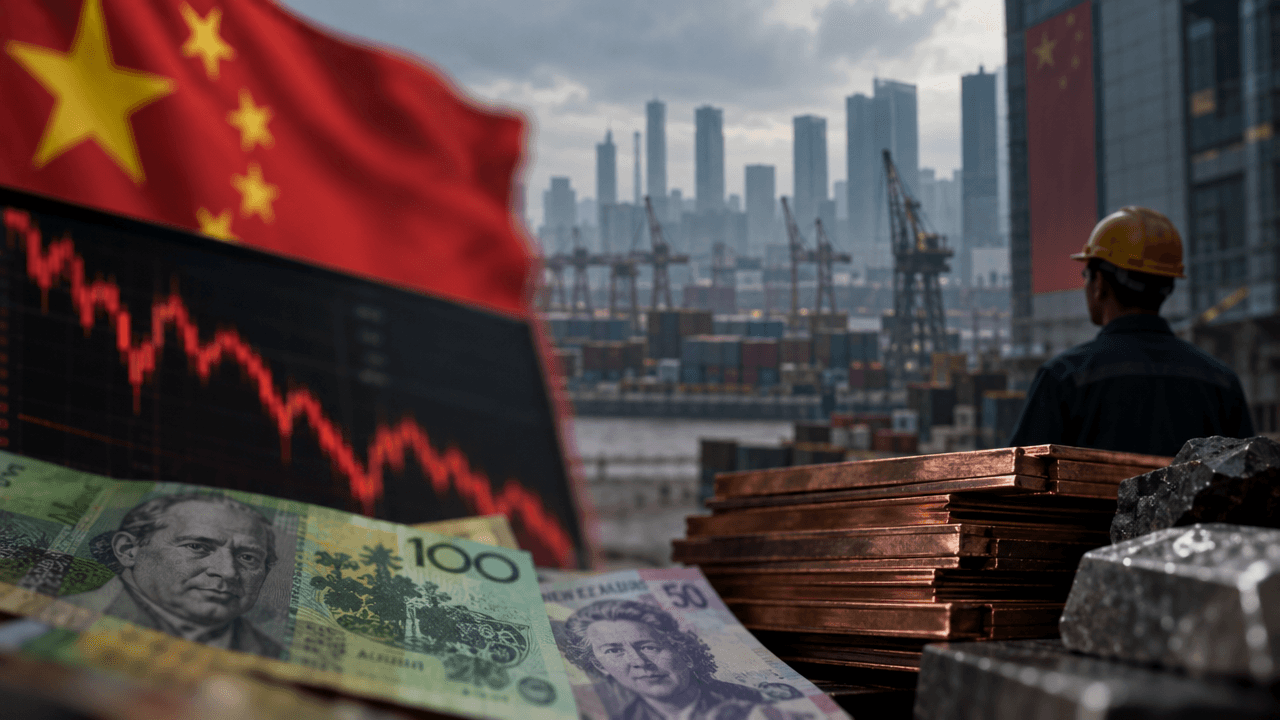
China’s October economic data delivered a clear warning: the world’s second-largest economy is still producing, but households are not spending with the same confidence. Industrial output grew 4.8% year over year, down from 5.5% in September, while retail sales increased only 0.4%, missing the 0.8% forecast and slowing sharply from September’s 1.1% gain. [1][6] The combination points to weaker domestic demand and creates fresh challenges for traders in currencies, commodities, and regional equities.
What The Data Reveals
Industrial production remains positive, but the slowdown matters because manufacturing is a major engine of China’s economy and a significant source of demand for raw materials. October’s 4.8% increase also fell short of the 5.3% consensus expectation, suggesting that factory activity lost momentum more quickly than analysts anticipated. [6]
The retail-sales figure is even more significant. Consumer spending is closely watched because policymakers have been trying to rebalance growth away from property and investment and toward household demand. A 0.4% increase indicates that this transition remains difficult.
The weakness is notable because October included seasonal support from a national holiday and the Singles Day shopping period. If those events failed to produce stronger spending growth, consumers may still be cautious about employment, income, housing values, and the broader economic outlook. [15]
This creates an uneven growth pattern. China’s export performance has remained strong, with exports reportedly rising 35.2% year over year in October, while domestic consumption has lagged. [13] An economy that depends heavily on external demand can continue to generate impressive headline figures, but it may remain vulnerable to trade restrictions, global demand shocks, and excess industrial capacity.
Why Domestic Demand Matters For Global Markets
China’s economic influence extends well beyond its borders. It is a major buyer of energy, industrial metals, agricultural products, and manufactured goods. When Chinese factories slow and households reduce spending, traders may reassess expected demand across the entire Asia-Pacific region.
Industrial metals are particularly sensitive. Copper, aluminum, and iron ore prices can respond to expectations for construction, manufacturing, infrastructure, and consumer-goods production. A slower property sector adds to the pressure because real estate and related industries have historically consumed large quantities of steel, copper, and other materials. The latest data therefore represents a headwind for industrial metals, especially if future releases confirm that the slowdown is broadening. [15]
Regional equity markets can also react. Shares of mining companies, materials producers, luxury-goods businesses, automakers, and exporters often reflect expectations for Chinese demand. A weak retail-sales number may weigh on companies that rely on Chinese consumers, while a softer industrial-output figure can pressure manufacturers and commodity producers.
The market response does not always move in a straight line. Weak data can hurt risk sentiment, but it can also increase expectations for monetary or fiscal support from Beijing. Traders must therefore distinguish between the immediate economic signal and the possible policy response.
Currency Impact: Aud And Nzd In Focus
The Australian dollar is one of the most closely watched liquid currencies when markets assess China’s outlook. Australia exports large quantities of iron ore and other commodities to China, while its economy and financial markets are sensitive to shifts in global risk appetite. A weaker Chinese growth outlook can therefore pressure AUD through both trade and sentiment channels. [15]
The New Zealand dollar can also be affected. New Zealand has strong commercial links with China, particularly through agriculture, food exports, tourism, and broader regional trade. Although its exposure differs from Australia’s commodity profile, weaker Chinese consumption can still reduce expectations for demand across the New Zealand economy.
For currency traders, the key issue is whether the data produces a temporary risk-off move or a sustained repricing of China-sensitive assets. The Australian dollar may initially weaken against the U.S. dollar, while AUD/NZD could become more volatile as traders compare Australia’s commodity exposure with New Zealand’s domestic and agricultural links to China.
Interest-rate expectations add another layer. If softer Chinese data reduces regional growth expectations, traders may look for easier policy in China or a more cautious stance from other central banks. However, currency moves depend on relative expectations. A weak China report may pressure AUD and NZD, but a simultaneous decline in U.S. yields or a broad fall in the dollar could offset part of that move.
How Traders Can Approach The Signal
The most important practical lesson is to avoid treating a single release as a complete market thesis. Traders should monitor follow-up indicators, including China’s purchasing managers’ indexes, fixed-asset investment, property activity, credit growth, employment data, and future retail-sales reports.
Price action can provide confirmation. If weak Chinese data is followed by declining copper and iron ore prices, softer AUD and NZD, and underperformance in Asia-Pacific equity futures, the market is likely treating the report as a broader growth warning. If those assets recover quickly, traders may believe policy support will limit the impact.
In a simulated trading environment, this event is useful for testing a structured process. Define the scenario before entering: weaker demand, stronger policy support, or a mixed outcome. Set risk limits, identify invalidation levels, and avoid increasing position size simply because several China-sensitive assets are moving in the same direction. Correlations can rise during risk-off periods, turning apparently separate trades into one concentrated exposure.
A sensible checklist includes three questions. Is the weakness confirmed by other data? Are policymakers responding with credible support? Is the market already positioned for a slowdown? The answers can determine whether the better opportunity lies in following momentum, waiting for a reversal, or staying out until volatility settles.
The Broader Outlook
China’s October figures do not prove that a severe contraction is imminent, but they do show that domestic demand remains a weak point. Industrial growth is slowing, consumer spending is barely expanding, and strong exports may be masking softer conditions at home.
For traders, the report is best understood as a risk signal rather than a standalone forecast. It raises the probability of pressure on AUD, NZD, industrial metals, and regional equities, while also increasing attention on potential Chinese policy support.
The next phase will depend on whether Beijing can restore household confidence and convert export strength into stronger domestic consumption. Until that happens, markets are likely to remain sensitive to every indication that China’s factories and consumers are losing momentum.