
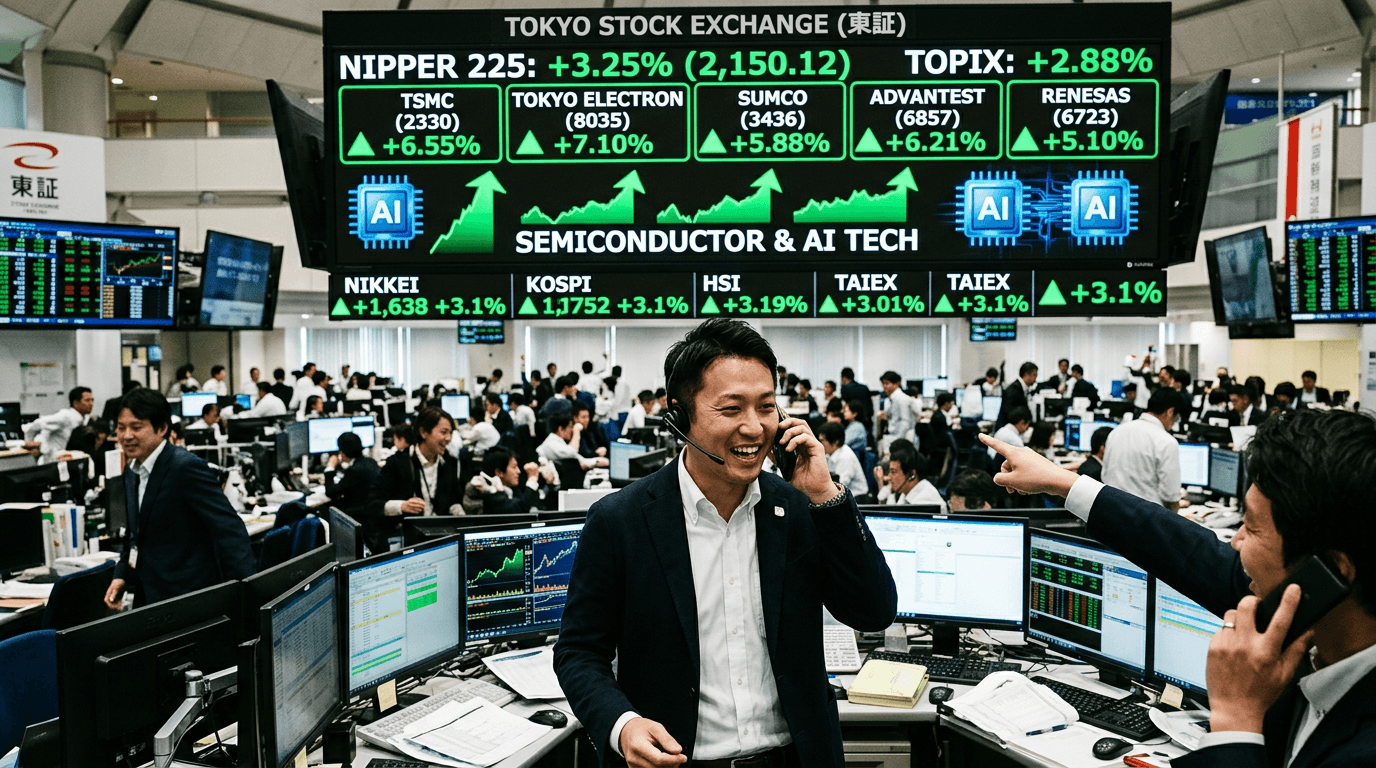
Asian equities are rallying again, and once more it is the semiconductor and broader technology sector setting the pace. Stronger U.S. equity performance, particularly in chipmakers tied to artificial intelligence, has spilled over into Asian trading hours, lifting regional benchmarks and reigniting risk appetite across global markets.[3][8] For traders watching index futures or navigating a SimFi environment, this is a textbook example of how sector-specific momentum in one region can ripple through global prices and sentiment.[12]
MARKET OVERVIEW: ASIA TAKES ITS CUE FROM U.S. TECH
The current upswing in Asian equities is closely linked to a rebound in U.S. markets, where tech and semiconductor names have led recent gains.[3][8] As Wall Street’s chipmakers recovered on improved earnings and optimistic guidance around AI-related demand, Asian investors followed suit, rotating back into growth-sensitive sectors that had been volatile in prior weeks.[3][10]
Japan’s equity markets illustrate this dynamic clearly. The TOPIX has pushed to fresh highs, supported by broad-based buying in technology, industrial, and export-oriented stocks.[2] The Nikkei 225 remains near record levels, with heavyweight semiconductor and electronics names doing much of the heavy lifting.[2] Similar patterns are visible in Korea and Taiwan, where AI chipmakers have driven significant advances in tech-heavy indices and helped the MSCI Asia Pacific Index approach or revisit record territory.[9][11]
Crucially, this rally is not happening in isolation. It sits on top of improving expectations for U.S. monetary policy and inflation, which investors believe could allow the Federal Reserve to start easing policy in coming meetings.[4][12] Softer inflation data and resilient labor figures have helped convince markets that a rate-cut cycle is plausible without a hard landing, reinforcing demand for equities and higher-beta sectors such as semiconductors.[4][12]
Chipmakers At The Heart Of The Move
The central narrative behind the rally is the renewed optimism surrounding artificial intelligence and memory chips. Upbeat forecasts from leading U.S. producer Micron Technology, including stronger-than-expected earnings and guidance for robust AI memory demand, have reassured investors that heavy capital spending in AI infrastructure may indeed translate into sustained revenue and profit growth.[3] That message has resonated strongly in Asia, where many of the world’s key semiconductor manufacturers are listed.
Across Japan, Taiwan, and South Korea, chipmakers and AI-related technology firms have been among the biggest contributors to recent index gains.[2][9][11] Japanese names such as Renesas Electronics and Rohm have advanced as investors position for an extended cycle in power chips, microcontrollers, and other components needed in data centers and advanced computing.[2] In Korea and Taiwan, giants in memory and foundry services have staged sizeable rebounds after prior volatility, reinforcing the perception that earlier drawdowns reflected profit-taking rather than a deterioration in fundamentals.[9][11][13]
Several structural drivers support these moves. Investors are pricing in continued surging demand from AI data centers and high-performance computing applications, alongside an ongoing supply crunch in certain memory and logic segments.[2][3] This combination gives major producers pricing power and supports expectations of margin expansion and stronger cash flows.[2][3] At the same time, the sector’s sensitivity to global growth and interest rates means any hint of a friendlier macro backdrop can quickly translate into sharp price moves, as seen in this latest rally.[12]
What This Means For Index Futures And Risk Sentiment
For traders in index futures, the chip-led rally in Asia is more than just a regional story. Semiconductor firms occupy outsized weights in many benchmarks, meaning their movements can materially influence index-level performance and futures pricing.[2][9][11] A strong open in Asia driven by tech and chips often sets the tone for European and U.S. sessions, shaping expectations for volatility, sector rotation, and intraday trend behavior.[12]
In practical terms, rising Asian tech stocks can support higher levels in global equity futures as traders extrapolate positive earnings and demand trends across regions.[3][12] When AI-exposed chipmakers move sharply, futures on tech-heavy indices—such as those tracking U.S. or Asian growth benchmarks—may see increased buying interest, tighter spreads, and a bias toward “buy-the-dip” strategies.[3][10] Conversely, any sudden reversal in chip sentiment can quickly spill into futures markets, producing outsized swings relative to more defensive sectors.[14]
Risk appetite is also directly affected. As expectations for central bank easing and robust tech earnings align, investors are more willing to take on cyclical and growth exposure, and less inclined to hide in cash or low-volatility assets.[4][12] That environment typically favors strategies that lean into momentum, sector leadership, and relative strength rather than pure mean reversion. For SimFi traders, monitoring how chip-heavy indices behave around key news—earnings, guidance revisions, or policy data—is a practical way to anticipate shifts in global sentiment.
Lessons For Traders Using Simulated Finance
Within a simulated trading framework, the current episode offers several educational lessons:
First, it highlights the importance of cross-market linkages. U.S. chipmaker earnings and AI commentary are influencing Asia’s tech sector, which in turn is affecting global index futures.[3][10][12] SimFi traders can use this to practice building trading plans that incorporate event calendars across regions—tracking not just domestic data, but key global earnings and policy announcements.
Second, it demonstrates sector leadership and concentration risk. With semiconductors driving a large share of index gains, a few names or subsectors can disproportionately impact portfolio performance.[2][9][11] SimFi users can test how different levels of exposure to chipmakers change the behavior of a multi-asset portfolio, including drawdowns during corrections and upside capture during rallies.
Third, it underscores the tension between growth narratives and valuation concerns. While AI demand appears robust and structural, investors remain wary about stretched valuations in some AI-related names.[12] In a simulated environment, traders can experiment with scenarios where earnings stay strong but multiples compress, exploring how that affects price trajectories and risk metrics.
Practical Takeaways For The Next Sessions
Going into upcoming sessions, there are several practical points traders can apply:
Watch for follow-through and breadth. Is the rally still concentrated in chipmakers, or broadening to financials, industrials, and domestic-demand sectors?[2] A narrow move led only by semiconductors can be more fragile than a rally with strong cross-sector participation.
Monitor key catalysts: U.S. tech earnings, AI demand guidance, and macro data that could alter rate-cut expectations.[3][4][12] Surprises in any of these areas can quickly shift sentiment toward or away from high-beta sectors.
Use index futures to observe real-time sentiment. Changes in futures pricing on tech-heavy benchmarks during Asian hours can provide early signals about how European and U.S. cash markets might open.[12] SimFi platforms are well-suited to practicing intraday adjustments based on these signals without real capital at risk.
Finally, maintain a disciplined view of risk. Chip-led rallies can be powerful but are often accompanied by elevated volatility and sharp swings on news.[13][14] Position sizing, scenario analysis, and clear exit rules are essential—whether you are trading live or in a simulated environment designed to build and test your strategy.