
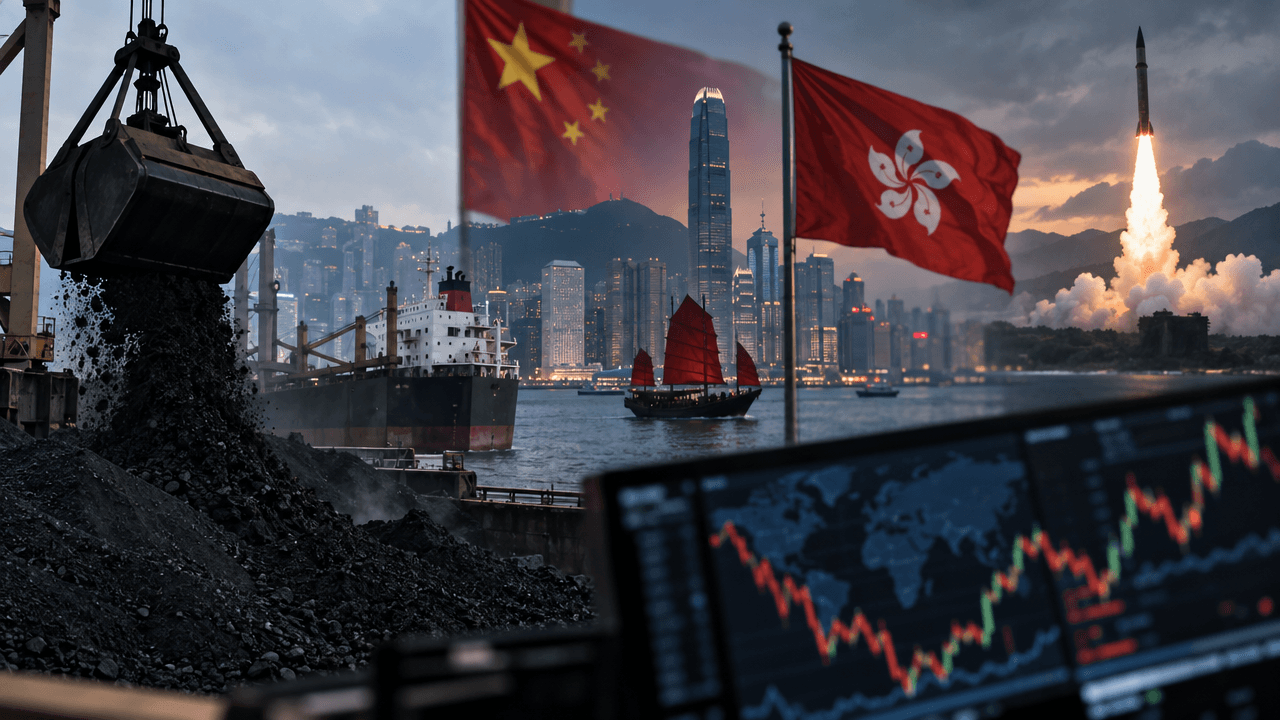
Risk assets are trading in a headline-driven environment where commodity flows, currency policy, and geopolitics intersect in real time. Cross-asset traders are seeing coal import data, Hong Kong’s yuan ambitions, and North Korea’s missile activity feed directly into pricing for futures, FX, and equity indices, keeping volatility elevated even in the absence of a single “big bang” event.
Global Macro Signals In A Headline-driven Market
In the current macro backdrop, markets are less anchored to long-term forecasts and more reactive to short bursts of information across commodities, currencies, and geopolitics. Short, sharp news flows can rapidly reprice growth expectations, risk premia, and liquidity conditions, especially for futures and leveraged instruments.
Coal import trends are reshaping expectations around Asian industrial demand and power costs, influencing everything from utility equities to dry bulk shipping futures. At the same time, Hong Kong’s strategic push to deepen offshore yuan markets is redefining regional FX and rates liquidity, with implications for carry trades and cross-border funding strategies. [2][10][12][14]
Overlaying this, recurring missile drills and weapons tests by North Korea are a reminder that geopolitical risk in Northeast Asia can flare without much warning, reinforcing a bid for defensive assets and risk hedges. [1][7][11][15]
For traders—whether live or in simulated environments—the key is understanding how these seemingly disparate headlines connect into a broader macro narrative about growth, inflation, and risk appetite.
Coal Imports And Commodity Sentiment
Recent data point to shifts in Asian coal trade flows, including a fall in China’s August coal imports from Indonesia alongside rising shipments from Russia. [9] These changes are compounded by reports of Indonesian coal bottlenecks that are squeezing seaborne supply and complicating logistics for utilities and traders. [13]
Coal is still a critical fuel for power generation in much of Asia, so import disruptions can feed directly into expectations for electricity prices, industrial production, and broader inflation. When key suppliers face bottlenecks, futures markets in thermal coal, freight, and even regional power can price in supply risk premia, pushing implied volatility higher. [13]
For risk assets, the coal story matters through multiple channels. Higher or more uncertain energy costs can pressure margin expectations for energy-intensive sectors, influence inflation-sensitive rates markets, and alter the relative attractiveness of commodities versus equities. Equity indices with heavy exposure to utilities, materials, and industrials tend to react first, while FX markets may reflect changing terms of trade for coal-exporting and importing economies.
Practical takeaway: Simulated traders can watch coal import headlines as an early indicator of changing energy cost expectations. When logistics disruptions emerge, consider how to express views via commodity-linked indices, sector futures, or volatility products rather than focusing only on the underlying physical market.
YUAN MARKETS AND HONG KONG’S OFFSHORE PUSH
Hong Kong has rolled out its first five-year plan since the handover, placing the expansion of its role as an offshore yuan hub at the center of financial strategy. [2][12] Authorities have pledged to scale up and refine offshore yuan business, strengthen yuan liquidity support, and establish a dedicated offshore liquidity provision mechanism. [2][10]
Policy statements highlight plans to broaden the application of yuan in pricing, settlement, and investment, including more frequent issuance of dim sum bonds and the exploration of yuan-denominated gold and commodity markets. [8][14] The government is also considering settling some of its own expenditures in yuan, reinforcing the currency’s institutional footprint. [2][12]
For FX and rates traders, these developments can alter liquidity distribution, cross-currency funding dynamics, and demand for yuan-linked products. An expanded offshore yuan ecosystem may support greater international use of the currency in trade and investment, impacting regional carry strategies and the correlation between yuan and other Asian currencies. [10][14]
In risk assets, greater offshore access and deeper product sets tend to encourage more sophisticated hedging and speculative flows into yuan-denominated futures and options, potentially amplifying both directional moves and volatility during macro shocks.
Practical takeaway: SimFi participants can treat Hong Kong’s yuan initiatives as a “structural” theme. In simulated portfolios, experiment with scenarios where offshore yuan liquidity improves, then test how that might affect relative performance of regional FX pairs, China-linked equity indices, and commodity contracts priced in yuan.
Geopolitical Risk: North Korea Missile Drills
Northeast Asia’s geopolitical risk premium has been reinforced by multiple reports of North Korean missile launches and live-fire drills. In early September, North Korea fired several short-range ballistic missiles from the Wonsan area toward the sea off its east coast, with flight distances of around 250 kilometers. [7] State media subsequently described some launches as part of integrated live-fire drills involving artillery, missiles, and drones, showcasing what it claimed to be “huge destructive power.” [1][5][6]
These events add to a pattern of repeated ballistic and cruise missile tests earlier in 2026, signaling persistent efforts to refine weapons capabilities and messaging to regional adversaries. [3][11][15] From a market perspective, each new launch tends to generate a short-lived spike in risk aversion, often expressed through lower equity futures, firmer safe-haven FX such as the yen, and higher demand for volatility hedges.
The impact is usually episodic, but a sustained escalation—or a test perceived as qualitatively different—can trigger more durable risk repricing in global indices, particularly those with heavy exposure to Asia or global cyclicals.
Practical takeaway: In simulated trading, treat North Korea headlines as catalysts for short-duration risk-on/risk-off swings. Test intraday strategies that respond to volatility spikes, such as adjusting index futures exposure or using options to manage gap risk around event windows.
Simulated Finance: Turning Headlines Into Strategies
The combination of shifting coal imports, evolving yuan policy, and heightened missile activity illustrates how global macro headlines can move risk assets through multiple, overlapping channels. Commodity supply disruptions feed into inflation and growth expectations, currency market reforms reshape liquidity and funding, and geopolitical events influence risk premia and safe-haven flows. [9][10][13][15]
For traders on SimFi platforms, this environment offers a rich testing ground for multi-asset strategies. Because simulated environments remove capital risk, participants can experiment with cross-asset linkages: pairing coal-related commodity views with regional equity index positions, or combining yuan FX scenarios with rates and credit exposures tied to offshore bond markets. [2][8][12][14]
Key actions to consider in a simulated framework include building watchlists around: 1) Energy and commodity headlines that hint at supply-chain stress. 2) Policy announcements from key financial centers about FX and offshore markets. 3) Geopolitical developments that historically correlate with spikes in volatility.
From there, traders can design playbooks that translate specific headline types into predetermined tactical responses—reducing noise and avoiding purely emotional reactions to breaking news.
Conclusion
Global macro headlines on coal imports, offshore yuan expansion, and North Korean missile activity are not isolated stories; they are components of a larger narrative about how energy, currency policy, and geopolitics shape risk appetite. [2][9][10][13][15] For risk assets, the result is a market that can pivot quickly as new information arrives, rewarding traders who understand transmission channels rather than chasing every headline.
In simulated finance, these developments offer an opportunity to build and stress-test cross-asset strategies, refine event-driven playbooks, and practice discipline in a reactive market landscape. Turning complex news flows into structured trading hypotheses is a skill that pays dividends in both simulated and live environments, especially when global macro themes refuse to sit still.