
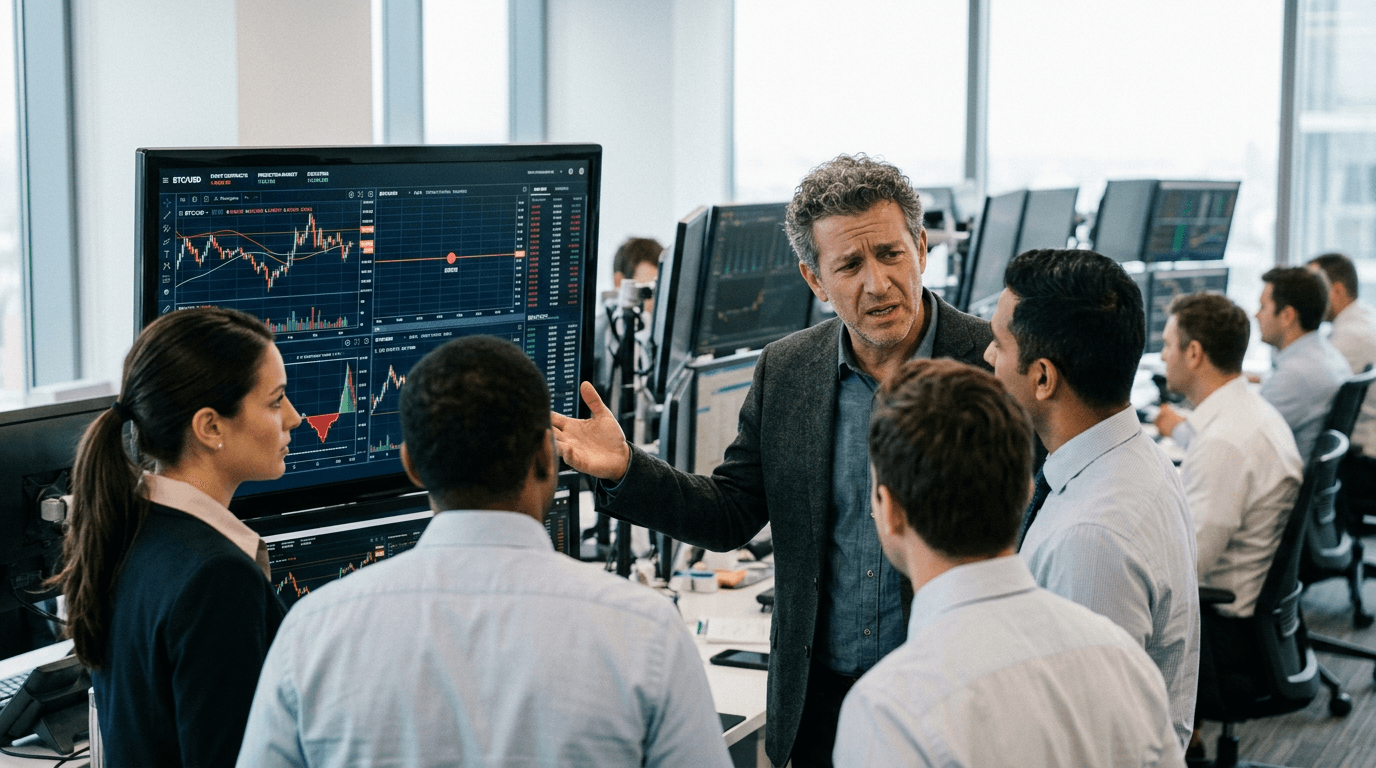
For traders in crypto prediction markets, Coinbase’s latest technical outage is a reminder that market risk is no longer just about price—it’s also about whether you can trade at all when it matters most.[1][7] The rapid restoration of service has calmed nerves, but the episode puts infrastructure risk and execution reliability firmly back in focus for anyone trading event contracts or exploring Simulated Finance (SimFi).[7]
WHAT HAPPENED TO COINBASE’S PREDICTION MARKETS
According to Coinbase’s status messages, users were temporarily unable to place trades in the platform’s prediction markets segment due to a technical issue, affecting both web and mobile access.[1][3][4] The company confirmed it was investigating the problem and assured customers that their funds remained safe despite the disruption.[4]
Reports indicate the outage was brief: one analysis cited a roughly 19‑minute window in which trading was unavailable, starting around 03:30 PDT and ending at 03:49 PDT.[2] Coinbase later told reporters that service had resumed but did not provide detailed information about the root cause of the malfunction or the precise mechanics behind it.[1][4]
Some commentary has suggested that internal errors, including a malfunction in AI‑driven alert systems, may have contributed to the interruption, though Coinbase has not publicly confirmed any specific technical fault.[2] What is clear from the status page timeline is that the incident was detected, investigated, and resolved within a short period, with prediction markets trading subsequently restored.[1][2][3][4]
Why Outages Matter More In Prediction Markets
Prediction markets—sometimes structured as event contracts linked to outcomes like elections, sports events, or macroeconomic releases—are uniquely time‑sensitive.[2][7] Prices in these markets incorporate changing probabilities in real time, often reacting sharply to news, data, and sentiment shifts as events approach.
When trading halts unexpectedly, participants lose the ability to enter, exit, or adjust positions during potentially critical windows. If a major news item hits while a platform is offline, traders cannot respond, and the price adjustments that would normally occur may be compressed into a much shorter window once trading resumes. That can amplify volatility and widen bid‑ask spreads, especially in products that depend on one main venue for liquidity.[7]
For prediction markets, where the payoff hinges on discrete outcomes rather than continuous price moves, execution risk around event deadlines is particularly acute. A short outage near a key announcement can change the risk profile of a position even if the underlying event itself is unchanged, simply because the trader’s ability to hedge or exit was temporarily removed.
Liquidity, Sentiment, And Operational Risk
The restoration of Coinbase’s prediction markets removes an immediate overhang on liquidity and sentiment in the affected products, reducing concerns that technical instability might become a recurring feature of this segment.[4][7] During an outage, order books can effectively “freeze,” and when they restart, participants may demand a premium for providing liquidity until confidence in platform reliability is re‑established.
Short, contained incidents like this one are unlikely to trigger long‑term structural damage, but they do feed into a broader assessment of operational risk: how often do outages occur, how quickly are they resolved, and how transparent is the communication around them?[1][4][7] For active traders, answers to these questions influence venue selection, position sizing, and whether certain instruments are suitable for time‑critical strategies.
In emerging products such as event contracts, where regulatory frameworks and market microstructure are still evolving, infrastructure reliability is part of the trust equation. Traders want to know not only that their funds are safe, but that the market itself will be available when it matters—during volatile news cycles, tight hedging windows, and impactful real‑world events.[4][7]
Lessons For Live And Simulated Traders
For traders operating both in live markets and on SimFi platforms like E8 Markets, this episode offers several practical takeaways.[7]
First, avoid concentrating too much risk in instruments whose liquidity depends heavily on a single venue’s uptime, especially around key event deadlines.[7] Diversification can mean using multiple exchanges, alternative instruments (such as options or futures), or simulated environments to test how strategies perform under execution constraints.
Second, treat platform reliability as a core input into your risk management framework, not an afterthought. That includes monitoring official status pages and communication channels so you can distinguish between a local connectivity issue and a platform‑wide outage, and adjusting your trading activity accordingly.[3][4][5][7]
Third, use simulated trading to model “what if” scenarios around outages and execution gaps. SimFi environments allow traders to stress‑test strategies under conditions where liquidity disappears temporarily, spreads widen on restart, or key events occur while trading is unavailable.[7] Practicing responses—such as pre‑positioning, conservative sizing near event windows, or incorporating margin for unexpected downtime—can make live trading decisions more disciplined.
Finally, be cautious about over‑reliance on automated systems, including AI‑based alerts or bots, without robust monitoring and fallback procedures.[2][7] Technology can enhance risk management, but it also introduces new failure modes. Ensuring that humans remain in the loop for critical oversight can reduce the impact of alert or automation errors when seconds matter.
Looking Ahead For Prediction Markets And Simfi
Coinbase’s swift resolution of the outage and restoration of prediction markets trading suggests the incident was contained and short‑lived.[1][2][4][7] Yet it underscores a broader reality: as prediction markets grow and SimFi platforms become more central to trader development, infrastructure resilience is becoming just as important as product design or pricing models.
For prediction market participants, the message is clear. Whether you are trading live event contracts or refining strategies in a simulated environment, you need to plan not only for price volatility, but for the possibility that the market itself may briefly go dark.[7] Incorporating platform uptime, communication quality, and technical robustness into your venue selection and trade planning will help you navigate future episodes with greater confidence.
As exchanges and SimFi providers continue to invest in monitoring, automation, and redundancy, traders who adjust their frameworks today—by pricing in execution risk and rehearsing outage scenarios—will be better positioned to turn inevitable infrastructure hiccups into manageable, rather than existential, events in their trading journey.[7]