
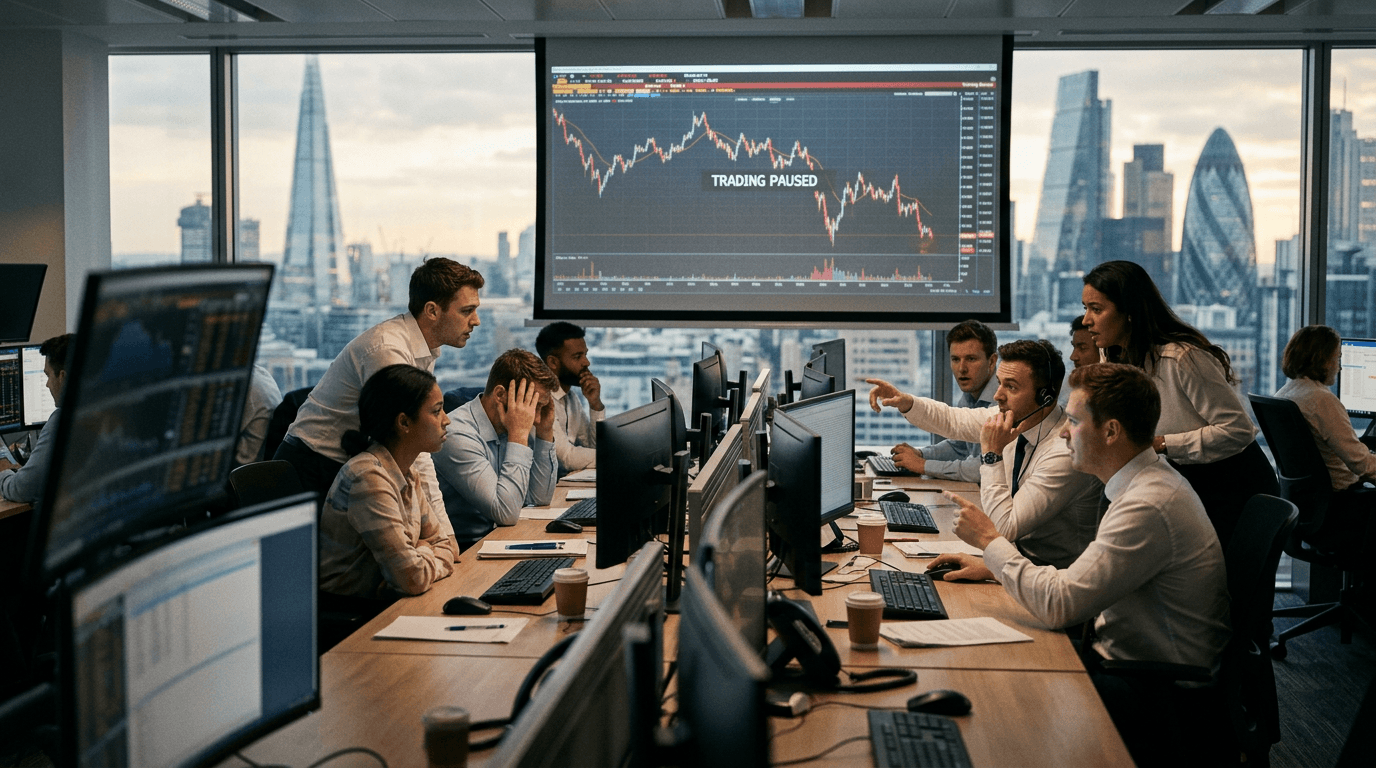
The brief disruption and rapid restoration of prediction markets trading on Coinbase is a small operational hiccup with outsized lessons for anyone trading event contracts or simulating them in environments like SimFi platforms. A few minutes or hours of downtime can change how probabilities are priced, how liquidity behaves, and how traders think about platform risk—especially when these markets are tied directly to real‑world events.
WHAT HAPPENED TO COINBASE’S PREDICTION MARKETS
Coinbase reported that users were temporarily unable to place trades in its prediction markets, with the issue affecting both web and mobile interfaces.[1][3][6][7] Status messages on its official page noted that the company was investigating the problem and that some users were seeing failed or delayed transactions.[3][6][7]
In statements to Reuters and other outlets, Coinbase confirmed that service had been restored, allowing prediction markets trading to resume without detailing the root cause or precise duration of the outage.[1][2] The exchange emphasized that customer funds remained safe, framing the episode as a technical trading disruption rather than a security or custody event.[3][6]
From a market structure standpoint, the key point is not only that prediction markets were briefly offline but that traders lacked clarity about when normal order flow would return. In a product where prices represent real‑time probabilities of events, even short periods of forced inactivity can have meaningful implications for positioning, hedging, and sentiment.[5]
Why Prediction Markets Now Matter To Mainstream Traders
Coinbase’s outage is notable because prediction markets are no longer a niche experiment—they are becoming part of a mainstream trading stack.[8][10] Coinbase has rolled out event‑based contracts that allow U.S. users to trade on outcomes such as elections, macroeconomic releases, sports results, and entertainment events, alongside crypto and equities in the same interface.[8][9][10]
This build‑out has been supported by a partnership with Kalshi, whose event contract platform has already processed tens of billions of dollars in notional volume, highlighting growing demand for trading views on real‑world outcomes.[8] For Coinbase, integrating prediction markets, stock trading, stablecoins, and tokenized assets is part of a broader push to become a one‑stop trading and investment app.[10]
As these products mature, they increasingly resemble traditional derivatives markets where probabilities, hedges, and risk transfer are central. That is why infrastructure reliability is now a core part of the value proposition. A trader who uses prediction markets to hedge election exposure, for example, is relying not only on pricing accuracy but also on consistent execution during the most important information releases.
When Platforms Go Dark: Liquidity, Pricing, And Risk
Even though Coinbase’s disruption was short‑lived, the episode illustrates how platform outages can reverberate through prediction markets.[5] When an exchange temporarily halts order flow in event contracts, several dynamics can emerge:
Spreads widen and liquidity thins. With no fresh orders, market makers and liquidity providers cannot continuously update quotes, which can lead to wider bid–ask spreads once trading resumes.[5] That makes it more expensive for traders to enter or exit positions.
Probabilities become “stale.” Prediction market prices are often interpreted as implied probabilities of outcomes. If trading stops while new information arrives—such as polling data, macro releases, or breaking news—prices can lag reality until the market reopens and participants reprice contracts.[5]
Risk management options narrow. Traders unable to place orders cannot hedge, rebalance, or cut risk in response to new information. For leveraged or time‑sensitive strategies, that inability to act can be as significant as a price move itself.[5]
For SimFi traders, these mechanics are particularly instructive. Simulated environments allow participants to stress‑test strategies against scenarios where markets freeze, spreads gap, and probabilities jump on reopen. Incorporating infrastructure risk into backtests and simulated trade plans can make live execution more resilient when similar disruptions occur on real platforms.
Lessons For Simfi Users And Active Traders
For both live traders and SimFi participants, the Coinbase incident reinforces several practical lessons.[5]
Treat platform reliability as a primary risk factor. It is not enough to analyze only event risk and price volatility; venue uptime, latency, and incident history matter too. When building strategies for prediction markets, factor in the possibility that your primary venue could be briefly unavailable.
Avoid concentration in a single venue around critical deadlines. If a major event—such as an election, central bank decision, or data release—is central to your strategy, consider diversifying across venues or instruments rather than holding all risk in contracts that depend on one platform’s uptime.[5]
Plan for outage scenarios in advance. In simulated trading environments, test how your strategy behaves if trading halts during key information windows. Decide beforehand how you will react: reduce leverage, increase cash buffers, or avoid last‑minute position changes near binary events.
Use simulation to rehearse execution risk, not just price risk. Many traders backtest on price paths alone. SimFi platforms can add value by allowing users to model delays, partial outages, and uneven liquidity so they can understand how operational frictions interact with their decisions.[5]
Regulation, Resilience, And The Future Of Event Contracts
Coinbase’s broader posture toward prediction markets underscores that these are evolving into regulated, institutional‑grade products rather than speculative side bets.[4] In a recent comment letter and public statement, the company argued that event‑based contracts fit comfortably within the existing federal derivatives framework and should remain under the U.S. Commodity Futures Trading Commission’s oversight rather than be treated as an entirely new category.[4]
Coinbase’s view is that the CFTC already has the authority to review, condition, or prohibit contracts that conflict with the public interest, including those vulnerable to manipulation or harm.[4] That argument, if accepted, would support clearer, uniform rules across interstate prediction markets and reduce fragmented, state‑by‑state enforcement.[4]
Regulatory clarity and robust oversight are closely linked to resilience. As prediction markets scale, regulators and venues alike will focus more on operational standards: incident reporting, recovery procedures, and transparency around outages. Traders will increasingly expect not just rapid restoration of service, but detailed post‑mortems explaining what went wrong and how similar issues will be prevented.
For traders and SimFi users, the core takeaway is that event contracts are moving into the financial mainstream—and that means infrastructure, regulation, and strategy design will evolve together. The Coinbase disruption was contained and funds remained safe,[3][6] but it serves as a practical reminder to build strategies that can withstand not only price shocks, but also brief moments when the market itself disappears from view.