
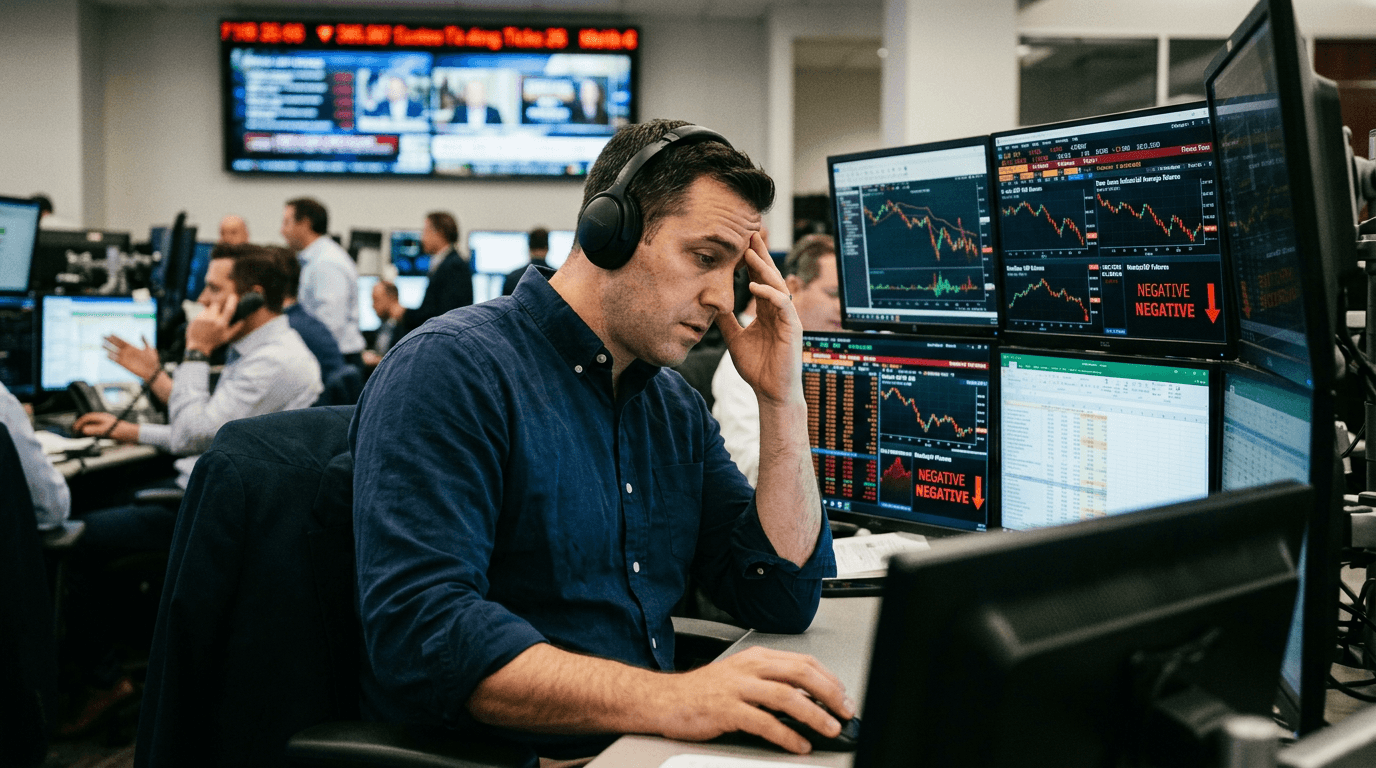
U.S. index futures are under pressure as traders rapidly reprice the path of Federal Reserve policy, challenging the narrative of a smooth transition to lower rates and unsettling risk sentiment across global markets.[4][11][12] For active and simulated traders alike, this kind of shift is a reminder that the macro backdrop can change faster than headlines, and that understanding how rate expectations translate into futures pricing is a critical edge.
WHAT’S DRIVING THE MOVE
The latest slide in S&P 500, Nasdaq 100, and Dow Jones futures is tightly linked to a sharp reassessment of how soon and how aggressively the Fed might cut interest rates.[4][11][12] After a series of firmer inflation and labor data, traders have trimmed expectations for near-term easing and even entertained the possibility that the next move could be a hike rather than a cut.[2][5][12] In premarket trade, Nasdaq-100 futures recently fell around 1%, while Dow and S&P 500 futures also dipped, reflecting this hawkish tilt.[4]
Rate expectations are not changing in a vacuum. Strong payrolls and sticky inflation have kept Treasury yields elevated, raising the discount rate investors use to value future earnings.[5][6] As yields rise, high-duration assets such as growth stocks and index futures linked to them tend to underperform, especially when valuations were already rich.[2][6] The result is a synchronized pullback across major U.S. equity futures contracts, with small-cap and high-beta segments often hit hardest.[6][7]
How Rate-cut Expectations Are Shifting
Just a few months ago, markets were pricing a series of cuts spread over late 2025 and into 2026; more recent data have pushed those expectations back and reduced their magnitude.[2][5][11] Futures tied to Fed policy now imply only modest reductions in rates by the end of the year, a far cry from the earlier consensus of multiple 25-basis-point cuts.[5][6] In some contracts, the probability of a September rate cut has dropped into single digits, while the odds of a hike or at least no change have risen materially.[4][11][12]
Event-based prediction markets and Fed funds futures tell a similar story. One venue recently priced a roughly 60% chance of a 25-basis-point rate increase at the upcoming Federal Open Market Committee meeting, with only about 1% odds assigned to a cut.[4][11] Other FedWatch-style tools show that traders now see rates more likely to be higher by December than lower, underscoring how quickly the easing narrative has eroded.[11][12] For traders, these probabilities are not just curiosities—they directly impact the fair value of index futures and volatility pricing.
Impact On Equities And Derivatives
When futures slide on shifting rate expectations, the move cascades into cash equities, options, and volatility products. On days when the market slashes rate-cut odds, U.S. index futures often trade down 0.5%–1% in early sessions, with tech-heavy benchmarks like the Nasdaq-100 typically leading the decline.[4][6][7] Sectors most sensitive to discount rates—technology, communication services, and speculative growth—tend to see the largest drawdowns, while more defensive or value-oriented names may outperform on a relative basis.[2][6]
Derivatives markets respond quickly. Implied volatility in near-dated options can spike as traders rush to hedge downside risk, and skew often steepens as demand for puts increases relative to calls.[6][7] On days following hawkish Fed rhetoric, futures tied to smaller domestic indices such as the Russell 2000 have shown outsized moves, reflecting concerns about higher borrowing costs for smaller, more leveraged firms.[6] For SimFi participants, this provides a rich environment to study how macro shocks propagate through the volatility surface and index spreads.
What Traders Should Watch Next
For both live and simulated traders, the key is not predicting every Fed move but mapping out how different policy paths affect market regimes. Start with three anchors: economic data, Fed communication, and rate-probability tools. Labor-market releases and inflation prints often drive the largest repricings, especially when they surprise relative to consensus.[5][8] Fed speeches and meeting minutes can then reinforce or challenge those reactions, shifting the market-implied odds of future hikes or cuts.[8][11]
Rate-probability dashboards derived from Fed funds futures and other money-market instruments translate this information into a tradable view of policy expectations.[5][11][12] Watching how the implied probability of a cut or hike shifts after each data point helps explain intraday moves in S&P 500 and Nasdaq futures.[6][15] When the market moves from expecting several cuts to expecting almost none—or even a hike—the repricing can be abrupt, creating gaps, momentum bursts, and volatility clusters that are valuable to model in a simulated environment.
Practical Takeaways For Simulated Traders
On a SimFi platform like E8 Markets, traders can turn this macro volatility into structured learning rather than costly mistakes. One practical exercise is to build scenarios around different Fed paths: a “hawkish surprise” case where cuts are delayed and a “dovish pivot” case where inflation cools faster than expected. In each scenario, simulate the impact on index futures levels, volatility, and sector-relative performance, then test how different strategies behave across those regimes.
Another action item is to practice trading around major macro events with strict risk rules. Set position limits and maximum drawdown thresholds ahead of jobs reports, CPI releases, or Fed meetings, then review how your futures and options strategies would have performed under the actual outcomes. Incorporate tools that link rate expectations to futures prices—such as tracking implied probabilities from FedWatch-style models—and see how adjusting your exposure as those odds evolve would have changed results.[5][11][12] This builds discipline in tying macro views to position sizing rather than to single trade ideas.
Conclusion
The recent slide in U.S. index futures as rate-cut expectations wobble is a reminder that monetary policy is still the dominant driver of equity valuations and risk sentiment.[2][4][11] When the market moves from expecting multiple cuts to pricing in a potential hike, futures do not just drift lower—they reprice an entire path of growth, inflation, and liquidity.[4][11][12] For traders, the opportunity lies in understanding that connection and training for it in a low-risk environment.
By systematically linking macro data, Fed communication, and rate-probability tools to futures behavior, SimFi participants can turn episodes like this into a learning laboratory for regime shifts. Rather than reacting emotionally to red screens, you can build and test playbooks that anticipate how different Fed paths affect indices, sectors, and volatility. In an era where a few basis points of perceived policy change can move trillions in market value, that preparation is no longer optional—it is a core trading skill.