
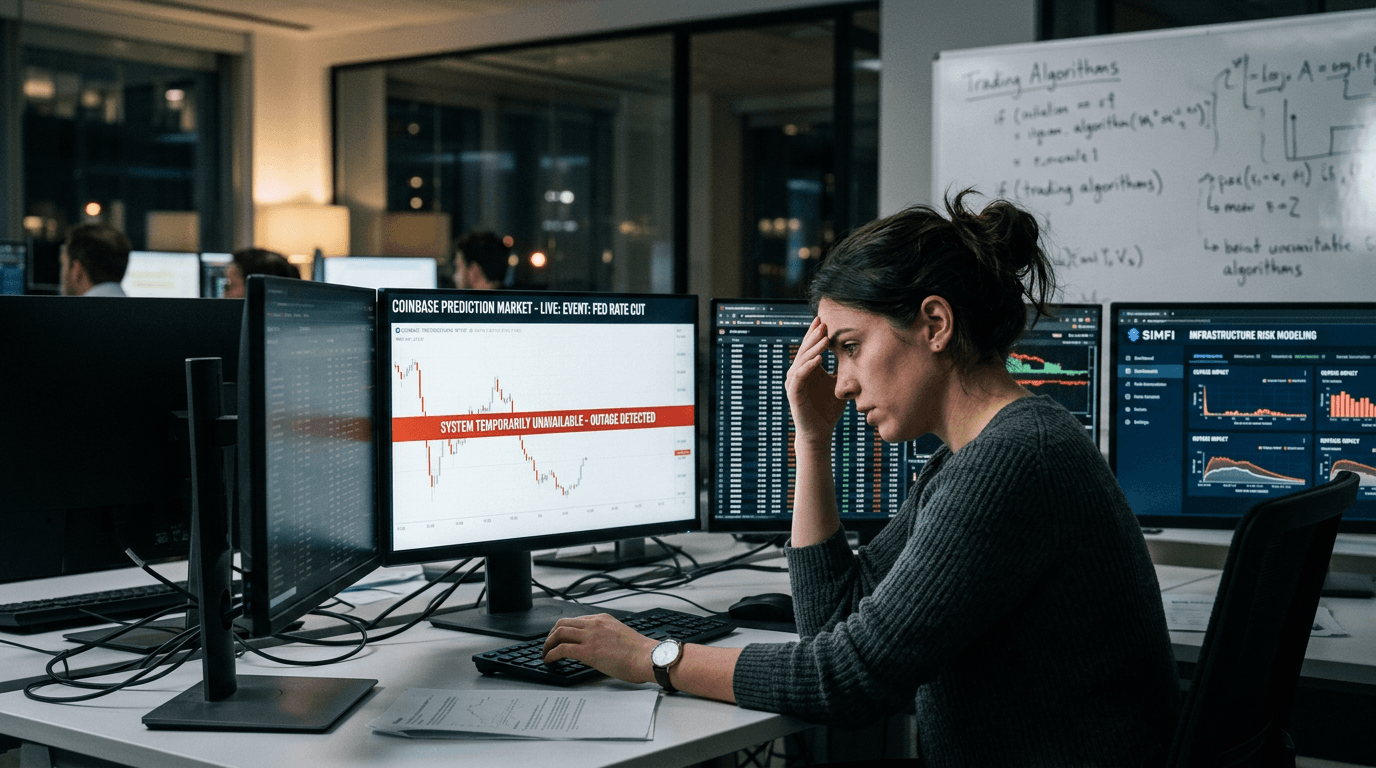
Coinbase’s brief outage in its prediction markets product is a reminder that even the largest, most sophisticated trading venues are not immune to technical issues.[1][3][4][7] For traders and SimFi participants, the incident underscores how platform reliability, risk management, and market confidence intersect in modern digital finance.
Outage Overview
According to Coinbase’s status page and subsequent reporting, users were temporarily unable to place trades on prediction markets through both web and mobile platforms.[1][3][5][7] The disruption began around 03:30 PDT and was resolved by 03:49 PDT, resulting in roughly 19 minutes of downtime for event-contract trading.[3]
During the incident, Coinbase indicated that it was investigating the problem and confirmed that customer funds remained safe despite the trading interruption.[5][7] Shortly after the issue was resolved, the company restored full functionality and updated its status message to reflect that prediction markets were again available for trading.[1][4]
The exchange did not publicly elaborate on the exact cause, though reports suggest that internal errors, including a malfunction in AI-driven alert systems, may have contributed.[3] Even though the outage was short, the combination of limited transparency and reliance on complex automation raises important questions about operational resilience in high-speed, data-intensive trading environments.
Why Prediction Markets Matter
Coinbase’s prediction markets differ from traditional crypto spot and derivatives trading because they are based on event contracts rather than digital assets.[3] Instead of buying or selling tokens, users trade contracts tied to outcomes such as elections, macroeconomic data releases, or sports events.[3] These instruments give traders a way to express views on real-world probabilities, often with clear, binary payoffs.
Coinbase launched this product for U.S. users in partnership with Kalshi, a regulated operator of event contracts overseen by the U.S. Commodity Futures Trading Commission (CFTC).[3] That regulatory framework is significant: it means prediction markets on Coinbase sit at the intersection of crypto-native interfaces and traditional, supervised financial infrastructure.
From a market-structure perspective, prediction markets can function as sentiment gauges. If traders sharply shift the probability on an election contract or a central bank decision, it can signal potential volatility in related assets, including major cryptocurrencies. Outages that temporarily halt trading therefore not only affect short-term activity but can blunt a valuable information channel for price discovery and risk hedging.
Trust, Reliability, And Centralized Infrastructure
Although this outage was minor in duration, it touches a deeper issue: how much operational risk traders are willing to tolerate in centralized platforms. When a major exchange experiences even a brief interruption, users are reminded that execution, access, and liquidity are contingent on complex backend systems that can fail or malfunction.[1][3][4][7]
Coinbase has emphasized that customer funds were safe and that services resumed quickly, which helps support confidence.[7] Still, recurrent glitches—whether in trading engines, alert systems, or ancillary services like notifications—can gradually erode trust if not matched by robust incident communication and visible infrastructure improvements.[3][8]
For professional traders, this kind of event is a cue to reassess dependency on single venues. Diversifying across exchanges, maintaining backup access channels, and understanding each platform’s outage history become part of a broader operational risk framework. Retail users, meanwhile, can see such incidents as a prompt to learn the differences between custodial platforms, on-chain alternatives, and simulated environments where execution risk is modeled without real capital at stake.
Implications For Simulated Finance And Trader Education
For SimFi traders on platforms like E8 Markets, the Coinbase prediction markets outage is a practical case study in real-world infrastructure risk. In simulation, a trader can test how strategies behave when liquidity disappears abruptly, spreads widen, or order routing fails—conditions that mirror the effects of an outage without exposing actual capital.
Event contracts are particularly useful teaching tools because they tie trading decisions to discrete outcomes with clear timestamps. A simulated portfolio that trades election or macro data contracts can be stress-tested against scenarios where a venue goes offline at precisely the wrong moment, forcing the trader to manage gaps in execution, missed hedges, and delayed exits.
Moreover, prediction markets highlight the importance of understanding product design. These contracts settle on observable outcomes rather than continuous price series, which changes how risk is measured and managed. SimFi environments can walk traders through mechanics like settlement rules, margin behavior around event dates, and the impact of regulatory oversight—skills that transfer directly to live prediction-market trading when users eventually move beyond simulation.
Practical Takeaways For Traders
Traders looking to learn from this incident—whether they operate in live markets or SimFi—can focus on a few practical actions:
First, review platform-status monitoring habits. Coinbase maintained a public status page and used it to communicate the timeline from detection to resolution.[1][3][5] Building a routine of checking status pages and subscribing to alert channels reduces the chance of being surprised by an outage in the middle of a key event.
Second, incorporate venue risk into your trading plan. This includes diversifying across exchanges, keeping contingency workflows for switching venues, and understanding which products (like event contracts) are exclusive to specific platforms.
Third, practice outage scenarios in a simulated environment. Designing drills where trading is “paused” mid-session, then resumed, can help traders refine reaction protocols—from recalculating exposures to adjusting entries and exits once the market reopens.
Fourth, deepen your understanding of prediction markets themselves. Learning how probabilities translate into pricing, how events are selected and verified, and how regulation shapes contract design makes it easier to respond intelligently when disruptions occur.
Looking Ahead
Coinbase’s restoration of prediction markets trading after a brief outage is reassuring in its speed but instructive in its implications.[1][3][4] The episode underscores that as digital finance blends crypto exchanges, regulated event contracts, and AI-assisted monitoring, operational resilience becomes as critical as product innovation.
For traders, the lesson is not to avoid these markets but to approach them with a layered risk framework—one that accounts for venue reliability, product structure, and the role of simulation in building robust decision-making skills. As prediction markets continue to grow and integrate with the wider trading ecosystem, incidents like this will remain valuable reference points for how platforms handle stress and how traders prepare for the unexpected.