
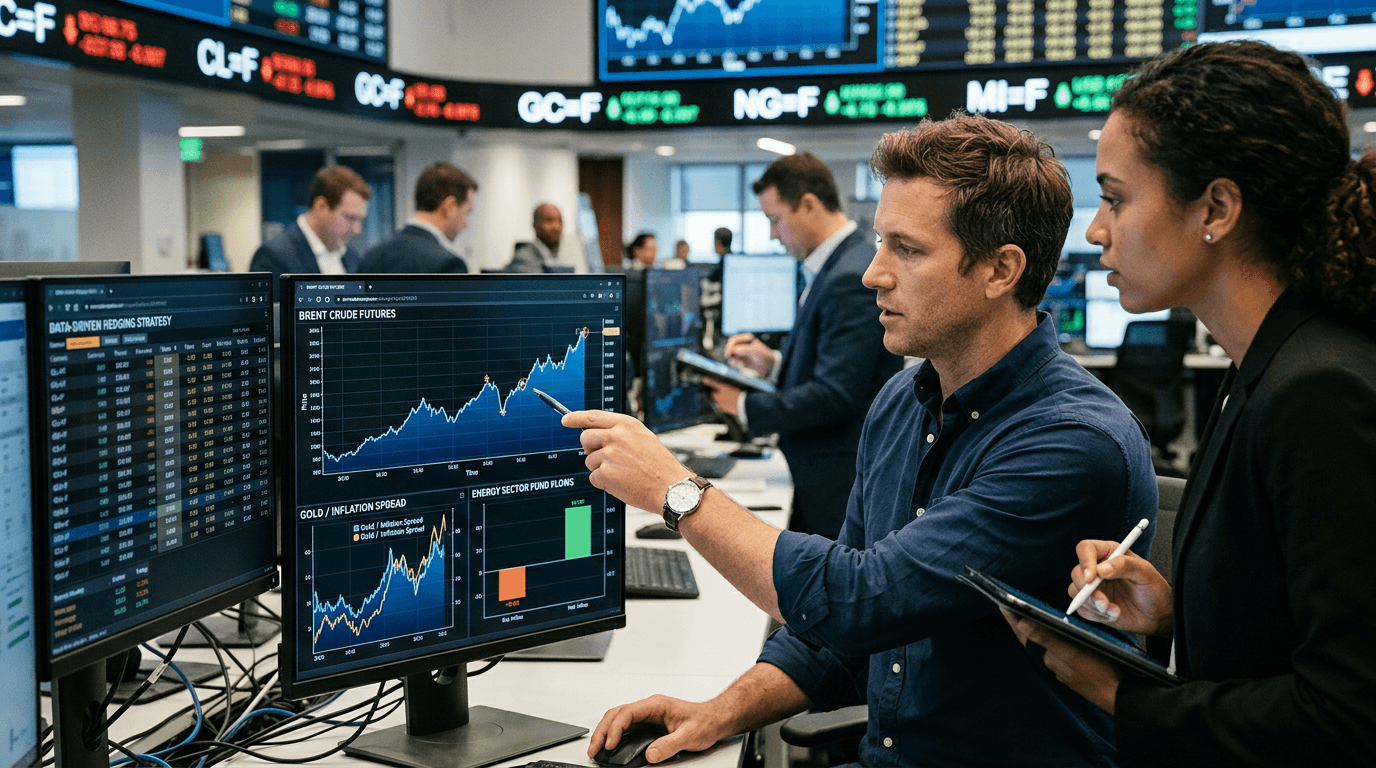
Brent crude moving toward the high-80s per barrel, alongside gains in gold, copper and soybeans, signals that inflation-hedge assets are back in focus and that markets are leaning into a mild reflation narrative.[14] For traders and investors, this backdrop reinforces the role of commodities and energy futures as tools to manage purchasing-power risk and portfolio volatility when price pressures resurface.
Current Market Signals
Today’s move higher in key benchmarks like Brent crude, gold, copper and soybeans is more than just another commodity rally; it reflects renewed demand for assets that tend to benefit when inflation expectations drift up.[14] Energy prices filter directly into transportation and heating costs, while metals and agricultural products shape the cost of manufactured goods and food.[12] As these inputs rise, investors often seek exposure via futures to offset potential real-return erosion in traditional bond and equity holdings.[8][14]
The tone is “mild reflationary” rather than outright inflationary, which matters for positioning.[14] Reflation implies expectations of firmer growth and slightly higher prices, a regime where cyclical assets like copper and energy can perform well without triggering aggressive policy tightening. In this environment, modest allocations to commodity and energy futures can serve both as tactical diversifiers and as insurance against a more persistent inflation surprise.[6][8]
Why Commodities And Energy Futures Matter For Inflation
Commodities are structurally linked to inflation because they are the raw materials embedded in consumer prices, from gasoline and electricity to food and electronics.[12][14] Historically, broad commodity futures indices have delivered positive real returns during periods of unexpected inflation, at times showing correlations with inflation in the 0.3–0.5 range depending on the basket and horizon.[3][8] This contrasts with stocks and bonds, which tend to suffer when inflation rises faster than anticipated.[6][8]
Energy stands out within the commodity complex. Research shows that energy, especially oil and refined products, has generated the strongest real returns among major assets when inflation surprises to the upside.[6][9] One analysis finds that a 1 percentage point inflation surprise has historically translated into an average real return gain of about 7 percentage points for commodities, compared with declines of 3–4 percentage points for stocks and bonds.[6] Another study highlights that energy is the only commodity aggregate that consistently provided an inflation hedge across multiple high-inflation periods over more than five decades.[10]
Part of the reason is mechanical. Oil prices feed directly into headline CPI, and a 10% increase in oil has been associated with roughly a 0.3–0.5% rise in headline inflation within three months, with effects persisting up to a year.[3][9] Futures allow market participants to manage that exposure: producers can lock in selling prices, consumers can hedge input costs, and investors can position for inflation trends without holding physical barrels.[12][14]
Hedging With Care: What The Data Actually Shows
Despite their intuitive appeal, commodities and energy futures are not a simple, one-size-fits-all inflation solution. Several academic studies find that the aggregate commodity futures market does not reliably hedge inflation across all regimes.[1][4][10] Over long samples, broad commodity baskets show only weak correlation with core inflation, and their hedging effectiveness varies significantly by sector and time horizon.[4][11][15]
Segment-level results are more nuanced. Industrial and precious metals often show stronger inflation-hedging characteristics than agriculture or livestock, particularly over multi-year horizons.[1][2][7] Energy stands out in some datasets as the most consistent hedge during high-inflation episodes, but even here the protection is imperfect and can come with substantial volatility.[2][10] One study estimates that an energy subsector futures index with a one-year horizon can reduce more than 40% of the real return variance of a nominal bond, thanks to a correlation with inflation around 0.66.[2]
Timing also matters. Research suggests commodities are most effective as hedges when used with a clear, short-term, in–out game plan tied to changes in inflation expectations.[15] Implementing commodity hedges after inflation expectations have already surged can turn them into expensive insurance that drags on returns.[15] For traders, this underscores the importance of monitoring macro data, central bank communication and market-based inflation indicators (such as breakeven rates) when deciding whether to add or reduce commodity and energy exposure.
Practical Takeaways For Traders And Investors
In practice, traders and portfolio managers tend to use commodities and energy futures in a few distinct ways.[12][14]
1. Tactical inflation overlay: Adding a modest allocation to energy, metals and agriculture futures when inflation risks are rising can help cushion portfolios dominated by nominal bonds and growth stocks.[6][8][14]
2. Sector-specific hedges: Companies with heavy exposure to fuel, metals or agricultural inputs can hedge directly in the corresponding futures markets, aligning hedge sizes with projected consumption.[12]
3. Horizon-aware strategies: Evidence indicates that commodity futures’ inflation-hedging properties improve at longer horizons, while short-term moves can be dominated by idiosyncratic supply–demand shocks.[2][8] Traders should match hedge tenors to their risk window rather than chasing every price swing.
4. Diversified baskets, not single bets: Because no single commodity perfectly tracks inflation, many investors prefer diversified indices or carefully constructed baskets that combine energy, industrial metals and, in some cases, precious metals.[2][3][10]
Risk management is central. Commodity futures are leveraged instruments, and mark-to-market volatility can be significant even when the long-run inflation thesis is intact.[8][10] Portfolio-level constraints, scenario analysis and stress testing under different inflation paths help ensure that hedges do not inadvertently amplify overall risk.
Testing Strategies In A Simulated Finance Environment
Given the complexity and mixed empirical evidence around commodities as inflation hedges, a simulated trading environment offers a powerful way to learn before committing capital. In a Simulated Finance platform like E8 Markets, traders can design and test commodity and energy futures strategies that reflect the current backdrop of firm prices and mild reflation without real-money risk.
For example, a user might construct a hypothetical portfolio that pairs long energy futures with shorter-duration bonds, then run scenarios where oil moves from the high-80s into triple digits and core inflation remains sticky. Another user might compare a metals-heavy basket (gold and copper) against an energy-focused basket as an overlay on an equity portfolio, evaluating which allocation better stabilizes real returns under different inflation shocks.
Simulated environments allow traders to experiment with position sizing, margin management, roll strategies, and diversification across sectors such as energy, industrial metals and agriculture. They can observe how hedges behave during both inflation surprises and periods of disinflation, building an evidence-based understanding of when commodity and energy futures genuinely add value and when they simply add volatility. Over time, this practice can lead to more disciplined live trading decisions and a clearer role for commodities within an overall inflation risk framework.
Conclusion
Firm commodities and energy futures prices, led by Brent crude in the high-80s, are reinforcing the market’s reliance on real assets as tools to navigate evolving inflation dynamics.[9][14] The data show that while energy and certain metals can provide meaningful protection against inflation shocks, broad commodity exposure is not a guaranteed hedge and requires careful timing, sizing and diversification.[1][2][10][15] For traders and investors, the priority is to treat commodities and energy futures as part of a broader inflation strategy—tested, refined and stress-checked in environments like SimFi—rather than as a standalone cure-all. In doing so, they can turn today’s reflationary signals into structured, risk-aware opportunities rather than reactive bets.