
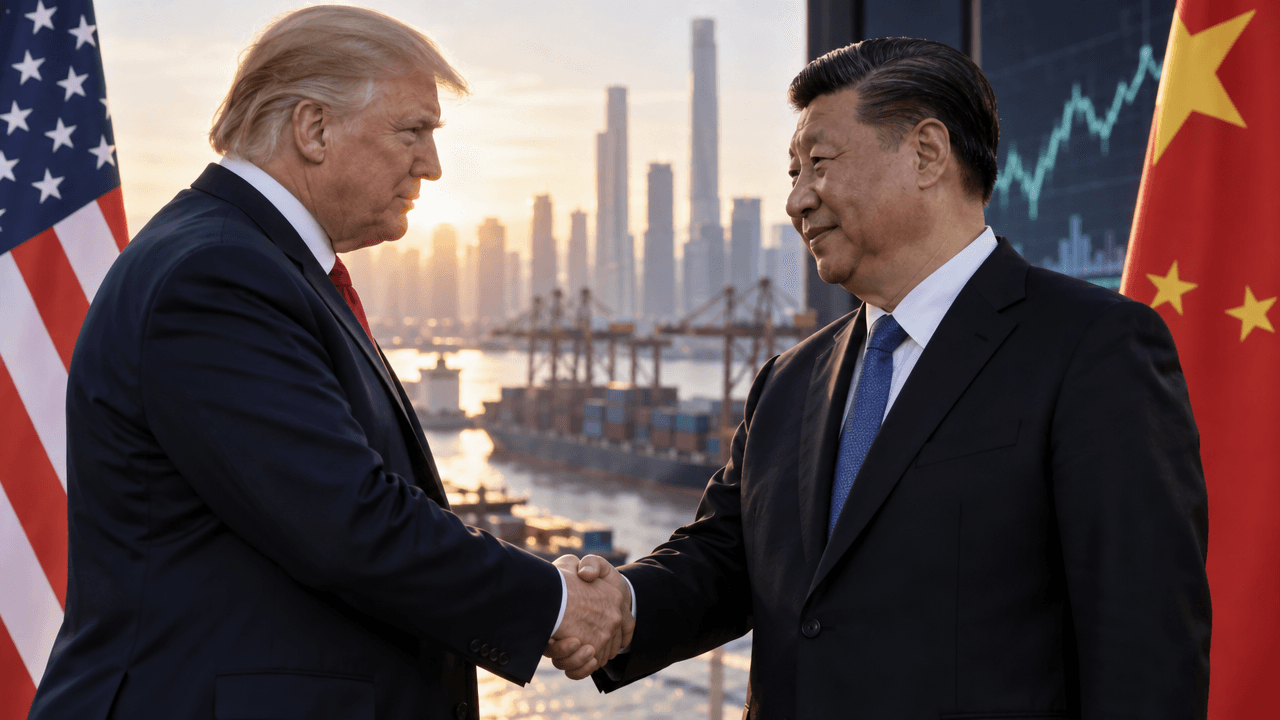
Plans for another Trump–Xi encounter in November, on top of this week’s summit in Washington, are sending a subtle but important risk-on signal through global markets.[6][13] Investors care less about the pageantry than about the fact that the US and China are committing to repeated, structured dialogue after years of tariff brinkmanship and technology sanctions.[8][11][13] While expectations for a sweeping deal remain modest and policy details are thin, the simple prospect of continuity and communication lowers the probability of a sudden breakdown—enough to tilt sentiment toward risk assets.
Geopolitical Risk-on: What The Meeting Plans Really Signal
In market language, “risk-on” describes periods when investors are more willing to hold equities, high-yield credit, and cyclical commodities, and less inclined to pay up for safe-haven assets such as US Treasuries, gold, or the Japanese yen. Trump’s decision to host Xi in Washington, combined with indications that the two leaders will meet again at Asia-Pacific and G20 gatherings later in the year, effectively anchors a diplomatic timetable for the rest of 2026.[6][11][13] That timetable matters because it reduces the odds of unilateral tariff hikes or sanctions surprises between now and the expiry of the current trade truce in early November.[9]
The last several summits have emphasized “managing” the relationship rather than striking a comprehensive trade deal, with US officials signaling interest in targeted tariff reductions and sector-specific agreements.[8][11] From a market perspective, that is still constructive: it suggests incremental progress instead of escalation, and it keeps channels open for deals on agriculture, technology access, or rare earth supplies.[9][11][15] Trump’s historically upbeat tone after interactions with Xi—including phone calls about accelerating Chinese purchases of US goods and earlier meetings he rated “12 out of 10”—adds to the perception that both sides want at least a stable, predictable framework.[10][12]
For traders, the key is not assuming a breakthrough, but recognizing that repeated summits and extensions of the truce reduce tail risks. When the worst-case scenario (a sudden collapse into tariff warfare) feels less imminent, capital tends to rotate out of defensive positioning and back into assets that benefit from growth and trade.
How Equities And Commodity Futures May React
Equity markets have already shown how sensitive they are to US–China headlines. Ahead of the current summit, Asian indices traded mixed: some gains earlier in the week gave way to cautious consolidation as investors waited for concrete outcomes.[4][14] In the US, stocks finished the day of the Trump–Xi meeting with a mixed but resilient tone, with at least one major index reversing intraday losses after news of a trade truce extension.[2][3][7] This pattern—early optimism, mid-meeting hesitation, and post-event relief when dialogue continues—is typical of geopolitically driven risk-on phases.
If November’s meeting goes ahead and extends or deepens the trade truce, the sectors most likely to benefit are globally exposed cyclicals: industrials, semiconductors, consumer discretionary, and logistics firms tied to cross-border supply chains.[5][8][9] Chinese equities linked to exports, rare earths, and AI-related hardware could see renewed interest if tariffs remain capped or are partially rolled back.[9][11] For index futures traders, that translates into potential upside bias in benchmarks such as US large-cap indices and China-sensitive regional indices, albeit with episodes of volatility around each headline.[7][15]
Commodity futures are another key channel. A stable US–China relationship supports visibility on manufacturing demand, which is constructive for industrial metals and energy.[5][9] If China’s “trade engine” remains strong and the US refrains from new tariff shocks, traders may lean into cyclical commodities rather than purely defensive plays.[5][9] However, as the recent sell-off in global bonds and rise in oil prices on inflation concerns show, Trump–Xi optimism does not erase other macro risks; instead, it interacts with them, sometimes amplifying volatility.[14]
Implications For Safe-haven Fx, Rates And Volatility
Geopolitical risk-on typically weighs on safe-haven currencies such as the US dollar, Japanese yen, and Swiss franc, especially when equity and commodity markets are firm. If investors infer from repeated Trump–Xi meetings that the probability of new trade shocks has fallen, they may be less inclined to hold large defensive FX positions against the yuan or China-sensitive currencies in Asia.[6][8][9] At the same time, any perception that US–China coordination could underpin growth or supply-chain stability can push bond yields higher, as seen in global fixed income markets where inflation and geopolitical dynamics have driven renewed selling.[14]
Options markets will likely price this series of summits as discrete event risks. Ahead of the current Washington visit, analysts framed the meeting as “high-stakes” and warned traders to brace for significant volatility if talks surprise either positively or negatively.[15] Implied volatility in equity indices, key FX pairs, and select commodities often rises into such events, then compresses if the outcome matches expectations—extensions rather than breakthroughs.[5][7][15] The announced intention to meet again in November therefore has a dual effect: it can calm medium-term fears while ensuring that short-term event risk premia periodically reappear around each gathering.
For portfolio builders, the message is nuanced. A risk-on signal does not mean abandoning hedges; instead, it suggests tilting from outright defensive positioning toward balanced exposure that can participate in upside while retaining protection against policy missteps or unrelated shocks, such as Middle East tensions or inflation surprises.[14][15]
How Traders Can Position Using Simulated Finance
For E8 Markets participants operating in a Simulated Finance environment, the Trump–Xi calendar is an ideal case study in geopolitically driven regime shifts. SimFi allows traders to model scenarios without capital at risk, making it a powerful tool for testing how portfolios might react to each iteration of US–China negotiations.
Practical steps for simulated trading include designing at least three macro scenarios: continued truce and constructive November meeting; disappointing November talks with renewed tariff threats; and a “headline whipsaw” environment where rhetoric swings but policy remains largely unchanged. In each scenario, traders can adjust exposure to US and Asian equity index futures, commodity contracts tied to global trade, and FX pairs involving the yuan and traditional safe havens. Position sizing, stop placement, and diversification rules can be stress-tested around event dates to see how different risk frameworks perform under sudden volatility spikes.
Because expectations for major breakthroughs are low and policy communication remains vague, simulated strategies should emphasize flexibility over conviction.[5][11][13] For example, traders might explore conditional strategies that lean risk-on but automatically reduce exposure if volatility jumps beyond predefined thresholds around summit headlines. Over time, this practice builds discipline and a data-driven understanding of how geopolitics maps into price action.
Conclusion And Key Takeaways
The prospect of repeated Trump–Xi meetings, including a planned November encounter, sends a genuine but measured risk-on signal: it lowers the odds of abrupt US–China escalation and supports a constructive backdrop for equities and cyclical commodities, while tempering demand for safe havens.[6][8][9] At the same time, modest expectations and limited policy clarity mean markets will remain headline-sensitive, with volatility likely to flare around each summit rather than disappear altogether.[5][11][15]
For traders—especially those using SimFi platforms—the opportunity lies in treating geopolitics as a structured source of scenarios rather than unpredictable noise. By mapping out possible paths for trade truce extensions, tariff tweaks, and sector-specific agreements, traders can build portfolios that participate in risk-on phases but remain resilient when negotiations disappoint. In a world where diplomacy and markets are increasingly intertwined, the Trump–Xi calendar is not just a political story; it is a live laboratory for disciplined, scenario-based trading.