
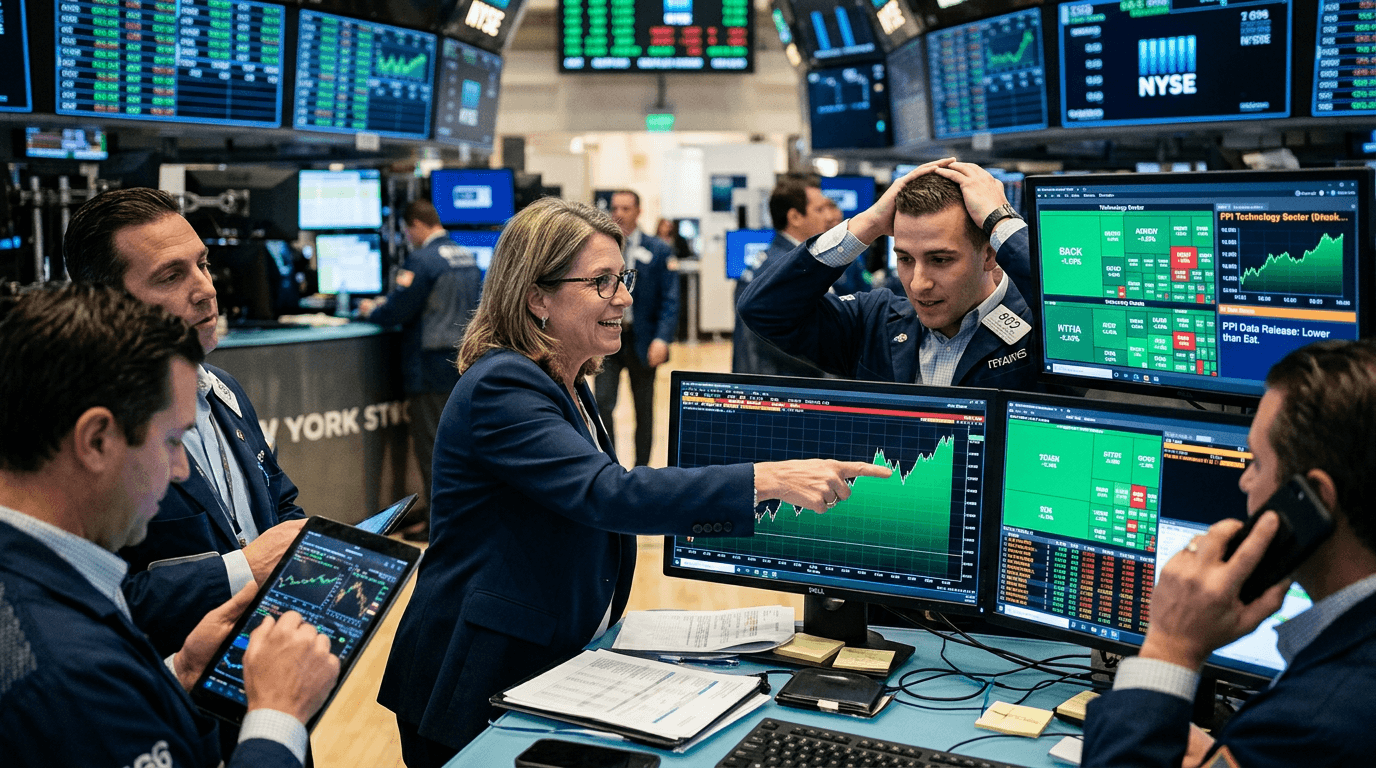
A cooler inflation and jobs backdrop has given U.S. equities fresh momentum, as investors dial back expectations for additional Federal Reserve rate hikes. Softer consumer price data and weaker-than-expected payrolls have pushed down Treasury yields, helping the S&P 500 and Nasdaq extend gains and lifting index futures in early trading. With rate-hike probabilities slipping and markets reassessing the path of policy, sentiment across risk assets—from large-cap tech to crypto—has turned notably more constructive.[7][10][11][12]
Macro Backdrop: Why Rate-hike Fears Just Eased
The latest leg of the rally has been driven by a combination of cooling inflation and softer labor data, both of which reduce pressure on the Fed to tighten further. A recent CPI report showed annual inflation slowing to about 3.5%, below economist forecasts, easing worries that renewed price pressures would force policy makers into additional hikes.[10] On the labor side, jobs growth came in weaker than expected and prior months were revised down, reinforcing the view that demand is normalizing rather than overheating.[7][8]
These data points matter because the Fed has been explicit that its decisions are “data-dependent.” When inflation surprises on the downside and hiring cools without collapsing, markets infer that policy is restrictive enough and that the bar for new hikes has risen. Fed funds futures—derivative contracts that reflect expectations for the policy rate—react quickly to such information. In this case, the implied probability of a near-term hike dropped sharply, from roughly 40–50% down to the high teens in some measures.[10][11]
As rate-hike odds fall, long-term yields tend to follow. That’s exactly what we’ve seen, with Treasury yields edging lower as investors price in a more stable rate path.[7][8] Lower yields reduce the discount rate applied to future cash flows, which mechanically supports higher valuations for equities, particularly in growth segments where much of the value comes from cash flows far in the future.
How Rate Expectations Feed Directly Into Index Futures
Index futures such as E-mini S&P 500 and Nasdaq futures are often the first place the market expresses new macro views. When traders conclude that additional hikes are less likely, they adjust positions in these contracts to reflect higher expected equity prices and lower volatility. Recently, S&P futures have edged higher—up around 0.1%—while Nasdaq futures gained closer to 0.4% amid the shift in rate expectations.[12]
Mechanically, index futures reflect the expected future level of the underlying index plus the impact of interest rates and dividends over the contract’s life. When policy rates are expected to stay lower for longer, the “cost of carry” declines. All else equal, that can support richer pricing for futures relative to spot. At the same time, lower discount rates improve the theoretical fair value of growth-heavy indices like the Nasdaq, which is one reason we often see tech futures outperform in periods of easing rate anxiety.[2][11]
For active traders, this linkage between macro data, rate expectations, and futures prices is crucial. A softer CPI print or jobs report can shift Fed probabilities in minutes, and that repricing is often visible first in rates markets, then in equity index futures, and only later in the broader cash equity market. Learning to read that sequence is a core skill for both real-money and simulated finance (SimFi) participants.
Sector Rotation And High-beta Ripple Effects
The easing in rate fears has not supported all sectors equally. Technology and consumer discretionary names—classic “high-duration” assets whose valuations are more sensitive to discount rates—have led recent gains.[2][7][11] The Nasdaq, with its concentration in tech and growth, has typically outperformed the Dow and broader S&P 500 in these windows, reflecting investors’ renewed appetite for future-oriented earnings streams.[2][10][11]
High-beta assets beyond equities also respond in similar fashion. Crypto and speculative growth names often trade as leveraged plays on liquidity and risk appetite; when markets believe the Fed is less likely to tighten, volatility tends to compress and investors are more willing to move out the risk spectrum. That doesn’t mean fundamentals no longer matter, but it does mean the macro backdrop becomes a tailwind rather than a headwind.
Defensive sectors—utilities, staples, some healthcare—can still participate but often lag during these “relief rallies,” as investors rotate toward cyclicals and growth beneficiaries of a more benign rate outlook. For portfolio builders, recognizing when the market is shifting from a “rates fear” regime into a “risk-on” regime is essential to tilting exposures appropriately.
Implications For Simulated Traders And Index Strategies
For traders using platforms like E8 Markets, this environment is a live case study in macro-driven positioning. SimFi allows market participants to test how their strategies perform when the main narrative swings from “the Fed might hike again” to “the Fed can stay on hold.” It’s an opportunity to explore several key questions:
- How quickly do index futures react to surprise data versus individual stocks?
- Which sectors or styles—growth vs. value, large cap vs. small cap—lead or lag after rate expectations shift?
- How does implied volatility in options respond when rate-hike probabilities decline?
One practical approach is to build and test playbooks around major economic releases: CPI, nonfarm payrolls, and Fed meetings. For instance, a trader might simulate scenarios where inflation prints 0.3 percentage points below consensus versus 0.3 points above, then observe how S&P and Nasdaq futures, yields, and sector ETFs respond. Over time, this helps refine reaction functions—rules for how to adjust exposure when the macro data deviate from expectations.
Another useful exercise is stress-testing strategies against a renewed spike in rate fears. While the current move is supportive, prior episodes have shown that markets can quickly reverse if inflation or wage data reaccelerate.[15][16] Simulated environments are ideal for rehearsing those reversals without capital at risk.
Key Risks And What To Watch Next
Despite the upbeat tone, the rally rests on a conditional story: that inflation continues to cool and the labor market slows without breaking. Any upside surprise in future CPI prints, wage growth, or inflation expectations could reawaken rate-hike concerns and push yields higher again.[15][16] Similarly, a sudden re-acceleration in jobs growth might raise questions about whether policy is truly restrictive.
Traders should keep an eye on
- Upcoming inflation data: Core measures and services inflation are especially important.
- Fed communications: Speeches that emphasize “higher for longer” could challenge the current narrative, even without immediate hikes.
- Market-based indicators: Fed funds futures, the yield curve, and credit spreads all provide timely signals of how investors are repricing risk.
For now, the easing in rate-hike fears has delivered a clear boost to U.S. stocks, index futures, and broader risk sentiment. For both traditional and simulated traders, it’s a timely reminder that in modern markets, macro data and central bank expectations remain powerful drivers of price action—and that understanding this chain is essential to navigating the next move.