
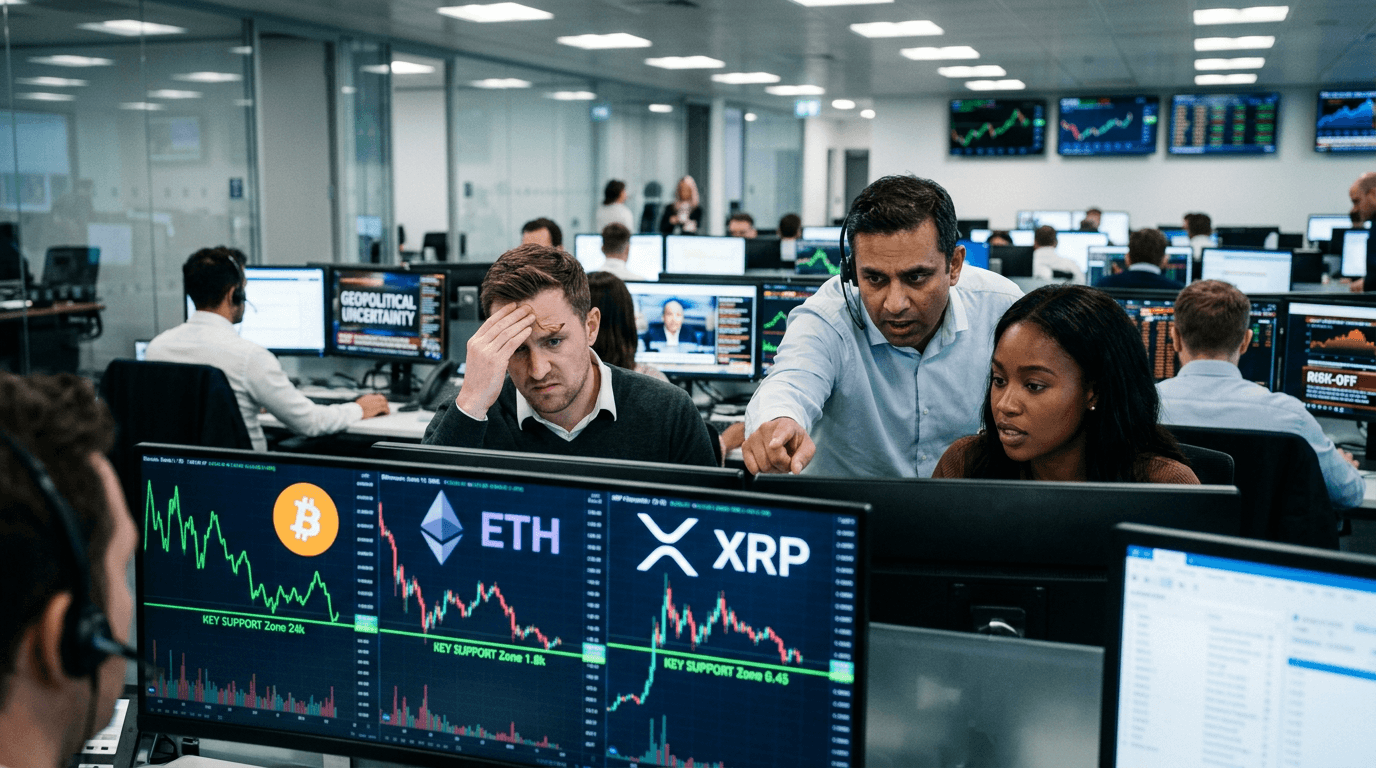
The crypto market is navigating a delicate balance: prices have pulled back, volatility has risen, yet Bitcoin, Ethereum and XRP are still defending key support zones even as geopolitical risks and macro uncertainty dominate headlines.[3][4] This combination of resilient price structures and fragile sentiment is creating a tense waiting game for traders, where the next big move may be driven as much by news flow as by charts.[3]
Market Backdrop: Crypto At Key Support
After a strong run-up earlier in the year, major cryptocurrencies have cooled, with recent sessions marked by cautious trading and modest declines rather than outright panic.[3][4] FXStreet notes that Bitcoin remains supported in the low-$70,000 region after recent losses, while Ethereum and XRP have also stabilized near important technical levels.[3][4] The tone is one of consolidation rather than capitulation, but markets remain highly sensitive to geopolitical developments and shifts in risk appetite.[3]
This environment is typical when global tensions rise: some investors trim risk across the board, while longer-term participants step in to buy dips at well-defined support zones. A softening US dollar can offer short-term relief to crypto markets by easing pressure on dollar-denominated assets, but persistent risk-off flows can offset that support if investors move aggressively into cash or government bonds instead.[3][4] As a result, the same headlines that pressure equities and commodities can quickly spill over into Bitcoin and altcoins.
The bigger picture is that crypto is no longer a niche asset class trading in its own bubble. Bitcoin and Ethereum, in particular, are increasingly woven into global macro positioning, meaning shifts in interest rates, currency markets and geopolitical risk now translate more directly into crypto volatility.[3][4] That interconnectedness is both an opportunity and a source of vulnerability.
Bitcoin: Psychological Levels And Macro Crosscurrents
Bitcoin’s ability to hold above key support in the low-$70,000 area is crucial for keeping the broader bullish structure intact.[3][4] This region carries both psychological significance and technical importance, having served as a recent consolidation zone where buyers previously absorbed selling pressure.[1] If this band were to fail decisively, the door could open to a deeper corrective phase as leveraged long positions unwind and sentiment turns more defensive.[1]
For now, though, the market is treating this area as a line in the sand. Each test of support offers information: firm rebounds with rising volume suggest strong dip demand, while shallow bounces and lower highs can be an early warning that buyers are losing conviction. Traders are watching for confirmation from other risk assets too; for example, a simultaneous rebound in equities and weaker dollar could validate a constructive outlook for Bitcoin.[3][4]
Macro factors remain a key driver. Elevated geopolitical tension tends to increase demand for safe-haven assets like the US dollar and government bonds, which can pressure Bitcoin in the short run if global liquidity tightens.[3][4] On the other hand, Bitcoin’s longer-term narrative as a hedge against monetary debasement and geopolitical instability can attract strategic buyers on larger pullbacks, especially institutional players seeking diversification.
Ethereum And Xrp: Different Structures, Same Headline Risk
Ethereum is also stabilizing after a pullback, with price action holding above an important support region around the low-$2,000s.[1][4] FXStreet highlights that Ethereum has recently defended the area near $2,100, a zone that has acted as both support and resistance in prior cycles.[4] On higher timeframes, ETH trades within an upward-sloping channel, but technicians warn that a break below February’s low could complete a bear-flag pattern with downside potential toward roughly $1,270–$1,350.[1]
This makes Ethereum particularly sensitive to a combination of negative headlines and technical breaks. A sudden escalation in geopolitical tensions or a sharp risk-off move in global markets could push ETH through those key levels, triggering algorithmic and stop-loss selling.[1][4] Conversely, if support holds and macro conditions stabilize, the setup leaves room for a move back toward major resistance zones higher up the chart.
XRP’s structure looks different but tells a similar story of cautious optimism. The token remains range-bound, with notable support near the lower band of its trading range and resistance toward the upper band.[1][2] Recent analysis shows XRP consolidating in a relatively tight zone compared with Bitcoin and Ethereum, reflecting trader hesitation and a “wait-and-see” stance as markets digest geopolitical risk.[1][2] This compressed range can precede either a sharp breakout or a breakdown, depending on whether risk sentiment improves or deteriorates.
Despite the near-term uncertainty, underlying adoption trends for the broader market remain constructive. On-chain data over the past year show that both Bitcoin and Ethereum continue to add non-empty addresses, indicating ongoing network growth even through periods of elevated volatility.[8] That structural demand does not eliminate downside risk, but it provides a fundamental backdrop that can support recovery once macro conditions improve.
What Geopolitical Risk Really Means For Crypto
Geopolitical risk is not just a headline; it affects crypto via several concrete channels. First, it influences global risk appetite: conflicts, sanctions and political standoffs can push investors into “de-risk” mode, reducing exposure to volatile assets, including cryptocurrencies.[3][4] Second, it often strengthens the US dollar and increases demand for safe-haven assets, tightening financial conditions and making leveraged crypto positions more vulnerable to liquidation.[3]
Third, geopolitical events can impact regulation and capital flows. Discussions around sanctions, cross-border payments and financial surveillance sometimes bring crypto into the policy spotlight, which can generate both uncertainty and opportunity depending on the narrative. Finally, volatility in traditional markets can spill over into crypto as traders rebalance portfolios and hedge exposures across asset classes.
For active traders, this means charts cannot be viewed in isolation. Technical levels on Bitcoin, Ethereum and XRP may hold or fail depending on the timing and intensity of geopolitical headlines. A strong technical setup can quickly be invalidated by unexpected news, while panic-driven selloffs can overshoot support and later reverse once the news is fully priced in.
Practical Takeaways For Traders
In a market where Bitcoin, Ethereum and XRP are holding key support but trading under the shadow of geopolitical risk, risk management becomes as important as trade selection. Rather than predicting the next headline, traders can focus on building processes that account for uncertainty.
Define your levels: Identify the key support and resistance zones on BTC, ETH and XRP that matter for your timeframe, and build your plan around them instead of reacting emotionally to every price swing.[1][4]
Size for volatility: When geopolitical risk is high, volatility can spike without warning. Position sizes that felt comfortable in calmer markets may be excessive now, especially for leveraged traders.
Use clear invalidation: Stop-loss levels should be anchored to technical structures, not arbitrary dollar amounts. If a support zone breaks convincingly, accept the signal rather than hoping for an immediate rebound.
Monitor macro and news flow: Track developments in the dollar, yields and equity indices alongside crypto prices, and stay aware of major geopolitical events that can trigger cross-asset moves.[3][4]
Practice in low-stakes environments: Simulated trading and structured backtesting can help refine strategies for headline-driven markets, allowing you to stress-test your approach before deploying significant capital.
Ultimately, the current setup in Bitcoin, Ethereum and XRP underscores a simple but powerful reality: markets can be both structurally bullish and tactically fragile at the same time. Key support levels are holding, but they are doing so in an environment where news can move prices quickly and sometimes irrationally. Traders who respect both the technicals and the macro backdrop—and who manage risk with discipline—will be best positioned to navigate whatever the next round of geopolitical headlines brings.