
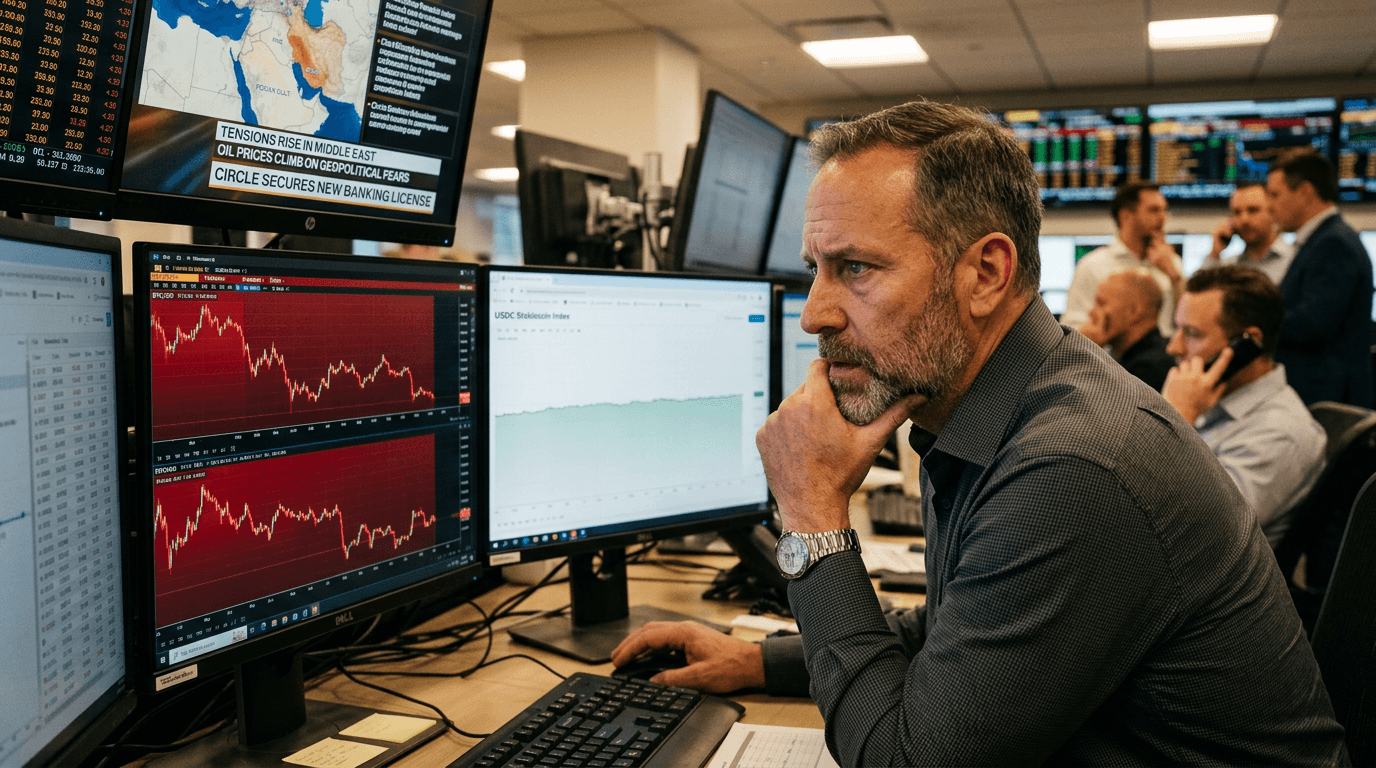
Crypto markets are treading cautiously after a sharp 2% pullback, with Bitcoin, Ethereum and XRP hovering above key support levels while traders reassess risk amid the ongoing US–Iran conflict and shifting regulatory signals.[6][10][8] The combination of war-driven risk aversion and a major regulatory win for stablecoin issuer Circle has produced a split market tone: defensive in major coins, constructive in regulated infrastructure and tokenization plays.[10][5][8]
Geopolitics And Risk Appetite
The US–Iran war has become a key overhang for global risk assets, amplifying volatility across energy, equities and digital assets as investors attempt to price in both immediate disruption and longer‑term geopolitical realignment.[1][10] In environments like this, traders often gravitate toward liquid benchmark assets such as Bitcoin and, in traditional markets, major FX and rates, but they do so with tighter risk limits and shorter holding periods.
Historically, crypto has shown periods of “safe‑haven” behavior, but the current backdrop is more nuanced: macro funds and institutional allocators are treating the conflict as a reason to reduce overall risk exposures rather than to add aggressive directional bets in high‑beta sectors.[10] That translates into subdued spot volumes, more conservative position sizing and a heightened focus on options strategies that cap downside while preserving upside participation.
For active traders, the key takeaway is that geopolitics rarely operates on the same timescale as technical setups. News flow around the conflict can change intraday, but the broader risk regime often persists for weeks, which is why combining macro scenario planning with intraday technical levels is essential when volatility is driven by headlines rather than fundamentals.
Technical Picture For Bitcoin, Ethereum And Xrp
Bitcoin, Ethereum and XRP have all faded around 2% from recent highs and are now clustering just above widely watched support zones, a pattern that often signals markets are in “wait‑and‑see” mode rather than in full risk‑off capitulation.[6][3][9] In such phases, price tends to respect key levels, but rallies stall quickly as participants use strength to lighten exposure.
For XRP, the psychological $1.00 level, a broader $1.11–$1.20 support band, and the 200‑day moving average near $1.12 have emerged as critical markers that traders use to track whether the current pullback remains a healthy consolidation or risks turning into a trend reversal.[6][9][12] A clean break and close below these areas would typically signal a shift from “defensive long” behavior into outright de‑risking.
When major coins trade defensively near support, simulated and live traders can adopt a few practical tactics. First, treat support as a decision zone rather than a guaranteed bounce point: define beforehand whether a test of support will be a place to add, to reduce, or to flip short. Second, monitor the correlation between crypto and macro proxies such as oil or equity indices; in war‑driven markets, breakdowns in correlation often provide early signals that one asset class is starting to lead sentiment rather than simply follow it.
Regulatory Tailwinds For Stablecoins And Tokenization
While war headlines are weighing on broad risk appetite, regulatory developments are quietly reshaping the medium‑term narrative for stablecoins and real‑world asset (RWA) tokenization. Circle has received final approval from the US Office of the Comptroller of the Currency (OCC) to establish Circle National Trust, a federally supervised national trust bank that will initially provide fiduciary digital asset custody and may later manage USDC reserves under direct oversight.[2][5][8] This approval aligns USDC more closely with traditional banking standards and strengthens its positioning as a regulated “digital dollar” for payments and capital markets activity.[5][8][11]
The news triggered a sharp reaction in Circle’s shares, which spiked over 16% intraday before settling to a single‑digit gain, underlining how investors are pricing a premium on regulated stablecoin infrastructure.[5][7][14] Market participants have interpreted the move as a signal that US regulators are willing to work with well‑capitalized firms to bring systemically important stablecoins into the banking perimeter, rather than pushing them to the fringes.
For crypto markets, this matters in three ways. First, stronger regulatory footing for USDC can reduce perceived counterparty risk for institutions using stablecoins as collateral, settlement or liquidity tools. Second, a bank‑chartered stablecoin issuer is likely to accelerate tokenization of traditional assets—from treasuries to credit—because custodial and reserve operations sit under familiar federal supervision.[2][5][8] Third, this can catalyze relative‑value rotation: traders may increasingly favor regulated stablecoin and RWA plays over unregulated high‑beta tokens when macro uncertainty is elevated.
In practice, that means sentiment can be bearish in headline coins while simultaneously bullish in selected infrastructure names and tokenization projects, creating a more segmented market than retail traders are used to seeing.
HOW TRADERS CAN NAVIGATE A SPLIT‑TONE MARKET
A market defined by geopolitical drag and regulatory optimism demands more nuance than simple “bullish vs bearish” labels. For discretionary traders, a useful framework is to separate the crypto universe into three buckets: benchmark layer‑1s (Bitcoin, Ethereum), higher‑beta altcoins (including XRP), and regulated infrastructure/tokennization plays.
In the benchmark bucket, the priority is capital preservation and liquidity. That typically means trading around support and resistance with clear invalidation levels, using tighter stops and smaller size when news risk is high. In the altcoin bucket, where beta is greater, traders may want to reduce leverage or focus on relative‑value pairs (for example, XRP vs Bitcoin) that hedge market‑wide shocks.
The regulated infrastructure bucket—where Circle and similar firms sit—lends itself more to thematic positioning and longer holding periods. Regulatory milestones like an OCC trust bank charter can act as multi‑month catalysts, especially if they open pathways to institutional adoption or new product lines such as on‑chain treasuries and tokenized credit.[2][5][8] For simulated traders, this is an ideal space to test “macro + regulation” theses: for instance, how a war‑driven risk‑off episode interacts with a structurally improving backdrop for tokenized RWAs.
Simulated Finance Takeaways
For SimFi participants and E8‑style traders, the current environment is rich with scenarios to model and stress‑test:
1) War shock scenarios: simulate sudden escalations or de‑escalations in the US–Iran conflict and observe how Bitcoin, Ethereum and XRP behave around their support zones under different volatility regimes.[6][10]
2) Regulation surprise scenarios: model additional regulatory approvals or setbacks for stablecoin issuers and tokenization platforms, then map likely rotations between benchmark coins, infrastructure tokens and RWAs.[2][5][8]
3) Cross‑asset contagion tests: link crypto positions to synthetic equity, energy or FX exposures to better understand how multi‑asset portfolios respond when geopolitical headlines hit one market first and then spill over.[1][10]
By rehearsing these scenarios in a simulated environment, traders develop playbooks for entries, exits and risk controls that can be deployed more confidently in live markets, where slippage, emotions and execution risk complicate decision‑making.
Conclusion
Crypto markets today reflect a complex blend of caution and conviction: caution driven by a live US–Iran conflict that suppresses broad risk appetite, and conviction expressed through strong market reception to Circle’s OCC‑approved trust bank and the broader regulated stablecoin narrative.[10][5][8] For traders, the message is clear. Geopolitics may dictate the short‑term tone, but regulation and infrastructure will increasingly shape the medium‑term path of digital assets.
Navigating this landscape requires more than directional calls; it demands structured scenario analysis, disciplined risk management around key technical levels, and an appreciation of how regulation can change the relative value map within crypto. Simulated finance platforms offer a powerful laboratory for building those skills before capital is truly at risk, turning today’s cautious market into an opportunity to refine strategy rather than retreat from it.