
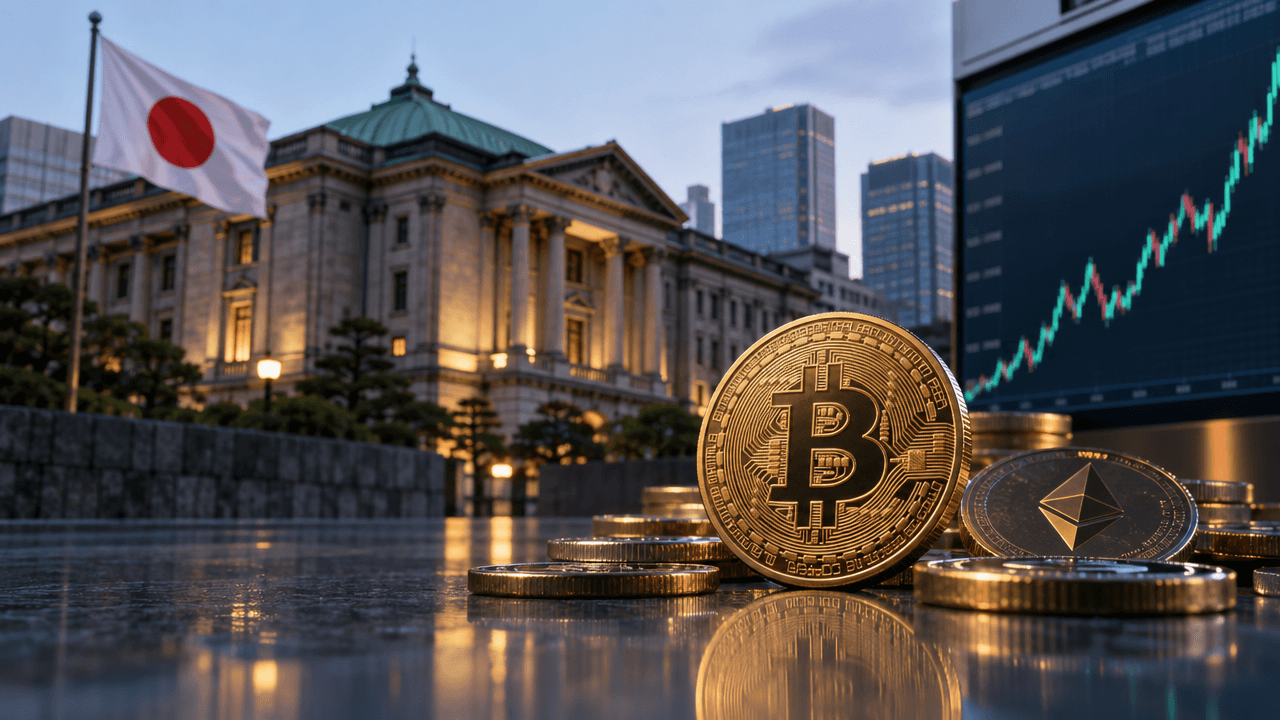
Crypto markets have treated the Bank of Japan’s latest rate hike as a signal of policy normalization rather than a warning of imminent stress, allowing major tokens to hold a constructive tone despite choppy intraday price action.[2][5][8] By framing the move as part of a broader global shift away from ultra-easy money, investors have so far maintained supportive risk sentiment instead of rushing to de‑risk portfolios.[2][10][14]
GLOBAL CONTEXT: BOJ’S SHIFT TO TIGHTENING
The Bank of Japan raised its key short‑term rate by 25 basis points to around 1.25%, up from 1.0%, taking borrowing costs to their highest level in roughly 31 years.[2][5][8] The decision was carried by a 7–2 vote on the policy board, underlining that while normalization is underway, there is still internal debate about the pace of tightening.[2][11][15] At around 1.25%, the policy rate now sits within the lower end of the BOJ’s estimated “neutral rate” range, where policy is viewed as neither strongly stimulative nor restrictive for growth.[2][4][14]
This shift is motivated by persistent inflation pressures and rising wages, with policymakers increasingly focused on preventing inflation from overshooting the 2% target rather than fighting deflation.[1][2][11] Japan’s central bank joins the Federal Reserve and European Central Bank in moving away from emergency-era settings, reinforcing the sense that the global monetary backdrop is transitioning from ultra‑loose to moderately tight but still manageable.[2][7][10] For risk assets, including crypto, this distinction between aggressive shock tightening and steady normalization is critical in shaping sentiment.
Why Crypto Reacted Constructively
For crypto traders, the key insight is that markets were prepared for this move, and expectations were well telegraphed.[2][10][13] When central banks deliver in‑line decisions, even if they are hikes, the reduction in policy uncertainty can support risk assets because it removes the fear of a surprise or a disorderly reaction.[2][12][14] In this case, the BOJ’s 1.25% rate was widely anticipated, and the message that future hikes would be gradual helped investors interpret the shift as a reflection of resilient economic conditions rather than a crisis response.[2][10][15]
That backdrop allowed crypto to lean into the “normalization” narrative: higher rates driven by stable growth and controlled inflation are less threatening than emergency tightening driven by runaway prices or financial stress.[1][2][11] As a result, major tokens initially reacted positively, with supportive risk sentiment showing up in flows into large‑cap coins and continued interest in higher‑beta names, even as intraday volatility remained elevated. From a behavioral standpoint, this is a textbook example of how expectations management by central banks can cushion the impact of policy tightening on speculative assets.
Implications For Risk Sentiment And Flows
Supportive risk sentiment does not mean risk‑free conditions; it means investors are willing to stay engaged while being more selective and tactical. Crypto traders now have to price in a world where carry trades and global liquidity conditions gradually adjust to higher rates in Japan, adding another layer to cross‑asset correlations.[2][5][14] The BOJ’s move may reduce some of the incentive for Japanese investors to seek yield exclusively abroad, potentially influencing flows into foreign bonds, equities, and, at the margin, crypto.
However, because the new rate still sits close to estimates of a neutral stance, the policy remains far from outright restrictive.[2][4][14] This helps explain why risk sentiment has not flipped into full risk‑off mode and why crypto has been able to digest the news without a sustained drawdown. The lesson is that the level and trajectory of rates both matter: modest hikes that keep policy near neutral tend to be less damaging to risk assets than sharp moves into clearly restrictive territory.
What Simulated Finance Traders Can Learn
For traders using simulated finance platforms like E8 Markets, the BOJ decision is an excellent case study in macro‑driven market behavior. It shows how a single central bank action can ripple through FX, rates, equities, and crypto, even when the headline move is widely expected.[2][10][12] In a SimFi environment, traders can build scenarios that test different reactions: a “benign normalization” case with supportive risk sentiment, a “surprise hawkish” case with sharp risk‑off, and a “policy misstep” case where markets question the BOJ’s credibility.
By running these simulations, traders can practice:
Position sizing around known macro events, using options or tight stop‑losses to manage intraday volatility.
Cross‑asset monitoring, tracking how yen, Japanese equities, and global risk proxies move alongside crypto when central bank news hits the tape.
Narrative analysis, distinguishing between hikes that signal confidence in growth and hikes that signal fear of overheating or instability.
This type of structured practice helps traders avoid overreacting to headlines and instead focus on whether new information truly shifts the medium‑term macro regime.
Key Takeaways For Crypto Traders
Several practical lessons stand out for crypto market participants:
First, central bank decisions matter even in a decentralized asset class; policy shifts change the cost of capital, liquidity conditions, and investor risk appetite.
Second, expectation management is often more important than the raw size of a hike. When a move to 1.25% is fully priced and framed as part of neutralization, markets can respond calmly, as seen in Japan.[2][4][10]
Third, supportive risk sentiment can coexist with higher rates if traders believe growth is durable and inflation risks are contained.[1][2][11] Crypto tends to thrive when investors see a credible path to stability, even if money is no longer free.
Finally, simulated trading offers a low‑risk environment to test strategies around macro events, refine reaction functions, and build discipline before deploying capital in live markets.
Conclusion
The Bank of Japan’s move to lift its key rate to around 1.25% marks a pivotal moment in Japan’s journey from ultra‑easy policy toward a more normalized stance, but it has not derailed risk appetite in crypto.[2][5][8] By signaling a controlled, data‑driven path and keeping policy near neutral, the BOJ has allowed investors to interpret the hike as confirmation of economic resilience rather than a red flag, sustaining supportive sentiment across major tokens.[2][4][14] For traders, the message is clear: macro tightening does not automatically mean risk‑off; what matters is context, expectations, and the narrative that markets build around each decision. In a SimFi setting, this episode is a powerful reminder that the best preparation for real‑world volatility is deliberate practice in understanding how central banks and crypto markets interact.