
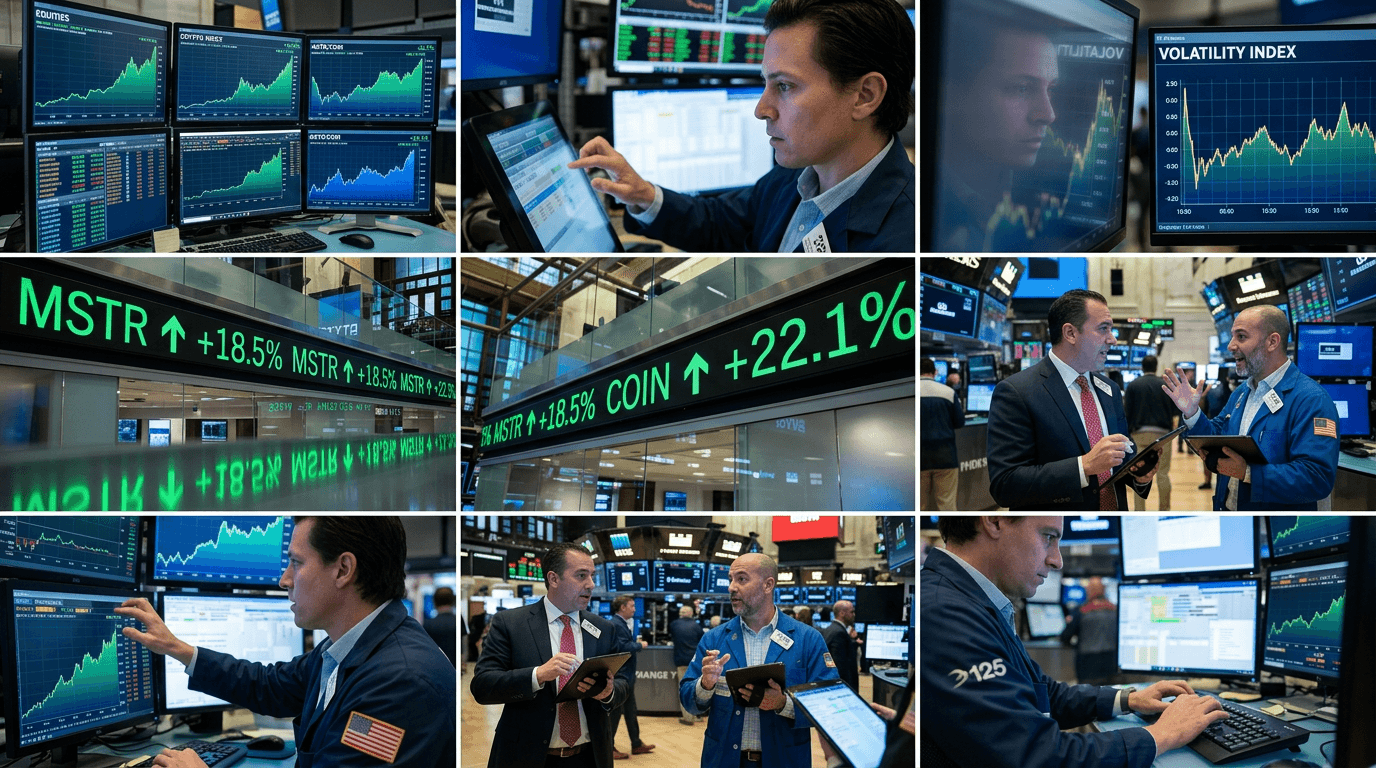
Crypto‑linked U.S. equities just delivered a powerful rally, with names like MicroStrategy and Coinbase posting mid‑to‑high single‑digit and even double‑digit gains in a single session.[1][14][15] For traders, this is a clear signal that equity markets are once again willing to take risk in the digital asset ecosystem, with potential spillovers into crypto itself and related derivatives.[1][3][15]
What The Rally Is Telling Traders
The latest surge in crypto‑linked stocks is not just about one or two tickers having a good day; it reflects a broad improvement in sentiment toward the entire digital asset complex.[1][14][15] MicroStrategy, often treated as a high‑beta proxy for Bitcoin because of its large BTC holdings, has repeatedly delivered outsized moves as crypto prices rebound.[3][8][9] Coinbase, the biggest U.S. crypto exchange, has similarly rallied when trading volumes and regulatory headlines turn supportive.[13][15]
Recent sessions have seen MicroStrategy jump by high single digits to low double digits as Bitcoin has pushed higher from its mid‑year lows toward the upper‑$70,000 to $80,000 range.[3][8][9] In parallel, Coinbase shares have climbed by mid‑single digits to more than 7% in response to stronger trading activity, short‑squeeze dynamics, and improving expectations around U.S. crypto regulation.[1][13][14] Moves of this magnitude in multiple stocks at once point to a sector‑wide re‑rating of risk rather than isolated, idiosyncratic news.
For traders, the message is straightforward: equity investors are once again willing to pay for exposure to crypto growth and volatility. That risk appetite can influence everything from spot Bitcoin demand to activity in listed options, futures, and structured products that reference these names or the underlying coins.[3][6][15]
KEY DRIVERS BEHIND THE CRYPTO‑EQUITY SURGE
Several overlapping drivers help explain why crypto‑linked equities have pushed sharply higher.
First, the core macro driver remains Bitcoin’s recovery. Over the past month, Bitcoin has rebounded from levels around the mid‑$50,000s to trade closer to the high‑$70,000s and above, restoring tens of billions in market value and flipping corporate BTC treasuries from unrealized losses to sizable gains.[3][8][12] MicroStrategy’s stock has amplified that move, rising roughly 30% over 30 days and delivering single‑day gains north of 6–12% during the strongest up‑swings.[3][6][8]
Second, the rally has been reinforced by short‑squeeze mechanics in both spot equities and derivatives. When heavily shorted crypto‑linked names begin to rise on improving fundamentals, forced covering can accelerate the move and attract momentum‑oriented capital.[6][13] MicroStrategy’s double‑digit single‑day jump and Coinbase’s rapid upside moves have both been linked to aggressive short covering as prices broke key resistance areas.[6][13][14]
Third, regulatory and policy narratives have skewed more constructive. Coinbase’s recent gains were supported by positive commentary from its leadership, expanded expectations of U.S. crypto legislation, and a perceived shift toward a more supportive regulatory framework following high‑profile policy discussions and summits.[1][13] Any easing of perceived regulatory overhang can justify higher risk premiums for crypto‑linked equities and encourage equity investors to re‑enter the space.
Finally, the breadth of the rally matters. Moves have extended beyond bellwethers into a wider group of U.S. crypto‑related stocks, including stablecoin and infrastructure names such as Circle, Bitmine, and SharpLink, all of which have recorded meaningful single‑session gains amid robust trading volumes and renewed interest in blockchain‑based payments.[1][15] Breadth is a classic confirmation signal that a move is driven by sector‑level flows rather than isolated stock stories.
Equity Risk Appetite And Derivatives Sentiment
Equity rallies of this type do not stay confined to the cash market. They can ripple into options, futures, and structured products referencing both the stocks and the underlying cryptocurrencies.[3][6][15] As MicroStrategy and Coinbase re‑rate higher, implied volatility in their listed options often rises, reflecting demand for leverage and convexity from traders wagering on continued upside or a sharp pullback.[6][13]
At the same time, stronger equity performance can bolster sentiment in crypto derivatives. A sharp rebound in Bitcoin prices has already coincided with renewed activity in BTC futures and options, alongside short squeezes in leveraged positions.[3][6] When equity investors treat MicroStrategy as a leveraged proxy for Bitcoin, aggressive buying in the stock can be interpreted as a vote of confidence in the sustainability of the underlying BTC trend.[3][9][12]
For SimFi traders operating in environments like E8 Markets, this linkage creates an important learning opportunity. Simulated portfolios that include both crypto‑linked equities and digital asset derivatives can be used to explore how shock moves in one market transmit to others, how correlation regimes change during rallies, and how position sizing should adjust when volatility picks up.[3][6][15] By tracking equity beta to Bitcoin and measuring the sensitivity of options pricing to sharp equity moves, traders can deepen their understanding of cross‑asset risk without putting real capital at immediate risk.
TRADING IMPLICATIONS FOR CRYPTO‑EXPOSED STOCKS
This kind of sector‑wide rally offers several practical implications for active traders and investors.
First, it reinforces the importance of treating crypto‑linked equities as high‑beta, event‑driven instruments rather than simple “stock picks.” MicroStrategy’s tendency to move roughly twice as much as Bitcoin on strong up‑days illustrates how leverage, balance‑sheet exposure, and market positioning can magnify underlying crypto moves.[2][3][6] Coinbase’s reaction to regulatory signals and trading‑volume trends shows how fundamental and sentiment drivers combine.[13][15]
Second, the breadth of the current rally suggests that systematic or thematic flows may be at work. When multiple equities across exchanges and sub‑segments of the crypto value chain rise together, index products, baskets, and factor‑based strategies are often involved.[1][14][15] SimFi traders can model this by constructing synthetic sector baskets and observing how they respond to shocks in Bitcoin, regulatory news, or liquidity conditions.
Third, strong positive moves are also a reminder to manage downside risk proactively. High‑beta names that rally 10–12% in a day can retrace quickly if the underlying driver—Bitcoin’s price, regulatory optimism, or short‑squeeze dynamics—fades.[3][6][9] Using simulated trading environments to test stop‑loss placement, dynamic hedging with options, and scaling into positions can help traders design more resilient approaches before committing to live markets.
Practical Takeaways For Simulated Traders
1) Treat crypto‑linked equities as leveraged expressions of broader crypto themes, not isolated stock stories.[3][9][12]
2) Monitor both Bitcoin’s trajectory and regulatory headlines; together they often explain a large portion of the variance in names like MicroStrategy and Coinbase.[3][8][13]
3) Use simulated portfolios to experiment with cross‑asset positioning—combining equities, BTC exposure, and options—to understand how risk concentration can help or hurt performance in fast‑moving markets.[3][6][15]
4) Pay attention to breadth and volume during rallies; the more names and turnover involved, the stronger the signal of genuine sector risk appetite rather than a short‑lived squeeze.[1][6][15]
Conclusion: Rally As A Signal, Not A Guarantee
The latest burst higher in crypto‑linked U.S. equities is a clear sign that risk appetite for the digital asset sector has returned, at least for now.[1][14][15] Strong, broad‑based gains in MicroStrategy, Coinbase, and other crypto‑related names, supported by a recovering Bitcoin price, short‑squeeze dynamics, and more constructive policy narratives, point to a market that is once again willing to embrace volatility and growth in this space.[3][6][13]
For traders and investors, the key is to read the signal without assuming it guarantees a new, uninterrupted bull cycle. High‑beta rallies can be powerful but fragile. Using simulated finance platforms to stress‑test strategies, calibrate exposure, and explore cross‑asset interactions offers a pragmatic way to harness renewed sector optimism while keeping risk discipline front and center. In that sense, the current equity surge is both an opportunity and a timely reminder that risk appetite is a tool to be managed, not a wave to be followed blindly.