
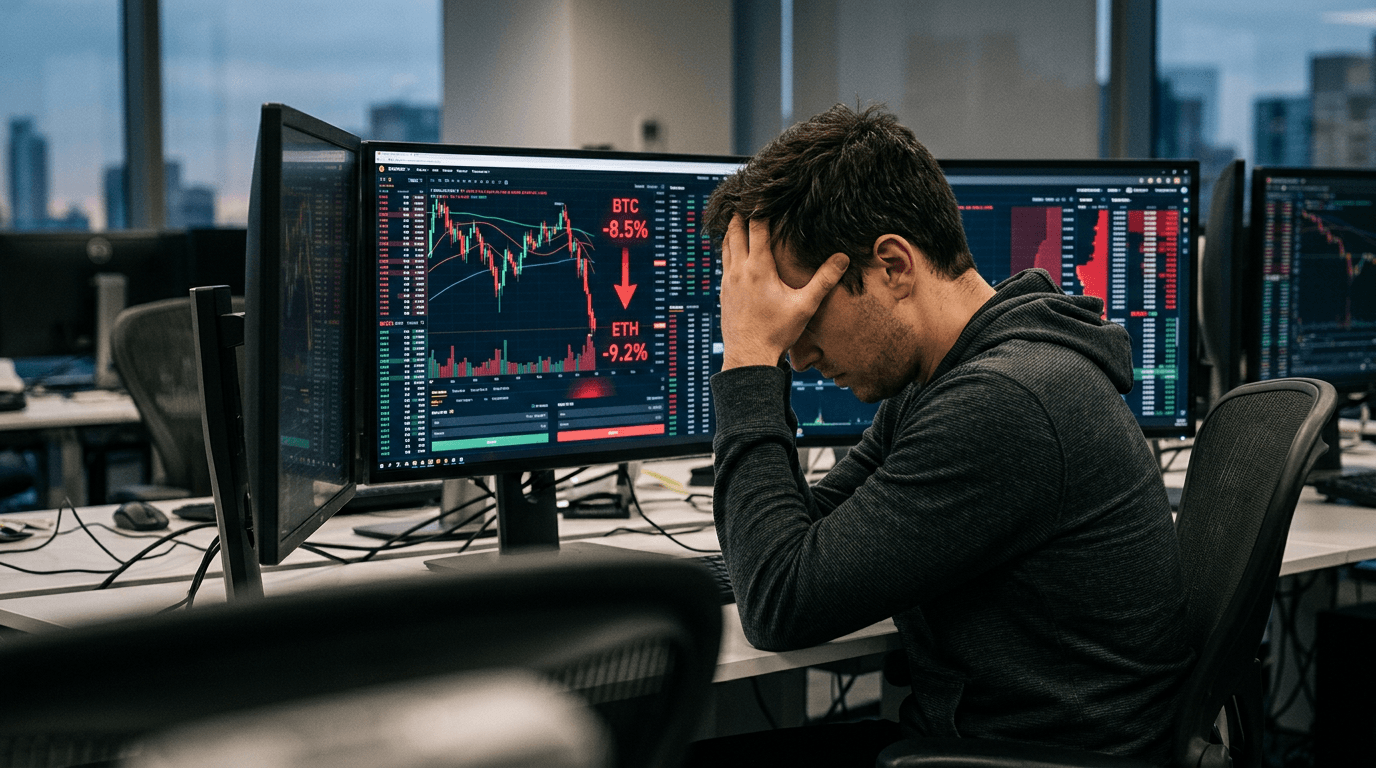
Crypto markets are seeing a wave of forced liquidations as Bitcoin and Ethereum slide, with about $116 million in futures positions wiped out in just one hour. This kind of rapid deleveraging underscores how quickly sentiment can flip when traders are heavily exposed to derivatives.
WHAT TODAY’S LIQUIDATION SPIKE SIGNALS
A sharp increase in futures liquidations typically means that a large share of market participants were using leverage and found themselves on the wrong side of a fast move. As prices dipped, margin thresholds were breached and positions were automatically closed by exchanges.
When liquidation volumes spike in a short window, it often reflects aggressive de-risking rather than a calm, orderly repositioning. The recent $116 million in liquidations in under an hour suggests that leveraged traders were caught off guard by the speed of the sell-off and forced to exit at unfavorable levels.
This dynamic can feed back into prices. As liquidations trigger market orders, they add selling pressure in a downturn, potentially accelerating moves in Bitcoin, Ethereum, and other digital assets. Traders who understand this feedback loop are better equipped to judge whether a move is driven by fundamentals or leverage unwinds.
How Futures Liquidations Work
In crypto futures and perpetual contracts, traders can control large notional positions with relatively small capital by posting margin. When the market moves against them, their unrealized losses eat into that margin. If the account value falls below the maintenance margin requirement, the position is liquidated.
Exchanges typically close positions automatically to protect the broader market and their own risk books. Liquidation engines sell or buy back contracts into the open market, which is why a cluster of liquidations can leave footprints in price action—sudden wicks, volume surges, and brief dislocations from spot markets.
Because leverage magnifies both gains and losses, traders may be tempted to increase position size during quiet periods of low volatility. The problem is that volatility in crypto can pick up quickly, and a move that looks modest in percentage terms can be large enough to wipe out highly leveraged accounts in minutes.
What The Data Says About Bitcoin And Eth Risk
Recent liquidation data across major exchanges highlights just how frequent these leverage events have become in Bitcoin and Ethereum. One 24-hour window saw roughly $1.19 billion in perpetual futures liquidated, with over $1.06 billion coming from long positions, indicating a broad long squeeze across the market.[1]
In another episode, around $275 million was liquidated in 24 hours, with Bitcoin accounting for $154.85 million and Ethereum $97.65 million, and the vast majority of those closures coming from long positions.[8] This pattern shows that traders often lean bullish with leverage, leaving them vulnerable when prices roll over.
Importantly, not every liquidation spike is driven by longs. There have been periods where roughly $295 million in liquidations were dominated by shorts, with about 71.77% of Bitcoin and 61.68% of Ethereum positions closed being short contracts.[13] That kind of short squeeze can send prices sharply higher as forced buying hits the market.
Aggregated trackers have described these repeated spikes as evidence of “acute volatility and leverage risk,” highlighting trader distress, potential short-term squeezes, and overall turbulence for leveraged participants.[14] For Bitcoin and Ethereum traders, the key takeaway is that leverage is now a central driver of intraday price behavior.
Practical Risk Management Lessons For Traders
For active traders, the current environment is a reminder that leverage should be treated as a risk tool, not a shortcut to outsized returns. Position sizing needs to account for realistic volatility scenarios in Bitcoin and Ethereum, not just recent price calm.
One practical step is to define a maximum leverage level based on your strategy and experience, then refuse to exceed it—even if markets appear “safe.” Keeping leverage moderate reduces the probability that a routine 3–5% move will trigger liquidation rather than a planned stop-out.
Risk management should also incorporate stress testing. Ask how your portfolio would react if Bitcoin or Ethereum moved 10–15% against you in a single day, and adjust position sizes and margin accordingly. This mindset shifts the focus from “How much can I make?” to “Can I survive a sudden repricing?”
Stop-loss discipline matters as well. Voluntary exits at predetermined levels are almost always preferable to forced liquidations at arbitrary prices. Traders can manage risk by placing stops where the trade thesis is invalidated, not where the exchange decides their margin is insufficient.
Using Simulated Finance To Navigate Volatility
Simulated Finance (SimFi) environments, such as those offered by platforms like E8 Markets, allow traders to experience liquidation dynamics and leverage stress without risking real capital. This is particularly valuable in crypto, where price swings and liquidation cascades can be extreme.
In a SimFi setting, traders can practice sizing Bitcoin and Ethereum futures positions, experiment with different leverage levels, and observe how margin changes as markets move. Seeing simulated accounts liquidated in fast markets can be a powerful lesson in why conservative leverage and robust risk rules are essential.
SimFi platforms also make it easier to test systematic risk frameworks. Traders can backtest scenarios where they cap account-wide leverage, diversify across assets, or reduce exposure when volatility indicators spike. By iterating in a simulated environment first, they can refine rules before applying them to real markets.
For newer traders, this approach shortens the learning curve. Instead of discovering the mechanics of liquidations through painful losses, they can learn through data, repetition, and controlled experiments. More experienced traders can use SimFi to test new strategies under stress conditions, such as rapid multi-asset sell-offs.
Conclusion
The latest spike in crypto liquidations, coinciding with declines in Bitcoin and Ethereum, is more than a headline—it is a live demonstration of how leverage reshapes market behavior. Forced closures can amplify moves in both directions, turning modest price shifts into sharp volatility events.
For traders, the lesson is clear: understanding liquidation mechanics, monitoring derivatives data, and respecting leverage are now core skills in crypto markets. Combining disciplined risk management with practice in simulated environments can help traders respond to volatility with a plan, rather than panic.