
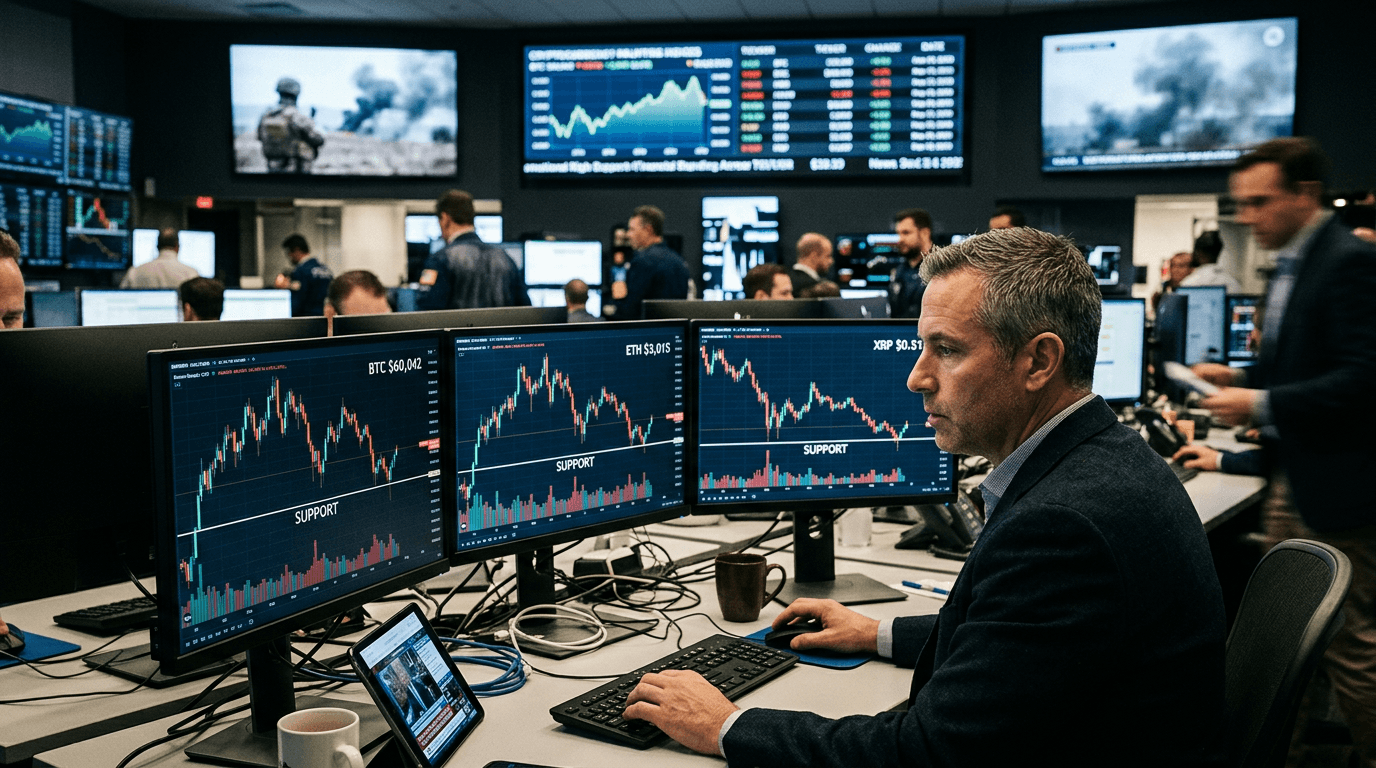
Crypto’s largest names are catching their breath after a brisk pullback, with Bitcoin, Ethereum and XRP all trading cautiously just above key support levels as geopolitical and macro risks reprice sentiment.[1][4] A roughly 2% drop has pushed prices back toward zones that have repeatedly attracted dip-buyers in recent weeks, turning the latest move into a stress test of the prevailing uptrend rather than a clear trend reversal.[1][4] Higher oil prices, a softer US dollar and war‑related headlines are keeping volatility elevated, and that uncertainty is now feeding directly into crypto futures and options positioning as traders hedge more aggressively.[1][5]
Market Snapshot: Crypto Holds The Line
Bitcoin is hovering near the 71,000 USD region, a level that sits just above a broader support band where buyers stepped in during prior pullbacks.[1] Ethereum is oscillating around 2,000 USD, another psychologically important area that has repeatedly served as a pivot for short‑term sentiment.[1][9] XRP, meanwhile, remains locked in a consolidating range near the 1.00 USD psychological line, digesting recent volatility rather than breaking decisively in either direction.[1][4]
Despite the pullback, this is less a collapse and more a pause at an inflection point: price action is compressed, volatility is elevated, and positioning is cautious.[1] On‑chain and derivatives data show traders are increasingly using Bitcoin and major altcoins as real‑time vehicles for expressing views on war risk, inflation and interest rates, rather than waiting for slower traditional markets to fully react.[5] This dynamic helps explain why even modest geopolitical headlines can now trigger outsized swings around well‑defined technical levels.
Bitcoin: Bellwether At A Pivotal Zone
As usual, Bitcoin remains the market’s bellwether, and its behavior near support is setting the tone for the entire complex.[4] Recent analysis highlights a well‑watched support band in the mid‑60,000s that has repeatedly attracted dip‑buying interest and helped preserve the broader bullish structure.[1][4] As long as price holds above this structural floor, many traders continue to frame the latest decline as a corrective move inside an ongoing uptrend, not the beginning of a new bear phase.[1][4]
At the same time, options market data shows a cluster of downside interest in the 60,000–64,000 USD area, a zone where stress could intensify if geopolitical risk were to re‑emerge aggressively.[5] That options‑heavy band effectively acts as a “volatile support” region: if spot drifts toward it, hedging flows and forced deleveraging could amplify short‑term moves.[5] On the upside, previously tested resistance zones in the high‑70,000s to 80,000 USD area still represent heavy order‑flow and profit‑taking interest, meaning any recovery from current levels will need genuine conviction to break higher.[1][2]
For traders, the takeaway is clear: Bitcoin’s current range is not just another sideways chop, but a macro‑sensitive battleground where technical levels, geopolitical headlines and derivatives flows intersect. Understanding how these layers interact can help avoid overreacting to single candles while still respecting the risk of a deeper break if support finally gives way.
Ethereum And Xrp: Diverging Structures, Shared Risks
Ethereum’s roadmap is defined by stacked levels around the 2,000 USD zone, which has emerged as a key pivot between bullish continuation and broader consolidation.[1][4] Above that area, analysts still see a path toward higher resistance regions, but repeated failures to hold decisive momentum have made the asset more sensitive to shifts in broader risk sentiment.[1] ETF flows and regulatory debates around smart‑contract platforms have added another layer of uncertainty, contributing to a more hesitant tone even when Bitcoin stabilizes.[6]
XRP is telling a slightly different story. The token is trading sideways near the 1.00 USD psychological mark, with a wider macro support band between roughly 1.11 and 1.20 USD that has served as a structural floor in past phases.[4] Longer‑term chart work suggests deeper support could emerge if price ever retests the 0.70–0.90 USD zone, but for now the market appears content to keep XRP in a consolidation corridor while it digests macro risk and ongoing legal and regulatory narratives.[4]
Despite these differing structures, all three assets share a common backdrop: a market that is defensive, but not panicked, with traders more inclined to reduce leverage and tighten stops than to abandon the space altogether. For risk managers, this kind of environment often favors tactical trading around well‑defined support and resistance rather than chasing large directional bets.
Geopolitical And Macro Undercurrents
One of the most important shifts in recent years is that Bitcoin has evolved from a simple “risk‑on” asset into a real‑time geopolitical risk indicator.[5] Research shows that BTC now reacts directly to war‑related developments that change expectations for oil, inflation and interest rates, and traders increasingly use it as a first‑draft macro instrument when geopolitical risk spikes.[5] That means headline risk around conflicts, ceasefires or sanctions can now have a more direct and immediate impact on crypto prices than in past cycles.
At the same time, macro factors such as higher oil prices and a weaker dollar are reshaping inflation and Fed expectations, feeding into volatility across both traditional and crypto markets.[1][5] When rate path uncertainty rises, leveraged positioning in Bitcoin, Ethereum and XRP tends to adjust quickly, with futures and options seeing upticks in hedging activity as traders guard against tail risks.[1][5] The result is a feedback loop: geopolitical shocks move macro expectations, macro shifts move crypto, and crypto in turn becomes part of the broader market’s risk‑pricing process.
For traders, the key is not to guess every headline, but to recognize that technical levels do not exist in isolation. A support zone holds or breaks partly because of where global liquidity, rate expectations and commodity prices sit at that moment. Incorporating those variables into a trading plan can turn what looks like random volatility into a more structured, manageable process.
Practical Takeaways For Traders And Simulated Investors
In this kind of environment, a disciplined framework matters more than bold predictions. First, map the key levels: for Bitcoin, the mid‑60,000s structural support and the options‑heavy band near 60,000–64,000 USD; for Ethereum, the 2,000 USD pivot; and for XRP, the 1.00 USD psychological line and the broader 1.11–1.20 USD support zone.[1][4][5][9] Knowing where the market has previously absorbed selling pressure helps you size positions and set stop‑losses more intelligently.
Second, treat geopolitical headlines as volatility catalysts rather than trading signals in their own right. When news hits, look at how price behaves around your pre‑defined levels instead of chasing the initial move. Does Bitcoin absorb the shock and hold support, or does it slice through with volume and open interest confirming a genuine shift in structure?[1][5] This price‑plus‑context approach helps filter noise while still respecting the macro reality.
Finally, simulated trading environments offer a powerful way to practice this playbook without putting real capital at risk. By testing strategies in a SimFi setup, traders can experiment with different responses to support breaks, volatility spikes and macro events, refining their entries, exits and risk parameters before deploying them in live markets.[1] In periods when supports are fragile and headlines are unpredictable, that kind of preparation can be the difference between reactive trading and resilient decision‑making.