
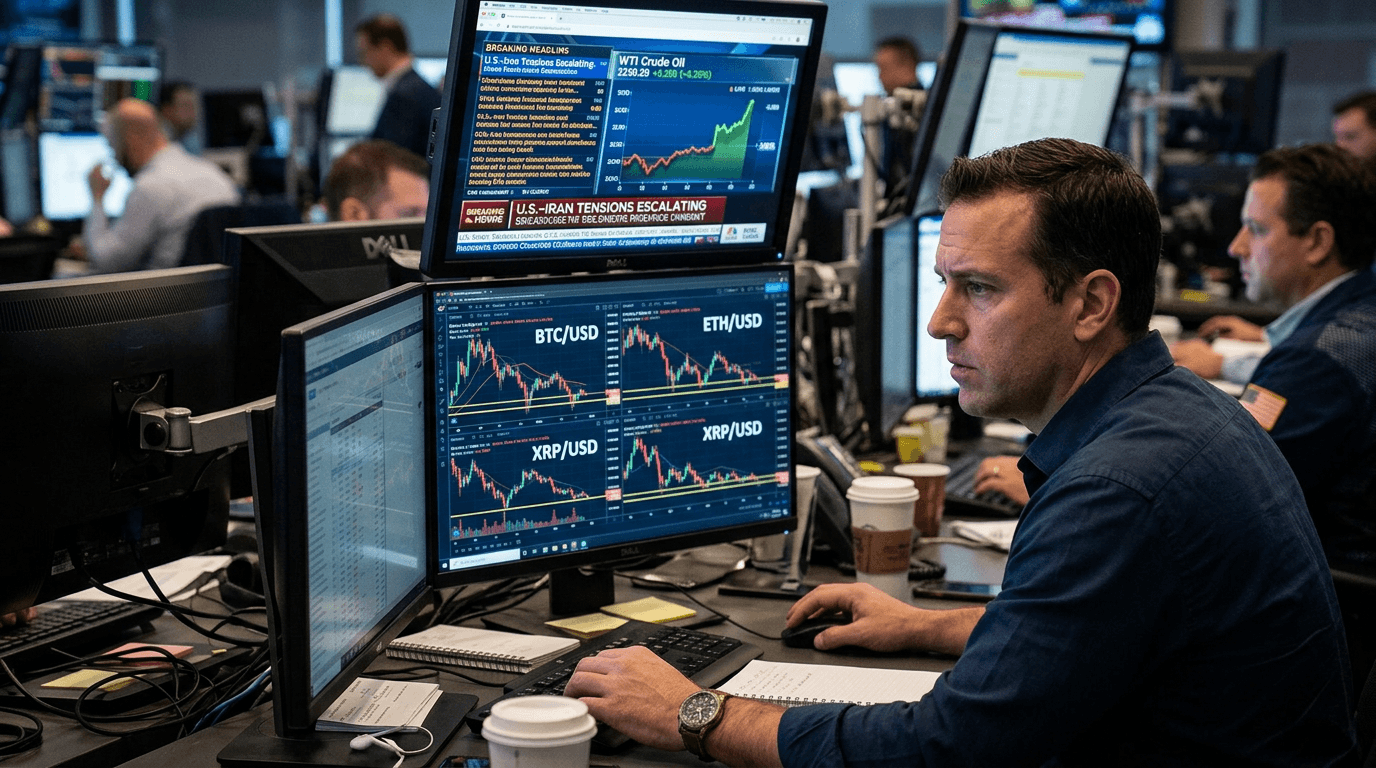
Bitcoin, Ethereum and XRP are trading in a holding pattern, hugging key support levels after a modest pullback as the U.S.–Iran war escalates and risk appetite fades across global markets.[1][3] A roughly 2% dip in major coins is coinciding with higher oil prices and renewed geopolitical anxiety, prompting traders to adopt a more defensive stance across crypto and other speculative assets.[1][3]
Geopolitical Shock And Risk-off Sentiment
The latest leg of the U.S.–Iran conflict has been driven by a fresh round of aerial strikes and retaliatory attacks on energy-related and military targets, raising questions over how long the ceasefire framework can hold.[1] In earlier phases of the war, crude oil spiked above $100 per barrel before retreating below $60, yet consumer inflation expectations stayed elevated, reinforcing fears that interest rates may have to stay higher for longer.[1]
When oil jumps and inflation worries intensify, investors typically rotate away from high-volatility assets and toward cash, bonds, and traditional safe havens.[3] That “risk-off” pattern is evident again: WTI crude futures have risen more than 2%, while the U.S. dollar index is holding above key levels, signaling a preference for relative safety.[1]
In this environment, cryptocurrencies are not behaving like a pure safe haven. Instead, they are trading more like high-beta macro assets—amplifying moves in broader risk sentiment rather than decoupling from it.[3] Earlier in the conflict, Bitcoin dropped about 7% immediately after U.S. strikes on Iran, underscoring how quickly defensive positioning can emerge when headlines turn darker.[3]
BITCOIN: HIGH-BETA MACRO ASSET, NOT PURE “DIGITAL GOLD”
Bitcoin’s current defensive behavior is best understood through a two-stage framework for how war can impact crypto markets.[3] In the first stage, the reaction is mechanical: oil rises, equity markets wobble, volatility increases, and investors systematically reduce exposure to risk assets, including Bitcoin.[3] Selling pressure is driven less by crypto-specific news and more by portfolio-level de-risking.
That is what we are seeing now. Prices have pulled back from recent highs, but Bitcoin is still holding above important structural support levels identified by technical analysts, such as the lower boundary of its ongoing bull-flag pattern.[1][5] During a recent overnight dip associated with Iran headlines, Bitcoin’s selloff to the low-$60,000 area was notable precisely because it stopped where chart support suggested buyers might defend the trend.[5]
The second stage is more nuanced and depends on the macro fallout from the conflict.[3] If the energy shock is temporary and growth remains resilient, Bitcoin could simply consolidate as investors wait out the uncertainty.[3] If inflation stays sticky and central banks are forced to keep rates high, crypto may struggle longer alongside equities.[3] But if the war and energy shock ultimately tip the global economy toward recession and policy easing, Bitcoin could later benefit from renewed liquidity and lower yields, potentially producing a sharp rebound after the initial pain.[3]
For traders, the takeaway is clear: in the short term, Bitcoin is behaving like a leveraged expression of global risk sentiment rather than a straightforward “war hedge.” Longer-term outcomes will hinge on how oil, inflation, and monetary policy evolve from here.[1][3]
Ethereum And Xrp: Range-bound But Sensitive To Headlines
Ethereum and XRP are following a similar defensive pattern, but with their own technical nuances. Earlier in the conflict, ether and XRP both dropped between roughly 1% and 2.3% when U.S. and Iran exchanged airstrikes, tracking the broader risk-off rotation.[1] Ethereum is hovering around a major psychological and technical zone near $2,000, a level that often serves as a pivot between growth optimism and macro caution.[3]
For Ethereum, wartime risk-off flows matter because they affect activity across the DeFi and NFT ecosystems that generate demand for block space and gas fees. When traders de-lever and speculative activity cools, fee revenues and on-chain volumes can soften, reinforcing the case for caution until macro visibility improves.
XRP, meanwhile, is trading in a sideways range, echoing prior episodes where geopolitical and regulatory uncertainty have encouraged range-bound price action rather than strong directional trends.[3] Video and community commentary around the Iran war being “back on” have highlighted how quickly retail sentiment can sour, sending XRP lower even without XRP-specific news.[9]
Importantly, markets have also shown how quickly sentiment can flip once tensions ease. When the U.S. and Iran recently neared a peace deal, XRP jumped about 8.8%, Ethereum gained 6.6%, and Bitcoin rose 3.4% over 24 hours, with total crypto market capitalization up about 3.6%.[2] That surge underscored that de-escalation in the Persian Gulf and prospects for smoother oil flows can rapidly boost risk appetite for digital assets.[2] In other words, the same geopolitical variable—war vs. peace—can swing crypto from defensive to aggressively bullish in a matter of days.
What Defensive Trading Looks Like In Practice
“Defensive” trading in crypto is more than just watching prices dip a couple of percentage points; it is a deliberate risk-management response to elevated uncertainty. Practically, this often includes:
- Smaller position sizes and reduced leverage, to limit the damage from sharp intraday moves and potential liquidation cascades.
- Tighter stop-losses and more selective entry points, often near well-defined support zones, rather than chasing breakouts in thin liquidity.
- Higher allocations to stablecoins or off-exchange cash, keeping dry powder to deploy once volatility stabilizes.
- Greater use of hedges, such as short futures positions or options strategies, to protect core holdings against tail-risk events.
History shows the cost of ignoring macro-geopolitical risk. At one point in the U.S.–Iran drama, a 48-hour ultimatum from Washington triggered more than $1 billion in crypto liquidations, with about 85% hitting long positions.[10] That episode highlighted how crowded leverage and complacency can turn routine headline risk into forced selling, even for traders who fundamentally believe in crypto’s long-term story.[10]
In a defensive phase like today, disciplined risk management usually matters more than bold directional calls. Preserving capital and maintaining flexibility makes it easier to capitalize on the eventual move when the macro narrative becomes clearer.
Using Simulated Trading To Navigate Wartime Markets
For many traders, especially those still building experience, simulated finance environments offer a practical way to stress-test strategies against war-driven volatility without putting real capital at risk. By replaying scenarios like prior Iran-related selloffs and peace-rally surges, traders can study how Bitcoin, Ethereum, and XRP respond to rapid changes in oil, the dollar, and equity indices.[1][2][3]
Practicing in a SimFi setting allows you to
- Experiment with different defensive playbooks—reducing leverage, adding hedges, rotating between majors and stablecoins—and see how they perform across varied market conditions.
- Test assumptions about correlations, such as how closely Bitcoin tracks risk-off moves in stocks or how quickly XRP responds to sentiment shifts unique to its community.
- Build muscle memory around reacting to breaking geopolitical news, from initial selloffs to potential second-stage rebounds as central bank policy adjusts.
Because war-driven markets are emotionally charged and fast-moving, having rehearsed decision frameworks can be a significant edge. Simulated trading helps convert abstract macro theory—like the two-stage impact of a U.S.–Iran war on Bitcoin—into concrete rules you can apply when volatility spikes for real.[3]
Ultimately, the current defensive tone in Bitcoin, Ethereum and XRP is a reminder that crypto does not trade in a vacuum. Geopolitics, energy prices, inflation and central bank policy all filter into digital asset pricing, often through the lens of global risk appetite.[1][3] By treating crypto as part of the broader macro ecosystem—and by practicing your responses in lower-risk environments—you can be better prepared for both the downside shocks and the upside surprises that wartime markets tend to deliver.