
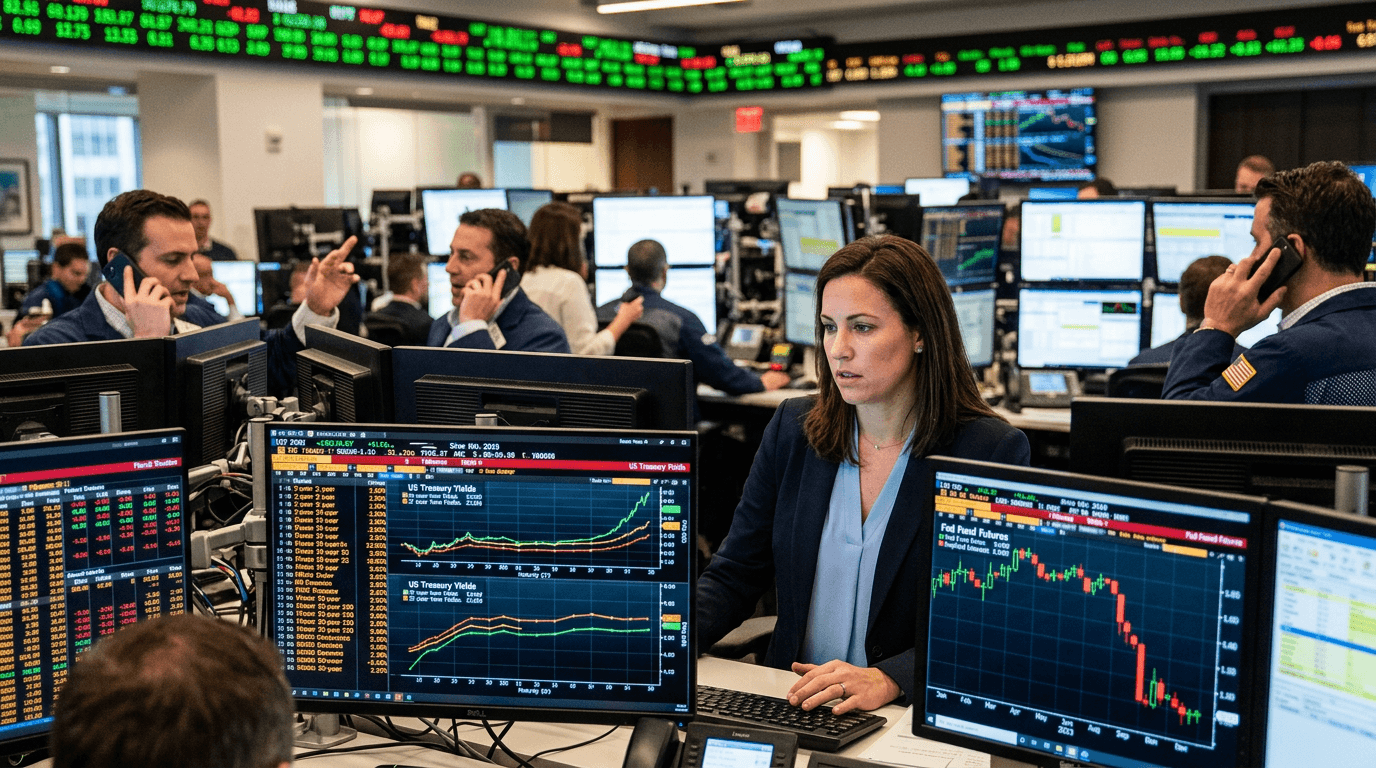
A surprisingly strong set of US economic data has jolted the rates market, sending Treasury yields higher and reshaping both the yield curve and interest-rate futures pricing. Traders who had been leaning toward an earlier start to Federal Reserve easing were forced to adjust, pushing up short- and intermediate-term yields and flattening parts of the curve as the expected path of policy was repriced into year-end.[6][8]
What Happened In The Bond Market
The catalyst was stronger-than-expected US data, including producer price inflation and sentiment indicators, which pointed to an economy that remains more resilient and possibly more inflation-prone than markets had anticipated. When data exceed consensus expectations, the immediate implication is that the Fed can afford to stay restrictive for longer, or at least delay rate cuts.[8]
In response, Treasury prices fell and yields rose across the curve, with the most pronounced moves often occurring in the two- to five-year sector, where securities are most sensitive to changes in the expected Fed policy rate over the next few years.[7][8] Higher yields reflect investors demanding more compensation to hold government debt if policy is likely to remain tight.
At the same time, interest-rate futures—contracts that embed the market’s expectations for future policy rates—quickly repriced. Futures linked to Fed funds and short-term rates showed lower implied probabilities of near-term rate cuts and a shallower cutting cycle into year-end, as traders pushed back the timeline for easing.[6]
Why The Data Surprise Mattered
To understand why one data surprise can trigger a broad reset in pricing, it helps to think in terms of “monetary policy surprises.” The Federal Reserve Bank of San Francisco measures these by looking at how short-term money market futures move around key announcements.[6] When futures shift sharply after data releases, it is a clear signal that the market’s prior expectations were wrong.
Academic and policy research shows that macroeconomic news—especially inflation, labor market, and growth data—has a powerful and immediate impact on both the level and slope of the Treasury yield curve.[8] A stronger inflation or growth print typically leads to higher yields and can flatten the curve if investors expect the Fed to stay tighter for longer.
This particular upside surprise in producer prices and sentiment data challenged the prevailing narrative that the disinflation process was firmly on track and that growth was cooling in a predictable way. Instead, it suggested lingering inflation pressures and robust demand, giving the Fed less urgency to cut rates and prompting traders to reprice the entire policy path.
How The Yield Curve Reacted
The US Treasury yield curve—the relationship between yields on short-term and long-term government bonds—is a key barometer of market expectations for growth, inflation, and policy.[3][7] It is often summarized by the spread between long-term and short-term rates, which has a strong historical link to future GDP growth and recession probabilities.[3]
Recently, analysts have highlighted an unusual “swoosh”-shaped curve, with relatively high short-term yields, a dip in intermediate maturities, and a pickup again at the long end.[4] This pattern reflects expectations that policy will eventually be eased, but that long-term structural forces—like higher fiscal deficits and debt levels—could keep long-term rates elevated.[1][4]
When stronger data hit, short- and intermediate-term yields moved up as markets priced fewer and later rate cuts, which can flatten the curve between two- and ten-year maturities. A flatter curve in this segment often signals that the market expects tighter policy to persist, even if long-run inflation expectations remain relatively anchored.[3][8] In some cases, the move can partially unwind an existing inversion (where short-term yields exceed long-term yields), which has been a prominent feature of recent cycles.[3]
The long end of the curve—the 10-year and 30-year maturities—may also rise in yield, but for slightly different reasons. Beyond expectations for Fed policy, these yields embed a term premium, reflecting compensation for interest-rate risk and concerns about long-run fiscal and inflation dynamics.[1][4] When markets reassess the macro outlook as stronger, long-term yields can climb both because rate cuts are delayed and because investors demand a higher premium to hold duration.
Implications For Rates Futures And Strategy
For rates and futures traders, the key impact of this data surprise is a repricing of the expected Fed path. Fed funds futures, OIS (overnight index swap) rates, and SOFR futures translate market expectations for the policy rate at specific points in time into tradable prices.[6] When data change the story, these contracts adjust almost instantly.
A stronger data print that lifts yields typically reduces the number of cuts priced in over the next 12–18 months, can even bring back the possibility of additional hikes in the near term, and alters the distribution of risks around the baseline outlook. This shift affects not just directional trades (bullish or bearish on rates) but also curve trades, such as steepeners and flatteners, and relative value positions along different maturities.
From a strategic standpoint, moves driven by surprise data can be both a risk and an opportunity. For example:
- Traders who were positioned for an earlier or more aggressive cutting cycle may face losses as yields rise.
- Those positioned for persistent inflation or stronger growth might benefit from higher yields and a flatter curve.
- Volatility sellers can be caught off-guard, as data surprises often trigger sharp, correlated moves across the curve.
In a simulated trading environment, such as a SimFi platform, these episodes offer a valuable live-fire exercise in managing macro news risk—without real capital at stake.
Practical Takeaways For Simulated And Live Traders
Whether you are trading real capital or building your skills in a simulated environment, a few practical lessons stand out:
1. Anchor your view in the data calendar Major macro releases—such as inflation, employment, and sentiment surveys—are known catalysts for yield-curve moves and policy repricing.[8] Planning around these events, with clear scenarios for “stronger,” “in line,” and “weaker” outcomes, can help avoid being blindsided.
2. Understand the curve, not just a single yield The yield curve embeds expectations for growth, inflation, and policy over different horizons.[3][7] An upside surprise may lift two-year yields much more than ten-year yields, or vice versa, depending on whether the shock is perceived as temporary or persistent. Simulated curve trades (e.g., 2s/10s flatteners or steepeners) are a powerful way to practice expressing macro views.
3. Watch how futures translate macro into pricing Interest-rate futures and options are where expectations become tradable. The San Francisco Fed’s work on policy surprises underscores how futures around announcements reveal shifts in the anticipated policy path.[6] Tracking how many cuts (or hikes) are priced in before and after a data release can sharpen your understanding of what the market is truly surprised by.
4. Respect volatility and risk management Data surprises are, by definition, events where consensus is wrong. That is where both opportunity and danger are greatest. Using simulated accounts to test position sizing, stop-loss rules, and hedging strategies under different volatility regimes is invaluable practice for real markets.
5. Keep the bigger cycle in mind While a single data release can move markets sharply, the broader trajectory still hinges on the evolution of growth, inflation, and labor markets over time. Some outlooks anticipate eventual Fed rate cuts as the labor market softens and growth slows, but the exact timing and magnitude are highly path-dependent.[9] Stronger data today can delay that process and push yields higher, but a subsequent slowdown could reverse the move.
For traders, the message is clear: economic data surprises do not just move single points on the curve—they reshape expectations, repricing the entire path of interest rates. Learning to read that repricing in Treasuries and futures, and to respond with disciplined strategies, is a core skill in modern macro trading, whether you are practicing in a simulated environment or navigating live markets.