
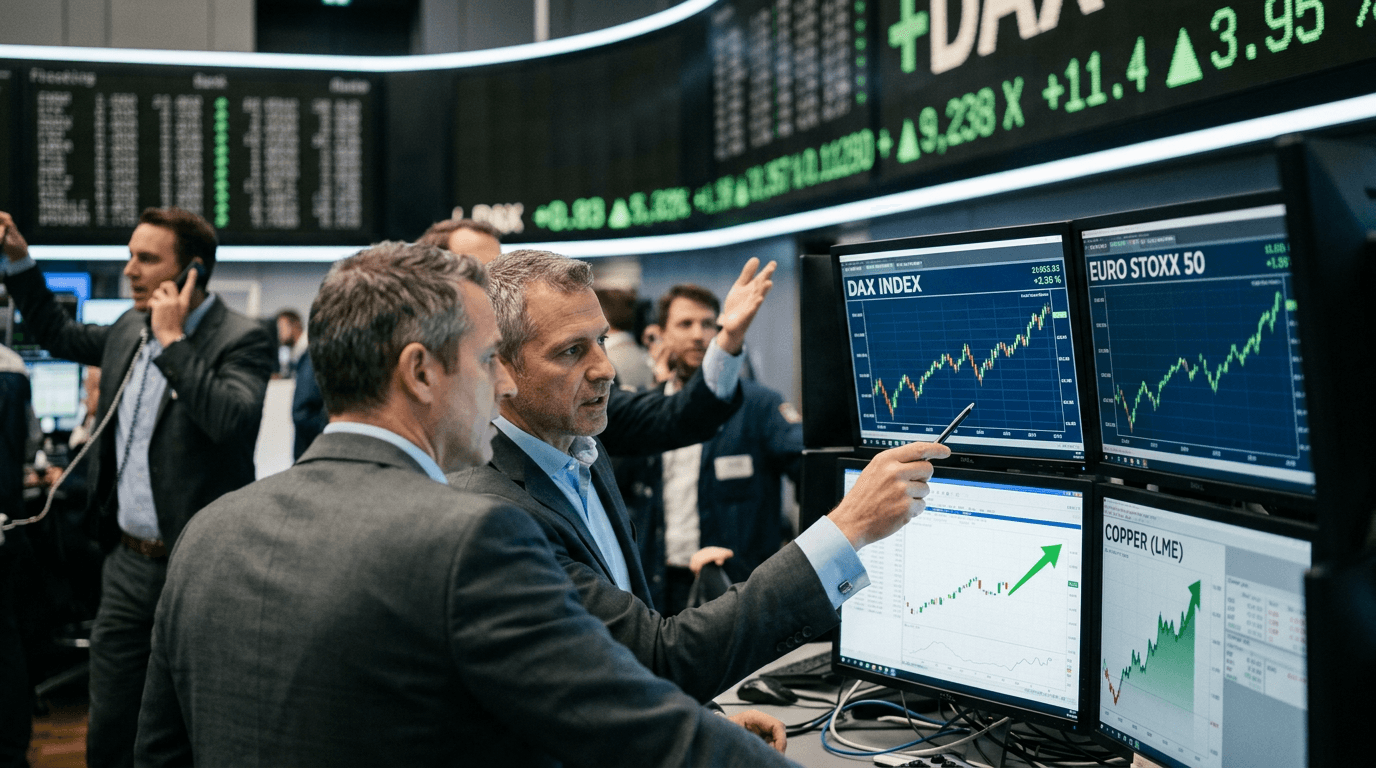
European equity markets have staged a notable rebound, with DAX 40 futures and other major indices bouncing back after recent weakness as risk appetite improves and rate expectations stabilize.[2][4] At the same time, a recovery in copper prices is breathing new life into cyclical and China-sensitive assets, supporting pro‑cyclical currencies like AUD and NOK and lifting industrials and materials futures tied to global growth.[3][4] For traders, this is a classic “risk‑on” rotation that opens up opportunity—but also demands discipline.
Why Europe And Dax Futures Are Rebounding
The rebound in European indices and DAX futures is happening against the backdrop of calmer interest rate expectations and slightly softer inflation dynamics in developed markets.[4][5] When markets believe central banks are closer to the end of their hiking cycles, discount rates stabilize, supporting equity valuations—especially in rate‑sensitive sectors such as industrials and consumer cyclicals.[4][5]
Earlier sell‑offs left many European indices trading near multi‑week or multi‑month lows, creating the technical conditions for a short‑covering rally once the macro headlines turned less negative.[3] As geopolitical tensions eased somewhat and key data came in less alarming than feared, investors began rotating back into risk assets, with the STOXX 600 and Euro Stoxx 50 edging higher alongside Germany’s DAX.[1][4]
Key takeaway: The current bounce is largely about recalibration of fear rather than euphoria—positioning, rates, and sentiment have shifted from extremely cautious toward neutral, giving indices room to recover.
Copper And Cyclicals: Why They Matter
Copper’s rebound is a crucial part of this story. Often called “Dr Copper” because of its sensitivity to economic activity, rising copper prices typically signal improved expectations for global manufacturing, infrastructure spending, and, importantly, Chinese demand.[3] When copper climbs, markets often treat it as a vote of confidence in future growth.
This helps explain the outperformance of cyclical sectors and assets tied to the global growth cycle. Mining and basic resources names, industrials, and transportation stocks tend to benefit when traders start pricing in stronger demand for raw materials and manufactured goods.[3] Luxury goods and European exporters with exposure to China can also see support as investors anticipate more resilient consumption and trade flows.[3]
The same dynamic extends into FX and commodity futures. Pro‑cyclical currencies such as the Australian dollar (AUD) and Norwegian krone (NOK) usually gain when commodity prices firm and growth expectations improve, reflecting their economies’ sensitivity to resource exports and global trade. Industrial metals futures and materials-linked equity futures often move in tandem, as macro and China‑related optimism feeds across asset classes.
Key takeaway: Copper is not just another metal—it is a high‑beta proxy for global growth expectations, and its rebound is a key signal underpinning the move in cyclical equities, FX, and futures.
Implications For Index, Fx And Commodity Futures Traders
For traders in a SimFi or live environment, this type of cross‑asset rebound offers a rich landscape of potential strategies—but only for those who understand the connections.
On the index side, the DAX is heavily tilted toward industrials, autos, chemicals, and exporters. These sectors are particularly sensitive to global demand, Chinese activity, and currency moves. A rebound in copper and other cyclicals naturally channels into stronger performance in DAX futures and other European benchmarks with similar sector weightings.[3][4]
In FX, a classic risk‑on regime often features stronger AUD and NOK versus defensive currencies like CHF and JPY, as carry and growth‑linked trades return to favor. When traders see copper and cyclicals rally, they frequently look for confirmation in pro‑cyclical FX pairs and vice versa, reinforcing the move across markets.
For commodity futures, the focus is on whether copper’s rebound is driven by genuine demand or temporary supply disruptions. If the rally is accompanied by better global PMIs, improved trade data, or stronger Chinese indicators, the signal is stronger. If not, traders may treat the move as fragile and short‑term.
Key takeaway: In a cyclical rebound, indices, FX, and commodities rarely move in isolation—successful strategies often come from treating them as an interconnected risk‑on ecosystem.
Practical Steps In A Simulated Environment
A simulated trading framework is an ideal place to test how you respond to these kinds of cyclical shifts without exposing real capital. Rather than simply “buying the rebound,” you can build structured, hypothesis‑driven strategies and track how they perform as conditions evolve.
You might, for example, design a playbook such as:
– When copper breaks above a key resistance level on strong volume and global risk sentiment improves, test a long bias in DAX futures or broader European indices, with predefined stop levels based on recent volatility.
– When pro‑cyclical FX (like AUD and NOK) strengthen alongside industrial metals, explore cross‑asset confirmation: only size up equity index exposure when the FX signal aligns with the commodities signal.
– When interest rate expectations stabilize or market-implied central bank hikes are priced out, evaluate whether to rotate from defensives (utilities, staples) into cyclicals within European equity baskets.
Because it is a simulated environment, you can track these rules over multiple cycles, analyze your drawdowns, and refine your entry, exit, and risk parameters without the emotional pressure of real losses. That helps you understand whether you are better suited to momentum‑style trades (riding the rebound) or mean‑reversion trades (fading overextended moves), based on real performance data rather than guesswork.
Key takeaway: Use the current rebound as a live case study—test scenarios, correlations, and risk rules now so you are prepared when similar setups appear in real markets.
Conclusion
The rebound in European indices and DAX futures, supported by a recovery in copper and cyclical assets, is a textbook example of how macro expectations, sector dynamics, and cross‑asset flows converge in real time.[2][3][4] Stabilizing rate expectations have eased pressure on valuations, while copper’s strength is re‑energizing the global growth narrative and pulling pro‑cyclical FX, industrials, and materials along for the ride.[3][4][5]
For traders, the key is not to chase headlines, but to recognize patterns: how “Dr Copper” often leads cyclical equities, how pro‑cyclical currencies confirm or contradict the equity move, and how rate expectations frame the entire risk environment. A simulated trading setting is the perfect laboratory to practice this playbook—so when the next growth scare or relief rally hits, you are reacting with a tested strategy, not improvising under pressure.