
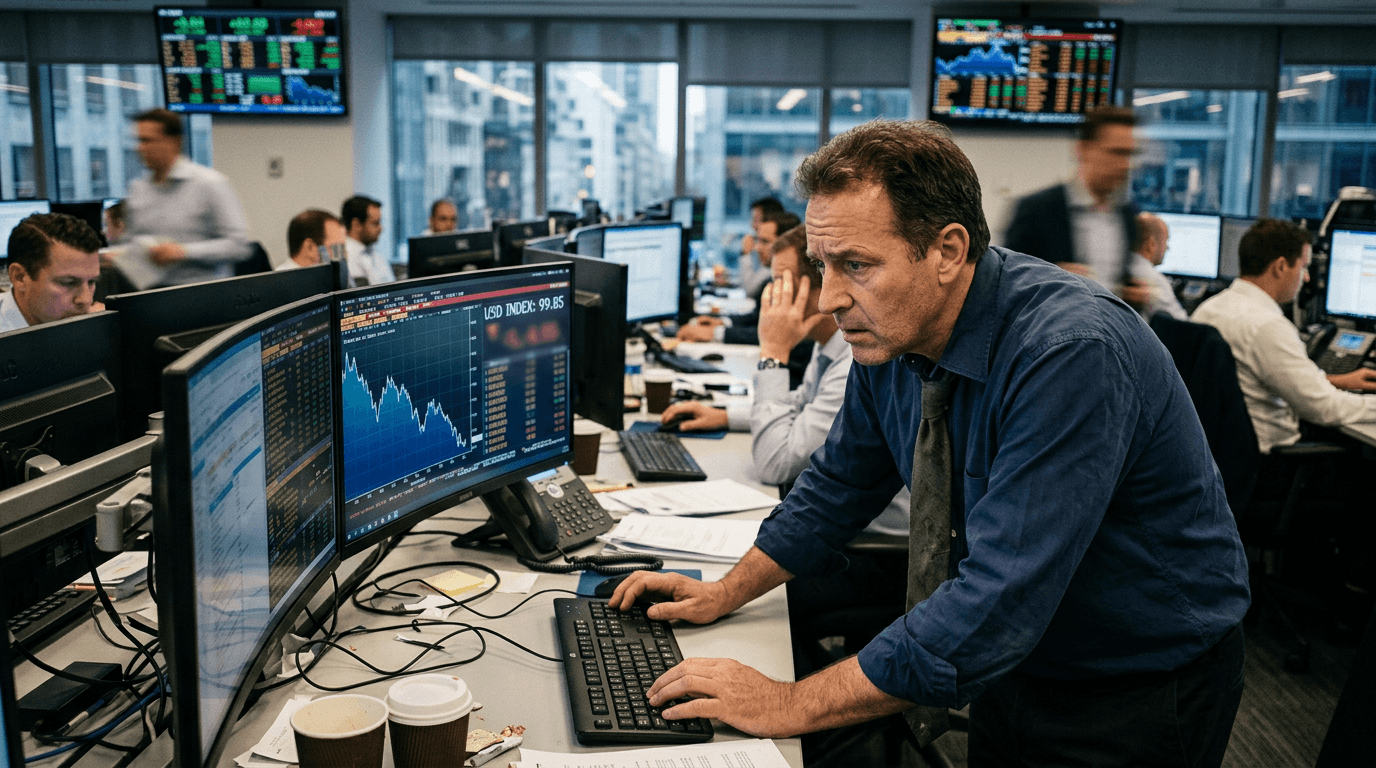
The U.S. dollar index slipping below the 100 level is more than a technical headline—it is a signal that global investors are reassessing the outlook for trade, growth, and policy. As tariff fears and trade tensions intensify, currency markets are recalibrating, with the dollar’s move reverberating across major FX pairs and broader risk sentiment.
WHAT IS THE U.S. DOLLAR INDEX?
The U.S. dollar index (often quoted as DXY or USDX) measures the value of the dollar against a basket of major currencies, including the euro, Japanese yen, British pound, Canadian dollar, Swedish krona, and Swiss franc.
The index was created in the early 1970s with a base value of 100, meaning that readings above 100 reflect a stronger dollar relative to that starting point, while readings below 100 indicate a weaker dollar compared with its historical base.
Because the euro makes up more than half of the index’s weight, EUR/USD tends to be the single most influential pair for DXY, but movements in yen, pound, and other majors also contribute meaningfully to the index’s direction.
For traders, DXY is a quick, high-level gauge of overall dollar strength or weakness, complementing, rather than replacing, pair-specific analysis on instruments like EUR/USD, USD/JPY, and GBP/USD.
Why Falling Below 100 Matters
The 100 level on the dollar index is both a historical baseline and a widely watched psychological threshold. Breaking below it suggests that the dollar has given back a substantial portion of the strength it accumulated in prior cycles of rate hikes, safe-haven flows, or robust U.S. growth.
When a major index breaches such a well-defined level, several things tend to happen at once: option structures tied to that strike are tested, algorithmic strategies trigger, and discretionary traders reassess positioning. All of this can amplify volatility in the short term.
From a macro perspective, a weaker dollar can ease financial conditions globally by reducing the burden of dollar-denominated debt and improving liquidity for emerging markets. At the same time, it can signal that investors expect slower U.S. growth, more dovish Federal Reserve policy, or heightened uncertainty that undermines the dollar’s relative appeal.
Importantly, the significance of the move is not just the level itself but the narrative behind it. In this case, tariff fears and renewed trade tensions are the dominant drivers, which carry their own implications for risk sentiment.
Tariff Fears And Trade Tensions: How They Hit Currencies
Tariffs and trade disputes affect currencies through several channels. First, they alter expectations for economic growth. If markets anticipate that trade barriers will dampen global activity or disrupt supply chains, they may price in slower growth for both the U.S. and its trading partners.
Second, prolonged trade tension increases policy uncertainty. Investors dislike not knowing how trade rules, costs, and corporate margins will evolve. That uncertainty can reduce capital inflows into the U.S. at the margin, particularly if alternative markets appear more stable or better positioned to benefit from shifting trade routes.
Third, trade conflict can reshuffle safe-haven dynamics. In some risk-off scenarios, the dollar strengthens as investors seek liquidity and security. In others—especially when the source of uncertainty is U.S. trade or policy itself—currencies like the Japanese yen or Swiss franc can receive a larger share of safe-haven flows.
Taken together, tariff-related headlines can pressure the dollar if markets conclude that U.S.-centric trade friction will weigh on domestic growth, push the Fed toward a less aggressive stance, or erode confidence in the predictability of U.S. policy.
Impact On Major Fx Pairs And Risk Sentiment
The dollar index moving below 100 has immediate consequences for major FX pairs. If broad dollar weakness persists, EUR/USD may trade higher, reflecting both a softer dollar and any relative improvement in European growth or policy expectations.
USD/JPY is often sensitive to risk sentiment. Trade tensions that spook equity markets can drive demand for the yen, pushing USD/JPY lower, especially when the dollar is already on the back foot. Similarly, safe-haven flows into Swiss franc can weigh on USD/CHF.
Commodity currencies—such as AUD, NZD, and CAD—may initially benefit from a weaker dollar, but their longer-term reaction hinges on how tariffs impact global trade volumes and commodity demand. If trade frictions threaten growth in China or broader Asia, the Australian and New Zealand dollars may face offsetting pressure.
Beyond FX, a softer dollar typically provides some support for risk assets like emerging market equities and commodities, as dollar-denominated borrowing costs ease and purchasing power outside the U.S. improves. However, if the catalyst is negative—like escalating trade conflict—the positive impact can be muted by broader risk aversion.
How Traders Can Navigate This Environment
For active traders, a break below 100 in DXY driven by tariff fears calls for a structured response rather than a knee-jerk reaction. Several practical steps can help:
First, separate the technical from the fundamental. The level breach is technically important, but the underlying driver—trade tension—dictates whether this move might extend or revert. Monitor policy statements, tariff announcements, and central bank commentary to gauge whether the narrative is intensifying or calming.
Second, focus on relative stories within FX. A weaker dollar does not automatically mean every other currency is strong. Some economies may be more exposed to trade disruptions than the U.S., while others may benefit. Studying factors like interest rate differentials, growth forecasts, and exposure to global trade helps identify which currencies are most likely to outperform.
Third, manage risk around event-driven volatility. Tariff headlines and policy comments can hit markets unexpectedly, creating gaps and sharp moves. Position sizing, use of stop-loss orders, and clear rules for trading during high-impact news windows become especially important in these conditions.
Fourth, use simulated environments to test strategies before committing real capital. A SimFi platform allows traders to model scenarios such as “DXY below 100 on renewed tariffs,” run backtests on breakout or mean-reversion approaches, and practice execution under stress without financial risk.
Finally, think in terms of regimes rather than single events. If trade tensions evolve into a prolonged theme, markets may shift into a new regime characterized by lower dollar strength, more selective safe-haven flows, and differentiated performance across regions. Recognizing regime changes early can be a key edge for both discretionary and systematic strategies.
As the U.S. dollar index hovers below the 100 mark, traders and investors are reminded that currencies sit at the intersection of policy, sentiment, and macroeconomics. Tariff fears and trade frictions may ebb and flow, but learning to interpret their impact on the dollar—and using that insight to navigate FX and broader risk markets—is an essential skill in today’s interconnected financial landscape.