
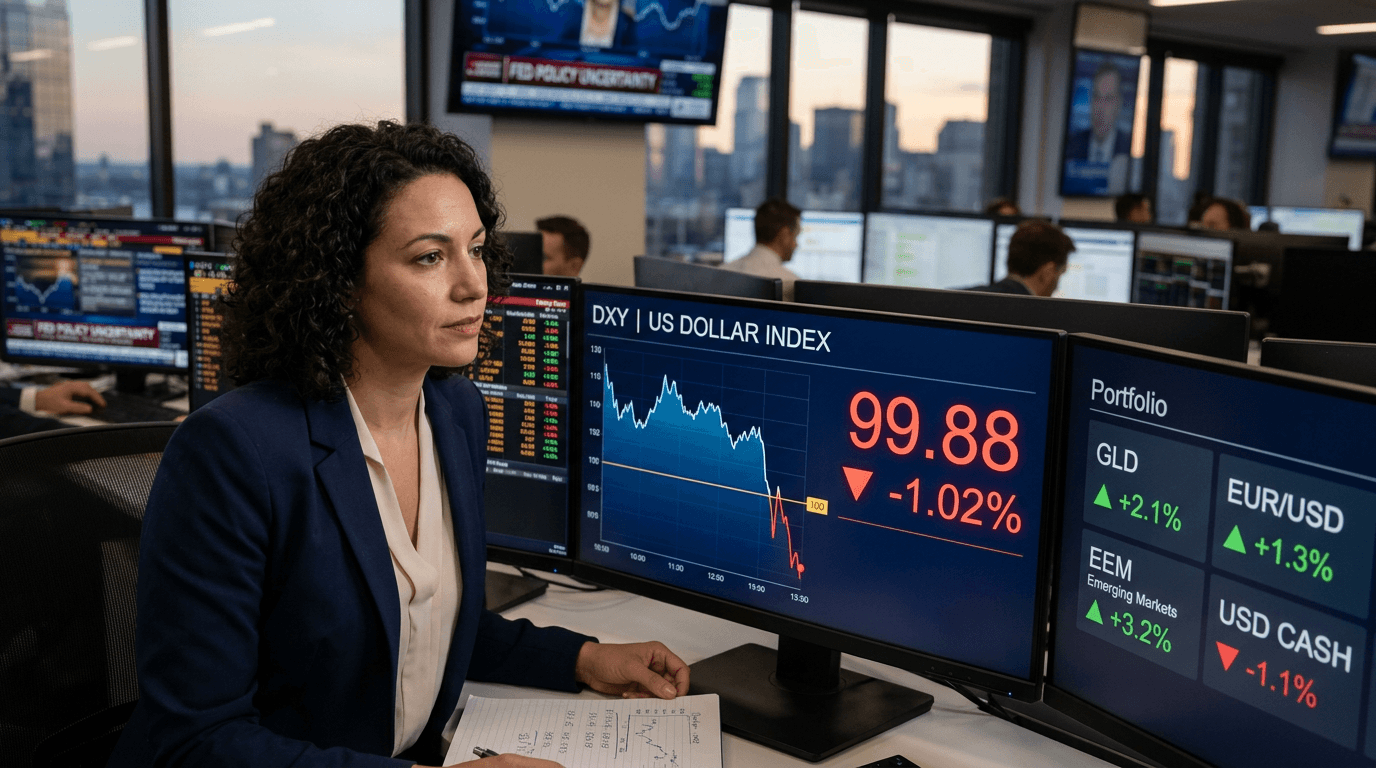
The US Dollar Index has recently dipped below the critical 100 mark, a significant psychological threshold, for the first time since July 2023. This fall signifies a notable shift in currency markets, highlighting deeper concerns about the economic landscape. The decline is attributed to a complex mix of geopolitical tensions, monetary policy uncertainties, and market reactions to recent tariff announcements, which have considerably impacted investor sentiment towards the US economy.[1][3][4]
The Recent Drop And Its Significance
The dollar index's descent below 100 is not just a technical issue; it reflects a broader re-evaluation of the US economic outlook. Currently trading at 98.226 USD, the index has sharply declined from its March 30, 2026 peak of 100.48, representing a retreat to levels last witnessed in May 2025.[4][7] This drop is particularly noteworthy given the elevated US interest rates, a situation that usually supports dollar strength. The dollar has now decreased by 7.3 percent from its January 13, 2025 peak, marking one of the largest monthly declines since 2009.[5]
Investors had closely monitored the 100 level as the DXY neared it in late March amidst Middle Eastern tensions. Although geopolitical stress, including regional conflicts and threats to shipping routes through the Red Sea, initially bolstered the dollar as a safe-haven asset, the currency's failure to maintain these levels indicates that other underlying factors are influencing trading decisions.[1][4]
What Triggered The Decline
A combination of factors has driven the dollar below 100. President Trump's tariff announcements, especially concerning imports from China, Mexico, and Canada, have sparked widespread fears of an economic slowdown and increased inflation pressures. Instead of bolstering the dollar through expectations of higher rates, these policies have led investors to re-evaluate US economic growth prospects and reduce their exposure to dollar-denominated assets.[5]
Further complicating the situation, President Trump's remarks about Federal Reserve Chair Jay Powell and potential policy changes have raised concerns about central bank independence. Investors consider Fed autonomy crucial for long-term currency stability, and any hint of political interference can trigger capital flight.[5] In addition, some European institutional investors have begun selling dollar-denominated debt assets, worried about the policy environment and seeking alternatives, further diminishing demand for the currency.[3]
The timing is also significant. The dollar experienced a sharp decline ahead of FOMC meetings, with a collective selloff of 2.50 percent driven by a mix of technical deterioration and fundamental concerns. The pre-FOMC positioning saw the index test vital support levels between 96.50 and 97.00.[3]
Market Technicals And Key Levels
Technically, the dollar's breakdown suggests more than short-term volatility. The index has breached its 200-day moving average, a shift that markets interpret as more than a temporary fluctuation but rather a lasting change in direction.[1] Several key support and resistance levels now shape the near-term outlook.
If the dollar stabilizes above 97.00, analysts anticipate a gradual but consistent rebound toward 99.00. However, a decisive breach below 97.00 could lead to testing 2025 lows around 96.50. The consolidation range between 96.80 and 97.30 is likely to represent near-term equilibrium, especially as markets await clarity from monetary policy decisions.[3] On the upside, the 100.20 to 100.50 range remains critical—if the dollar holds above these levels, it could climb higher toward 101.60 and possibly 103.[1]
Implications For Global Markets And Investors
A weaker dollar has broad implications for global markets. For US exporters, a softer greenback can enhance competitiveness abroad, potentially supporting growth in specific sectors. However, for investors holding dollar-denominated assets, currency weakness presents a challenge, particularly when combined with concerns about recession risk and tariff-induced inflation.[5]
The unusual pattern of rising Treasury yields coinciding with dollar weakness indicates that risk aversion toward US assets is driving the move rather than simple interest rate differentials. This reflects genuine concern about policy direction and economic growth prospects rather than technical rebalancing.[5]
For forex traders and investors, the key question is whether the dollar will stabilize near current levels or drop further. The FOMC decision and any additional policy signals regarding tariffs or Fed independence will be crucial. A resilient US economy could still attract inflows back into dollars, but policy uncertainty remains high.
Key Takeaways For Investors
Monitor the 97.00 support level closely—a break below it signals potential further weakness toward 96.50. Watch for FOMC communications about rate policy and any indications of policy continuity. Consider the tariff outlook; easing trade tensions could support dollar stabilization. Evaluate the correlation between Treasury yields and dollar weakness; a return to traditional patterns could indicate renewed confidence in US assets. Track European selling pressure; if it decreases, it could alleviate downside pressure on the dollar.
The dollar's decline below 100 reflects genuine economic concerns and policy uncertainty rather than temporary technical weakness. Investors should stay alert as central banks and policymakers navigate this complex environment.