
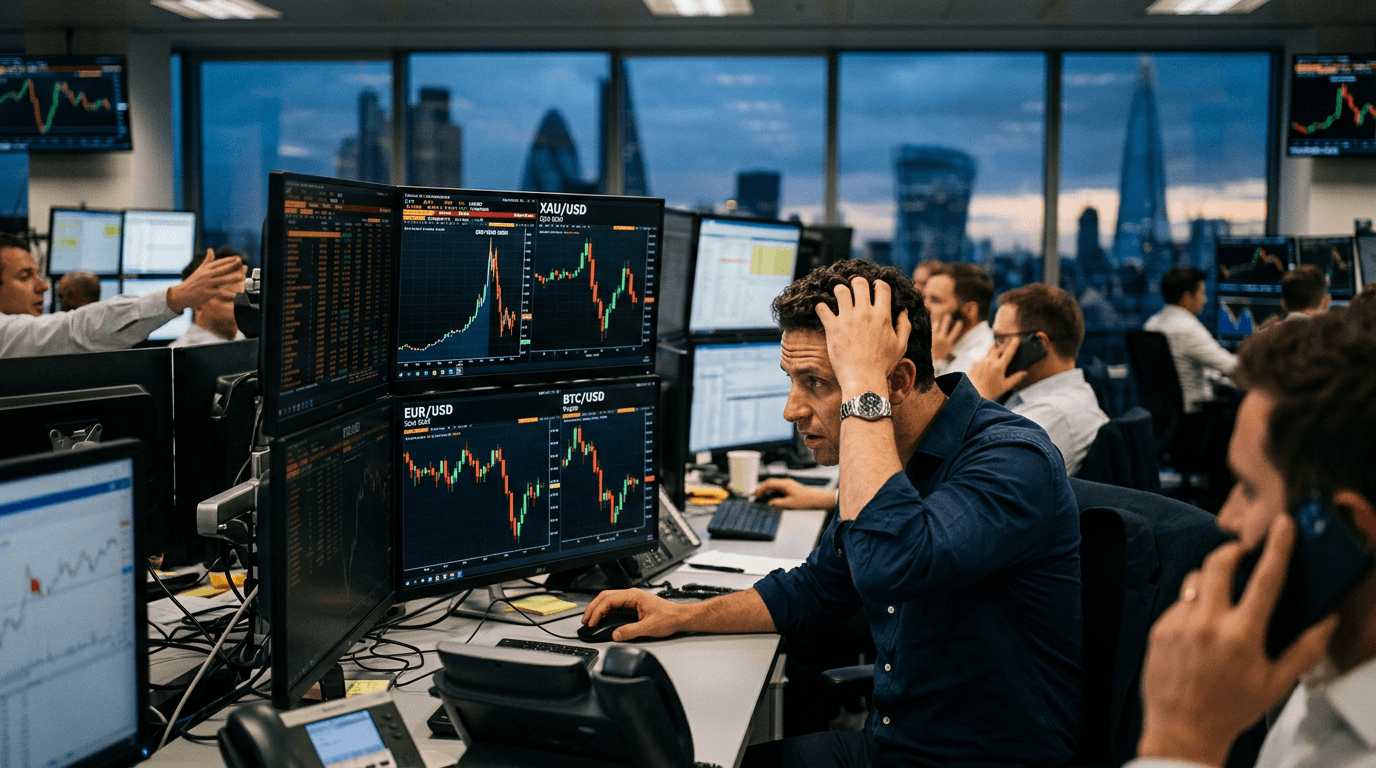
A sharp surge in the US Dollar Index to a one-year high, followed by a quick pullback, has rippled across global markets, pressuring precious metals and driving risk-off flows in foreign exchange before inviting two-way volatility as traders reassessed the Federal Reserve policy path.[4][12] For active and simulated traders alike, this kind of dollar whipsaw is a textbook example of how macro narratives can shift in hours, not weeks.
Dollar Surges To A One-year High
The US Dollar Index (DXY) measures the value of the dollar against a basket of major currencies, including the euro, yen, and pound, giving traders a benchmark for the greenback’s overall strength.[3][17] When DXY rises, it signals that the dollar is appreciating relative to this basket, often reflecting changing expectations for US interest rates and global risk appetite.[3][17]
Recent trading saw DXY break to its highest level in about a year as markets leaned into a more hawkish Federal Reserve narrative, pricing in the possibility of additional rate hikes or a longer period of restrictive policy.[4][12] The index climbed to levels last seen in mid-2025, supported by firm US data and elevated yields, echoing prior episodes where the dollar rallied on rising rate expectations.[4][11]
That move did not persist. As traders digested Fed communications and incoming data, markets began to reassess how far and how fast policy might tighten, leading the dollar to retreat from its peak and settle back into a broad range.[10][12] The result was a quick transition from one-way dollar strength to choppy, two-sided trading—precisely the kind of environment that tests risk management and strategy discipline.
Precious Metals Feel The Weight Of A Stronger Dollar
Gold and silver are typically inversely correlated with the dollar, in part because they are priced in US dollars globally.[3] When DXY spikes, metals become more expensive in other currencies, dampening foreign demand and often triggering selling pressure.[3] That dynamic was on full display as the dollar reached its one-year high, with earlier strength in the greenback weighing on precious metals prices.[12]
At the same time, higher real yields—often associated with a stronger dollar and tighter Fed policy—reduce the relative appeal of non-yielding assets like gold. In risk-off phases driven by policy worries rather than acute crisis, investors may prefer cash or short-duration bonds over metals, adding another layer of headwinds.
The subsequent dollar pullback, however, injected volatility rather than delivering a straightforward relief rally. As traders recalibrated their Fed expectations, both metals and FX experienced two-way price action, with intraday swings linked closely to every data point and policy remark.[12] For metals traders, this highlighted how quickly macro drivers can flip from a clear bearish impulse (strong dollar, higher yields) to a more nuanced tug-of-war.
Risk-off Fx Flows And Knock-on Effects In Crypto
The initial surge in the dollar supported classic risk-off positioning in foreign exchange, as investors rotated toward defensive currencies and away from higher-yielding or more cyclical FX.[4][12] Episodes of rapid dollar appreciation driven by rate expectations and global uncertainty tend to pressure emerging market currencies and commodity-linked FX, while supporting safe-haven or quasi-safe-haven assets.
In this case, the dollar’s run to a one-year high aligned with broader caution in risk assets, reinforcing the appeal of USD-denominated cash and short-term instruments.[4][12] That environment typically weighs on pro-cyclical trades such as long EM FX, carry strategies, and high-beta currency pairs tied to growth sentiment.
Crypto markets often mirror these macro swings. A strong dollar and rising yields can dampen speculative appetite, encouraging de-risking in digital assets and heightening sensitivity to macro news. As the dollar later pulled back and Fed expectations softened, crypto sentiment also became more two-sided, with traders oscillating between relief on lower yields and caution on still-elevated volatility.[12] For multi-asset portfolios, the episode underscored how FX, metals, and crypto can move together under the gravitational pull of the dollar.
What Traders Can Learn From Two-way Volatility
From a trading perspective, the dollar’s round trip—breaking to a one-year high before retreating—offers several practical lessons. First, narrative velocity matters: the fundamental story (hawkish Fed, strong data) can be valid yet still overshoot as positioning becomes crowded, setting the stage for reversal when new information arrives.[4][10]
Second, cross-asset alignment is critical. Watching how DXY interacts with yields, gold, silver, and risk-sensitive FX pairs can help confirm or challenge a directional view. For example, a dollar rally accompanied by falling yields or firm metals may signal a less durable move than a rally supported by rising real yields and broad risk-off flows.
Third, traders need a clear framework for handling regime shifts. When markets move from trending to choppy conditions, strategies that worked in the earlier phase—such as simple momentum or breakout trades—may require tighter risk controls, more conservative sizing, or a switch toward mean-reversion setups. The dollar’s pullback amid policy reassessment illustrated how quickly a breakout can morph into a range.
Simulated Trading: Turning Volatility Into A Playground
For SimFi participants, this kind of macro episode is an ideal testbed for building and refining a multi-asset playbook. On a simulated platform, traders can:
- Track DXY alongside gold, silver, major FX pairs, and key crypto indices to learn how correlations evolve as policy expectations shift.[3][12]
- Design and backtest strategies that respond differently to three regimes: strong dollar trend, consolidation after a peak, and reversal phases triggered by policy or data surprises.
- Practice risk management by stress-testing portfolios under scenarios where the dollar extends its rally versus scenarios where it sharply mean-reverts, measuring drawdowns and recovery paths in each case.
- Explore hedging approaches, such as using FX or metals positions to balance exposure in crypto or equity-linked trades when the dollar is the dominant macro driver.
By treating the recent dollar swing as a case study rather than a one-off, traders can turn market noise into structured learning—understanding not only how assets react to a stronger or weaker dollar, but also how quickly those reactions can change when the policy narrative evolves.
Ultimately, the US Dollar Index’s break to a one-year high and subsequent pullback shows why macro awareness is indispensable in modern trading. Whether you trade spot FX, metals futures, or crypto sentiment, the dollar remains a central compass. Learning to read its moves—and to adapt when those moves reverse—is one of the most valuable skills any trader, simulated or live, can develop.