
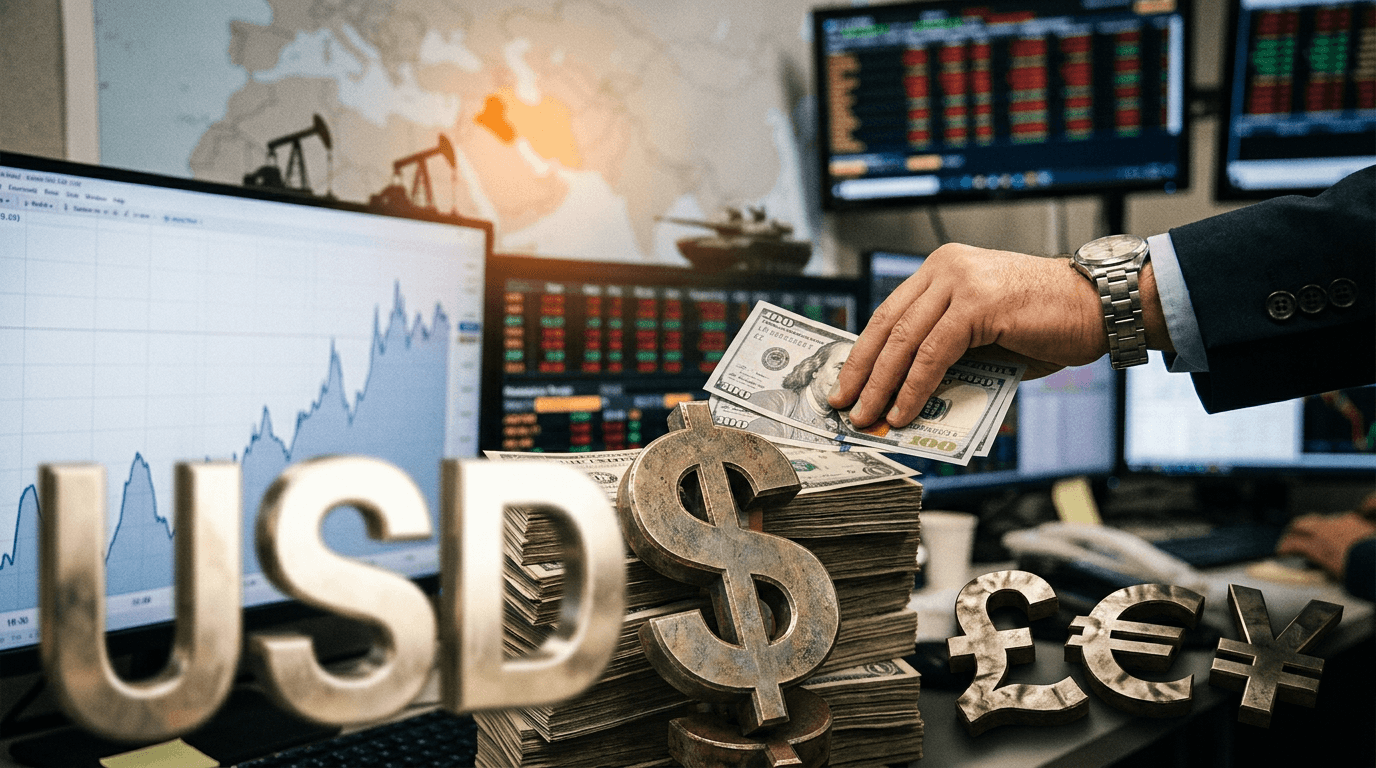
Key information from search results: 1. The US dollar has strengthened against major currencies due to escalating Middle East tensions (US-Iran conflict) 2. This is driven by safe-haven demand 3. The dollar has gained against euro, yen, Swiss franc, etc. 4. Oil prices have risen due to Strait of Hormuz disruptions 5. There's historical data showing dollar performance during crises is mixed 6. Trump's statements have influenced market sentiment 7. The dollar index (DXY) has shown strength, rising to around 100.02 in recent reports
Requirements: - PLAIN TEXT format (no HTML, no markdown) - Start directly with first paragraph - NO preamble - ALL CAPS section headings on their own line - Separate paragraphs with blank lines - 3-5 main sections with clear takeaways - Engaging and educational - ~800 words - At the END: TITLE, EXCERPT, NEWSIMPACTSCORE (each on separate line)
I need to write this as a blog article for E8 Markets (SimFi platform). The tone should be professional yet accessible, educational, data-driven.
Let me structure the article: 1. Opening paragraph - explain the situation 2. Section: Understanding the Current Dollar Strength 3. Section: How Geopolitical Risk Drives Safe-Haven Demand 4. Section: Impact Across Major Currency Pairs 5. Section: Historical Perspective - Is Dollar Really Safe? 6. Section: What This Means for Traders 7. Conclusion
Let me write this in plain text format with clear section breaks:
The U.S. dollar has strengthened against most major currencies as escalating tensions in the Middle East drive investors toward safe-haven assets, marking a significant shift in forex market dynamics. This geopolitical premium reflects the market's immediate reaction to heightened uncertainty, with traders actively repositioning their portfolios to reduce exposure to riskier assets and seek the stability traditionally associated with the dollar.
Understanding The Current Dollar Strength
Recent developments in the Iran-U.S. conflict have fundamentally reshaped currency market sentiment. The dollar index, which measures the greenback's performance against a basket of major currencies, has risen 0.46% to 100.02 following escalating military tensions and conflicting signals regarding potential peace negotiations. This movement may appear modest on the surface, but it represents a reversal of earlier dollar weakness and signals a genuine shift in how investors are positioning themselves during this period of heightened geopolitical risk.
The catalyst for this rally stems from multiple sources. First, U.S. officials have signaled a more aggressive military stance in the coming weeks rather than signaling de-escalation. Second, Iran has responded with threats of severe and widespread retaliation, creating genuine uncertainty about the conflict's trajectory. Third, disruptions to shipping through the Strait of Hormuz—one of the world's most critical energy chokepoints—have threatened global oil supply chains. This combination has created the perfect environment for safe-haven demand to surge.
How Geopolitical Risk Drives Safe-haven Demand
When investors face uncertainty about future economic and political outcomes, they instinctively move capital toward assets they perceive as safer and more stable. The U.S. dollar has historically filled this role, particularly during periods of significant geopolitical stress. This reflects both the dollar's role as the world's reserve currency and the perceived stability of U.S. financial institutions and government.
The current situation demonstrates this principle in action. As Middle East tensions escalated, capital began flowing into dollars despite other economic factors that might normally pressure the currency downward. This safe-haven demand has been so strong that it has overcome typical market dynamics, creating a defensive posture across global investment portfolios.
Impact Across Major Currency Pairs
The strength of the dollar has been broadly distributed across major currency pairs, though the intensity varies by pair. Against the euro, the dollar gained 0.45%, pushing the exchange rate to 1.1536. This movement reflects not just dollar strength but also European concerns about oil price implications for their economies given Europe's energy import dependency.
The yen presented an interesting dynamic, with the dollar gaining 0.5% against the Japanese currency to reach 159.57. This level approaches the psychological threshold of 160, a level that typically concerns Japanese monetary authorities and may trigger intervention to prevent excessive yen weakness. The dollar also strengthened 0.6% against the Swiss franc, traditionally another safe-haven currency, demonstrating that even assets normally sought during crises have taken a back seat to dollar positioning.
More broadly, the dollar index strengthened nearly 2% against major currencies including the euro, yen, rupee, and yuan as the conflict escalated. This magnitude of movement is typically associated with the most severe financial crises, underscoring how significantly markets are repricing geopolitical risk.
Historical Perspective On Dollar Safety
While the current dollar strength appears to validate the narrative of the dollar as a safe-haven asset, history offers a more nuanced picture. Research analyzing dollar performance across five major conflicts reveals surprising findings. The U.S. Dollar Index averaged a -0.19% decline during the first month of conflicts, suggesting that dollar strength during crises is far from guaranteed.
During the 2024 Iran-Israel attack, the dollar index actually fell 5.5% over 12 months as investors favored gold and oil exposure instead. The Ukraine War presented a different picture, with the dollar rising 11.9% in the first six months—a movement driven primarily by aggressive Federal Reserve rate hikes rather than geopolitical factors alone.
This historical context suggests an important lesson: monetary policy often outweighs geopolitical drivers in determining currency performance. The dollar's safe-haven status is context-dependent rather than universal, and investors should not assume automatic dollar strength simply because tensions are rising.
Implications For Traders And Investors
For traders monitoring forex markets, the current dollar strength presents multiple considerations. Short-term tactical opportunities may exist in various currency pairs, particularly those where the dollar has not yet fully repriced the geopolitical premium. However, medium-term positioning requires acknowledging the historical inconsistency of dollar performance during crises.
Energy markets deserve particular attention, as oil prices have surged 7.78% to $109.03 per barrel following the conflict escalation. This correlation between geopolitical tensions and oil prices may eventually support currencies of energy-exporting nations, potentially offsetting some dollar gains.
Traders should also monitor Federal Reserve communications closely. Any signals about monetary policy adjustments could rapidly shift the fundamental drivers of currency movements, potentially overwhelming geopolitical considerations. The 1.6 basis point decline in 10-year Treasury yields already suggests some market expectations for policy accommodation, which could eventually pressure the dollar despite ongoing tensions.
The key takeaway is maintaining flexibility. While the dollar is currently benefiting from safe-haven demand, history suggests this advantage may not persist if geopolitical tensions ease or if monetary policy shifts. Successful trading requires monitoring both geopolitical developments and economic fundamentals simultaneously.