
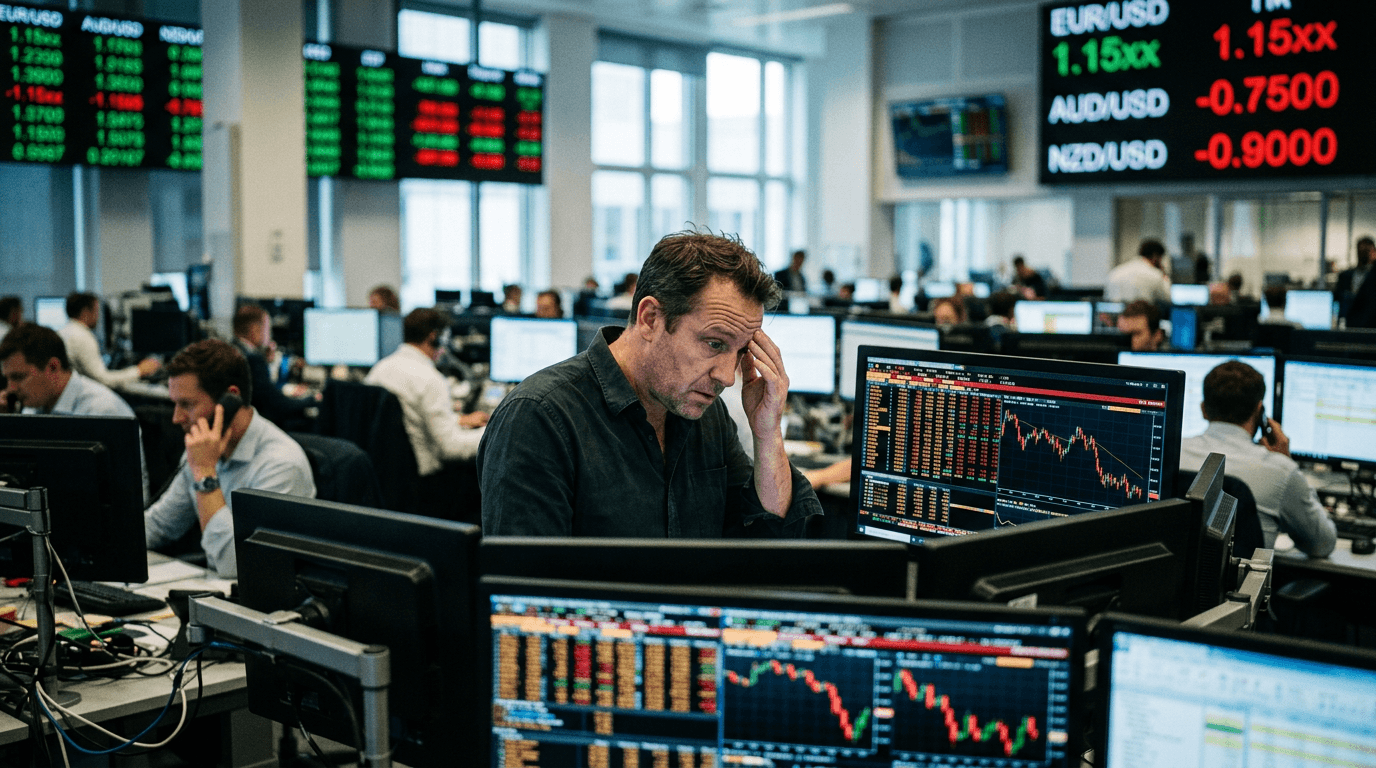
Currency markets are again being driven by a familiar combination of inflation anxiety, higher yields, and geopolitical stress, and the result is a decisive swing back toward the US dollar. The euro has slipped below the 1.16 handle against the dollar, while risk-sensitive currencies like the Australian and New Zealand dollars have broken lower as traders move into defensive positions.[1][5][10][15] For active traders—whether live or on simulated platforms—this environment demands close attention to macro drivers as much as to technical levels.
Markets At A Glance
The euro’s decline below 1.16 reflects a broader pattern of dollar strength as investors reprice the outlook for US interest rates.[1][5][15] Strong US data and firm labor markets have pushed Treasury yields higher, making dollar-denominated assets more attractive relative to their peers.[1][5] At the same time, renewed inflation pressure in the euro area, coupled with energy-price uncertainty, has weighed on confidence in the single currency.[5][15]
Risk appetite has also deteriorated as oil prices spike and geopolitical tensions threaten global growth, reinforcing a classic risk-off backdrop.[10][15] In this environment, cyclical currencies such as the Australian and New Zealand dollars have underperformed, with AUD and NZD sliding as investors rotate away from growth-sensitive assets.[10][13] Bond yields in key markets have moved higher, amplifying concerns about financing costs and slowing demand, especially for commodity-linked economies.[10][13]
GBP has been more resilient than some peers but still trades with a soft tone, reflecting a cautious stance from markets toward the UK growth and inflation outlook.[15] The net result is a FX landscape where the US dollar acts as a safe harbor, while most other majors struggle to attract capital on a relative basis.[1][5][15]
Why Inflation Fears And Geopolitics Matter So Much
The latest FX moves are not just about headline price levels; they are about the narrative markets are building around inflation and growth. Rising energy prices and ongoing geopolitical risks are fueling concerns about stagflation—slower growth alongside stubbornly high inflation.[10][15] When oil and gas prices climb while supply chains remain fragile, businesses face higher costs, and central banks are forced to weigh inflation control against growth risks.[10]
In the US, robust economic data has pushed investors to scale back expectations for rate cuts and even consider the possibility of additional tightening, lifting yields and supporting the dollar.[1][5] Higher US yields raise the opportunity cost of holding lower-yielding currencies like the euro, pushing EUR/USD lower as capital flows chase better returns.[1][5] In Europe, persistent inflation and energy uncertainty limit the European Central Bank’s room to ease aggressively, yet growth headwinds make aggressive tightening risky, leaving the euro caught in a difficult balance.[5][15]
For commodity-linked currencies such as AUD and NZD, the situation is more complex. On one hand, higher commodity prices can support export revenues. On the other, if higher energy costs hit global demand and spur risk aversion, investors often cut exposure to these “beta” currencies, which tend to move more sharply in risk-on and risk-off cycles.[10][13] That dynamic is playing out now as oil shocks and war-related risks leave traders wary of global growth-sensitive FX.[10]
EUR/USD: LEVELS, DRIVERS, AND WHAT TRADERS ARE WATCHING
With EUR/USD trading below 1.16, the pair has broken through a psychologically important handle and moved closer to multi-month lows.[1][5][15] Technical analysts note that the pair is now trading noticeably under longer-term moving averages that had previously acted as support, reinforcing a bearish bias.[1][11] Once a major support level is lost, it often flips into resistance, meaning rallies back toward 1.16 may attract sellers.[1][11]
Fundamentally, the euro remains pressured by the spread between US and eurozone yields. US 10-year yields hovering around elevated levels support the dollar by enhancing its carry appeal.[1][5] Meanwhile, heightened geopolitical tensions and attacks on regional energy infrastructure continue to cast a shadow over the European outlook, feeding further euro weakness.[15] Traders are watching upcoming inflation releases, central bank communications, and any shifts in energy supply headlines as key catalysts for the next leg in EUR/USD.[5][15]
For those trading or practicing on simulated platforms, EUR/USD in this environment becomes a case study in how macro data, central bank expectations, and technical structure intersect. Back-testing strategies around yield differentials, energy-price shocks, or ECB/Fed policy surprises can help refine approaches to trading major pairs under stress.
Aussie And Kiwi Under Pressure
The Australian dollar and New Zealand dollar have both come under sustained selling pressure as global risk sentiment deteriorates.[10][13] Rising bond yields and concerns about higher-for-longer interest rates worldwide have spooked markets, sending AUD and NZD lower against the US dollar.[10][13] Recent commentary from central bankers in the region suggests limited urgency to tighten policy further, which can leave these currencies less supported compared with the dollar when inflation fears are front and center.[3][13]
At the same time, energy-driven inflation and war-related risks are reinforcing stagflation dynamics, which tend to be negative for pro-cyclical currencies.[10] Investors worry that higher input costs will squeeze margins and curb demand in China and other key export markets for Australia and New Zealand, reducing the appeal of their currencies despite relatively solid domestic fundamentals.[10][13] Historically, periods of global risk-off—especially when tied to energy shocks—have often seen AUD and NZD underperform as traders cut exposure to higher-volatility assets.[10]
For traders, AUD/USD and NZD/USD in this context are prime examples of how “beta FX” amplifies broader risk themes. Even modest shifts in global risk sentiment can lead to outsized moves, creating both opportunity and danger. Simulated trading environments can be used to test tactics such as scaling into positions, hedging exposure across correlated pairs, or using volatility filters to avoid overtrading during extreme risk-off episodes.
Practical Takeaways For Simulated And Live Traders
This type of market backdrop—where inflation fears, yields, and geopolitics collide—offers several concrete lessons:
1) Follow yields, not just charts Major FX trends often start in fixed income. Monitoring relative bond yields between the US, Europe, and the Antipodean economies provides early signals for EUR/USD, AUD/USD, and NZD/USD.[1][5][13]
2) Respect key levels and regime shifts The break of EUR/USD below 1.16 and the slide in AUD and NZD highlight how losing long-held support can shift market regimes from range-bound to trending.[1][11][15] Simulated trading can help stress-test strategies under breakout conditions rather than assuming mean reversion.
3) Connect macro themes across assets Oil shocks and geopolitical developments are not just headlines; they drive inflation expectations, yields, and risk sentiment in a chain reaction.[10][15] Practicing cross-asset analysis—equities, commodities, bonds, and FX together—can sharpen decision-making when markets move quickly.
4) Manage risk for higher volatility When multiple macro risks align, volatility can spike without warning. Using smaller position sizes, wider but well-defined stops, or volatility-based position sizing can help avoid overexposure. SimFi platforms are ideal for rehearsing these risk frameworks before applying them in live markets.
Conclusion
The recent slide in EUR/USD below 1.16 and the weakness in AUD and NZD encapsulate a classic risk-off episode driven by inflation worries, higher yields, and geopolitical uncertainty.[1][5][10][15] In such conditions, the US dollar tends to dominate, while more cyclical and yield-sensitive currencies struggle to attract inflows.[1][5][13][15] For traders, the key is not just noticing that prices moved, but understanding why they moved—and how those drivers might evolve.
By focusing on the interplay between inflation expectations, central bank policy, energy markets, and risk sentiment, traders can build more robust frameworks for navigating volatile FX conditions. Simulated finance environments provide a low-risk arena to experiment with these frameworks, refine reaction plans, and test strategies across a wide range of macro scenarios. The current episode is a reminder that in FX, the biggest moves often happen when macro narratives and technical levels align—and that being prepared, both intellectually and practically, is an edge in itself.