
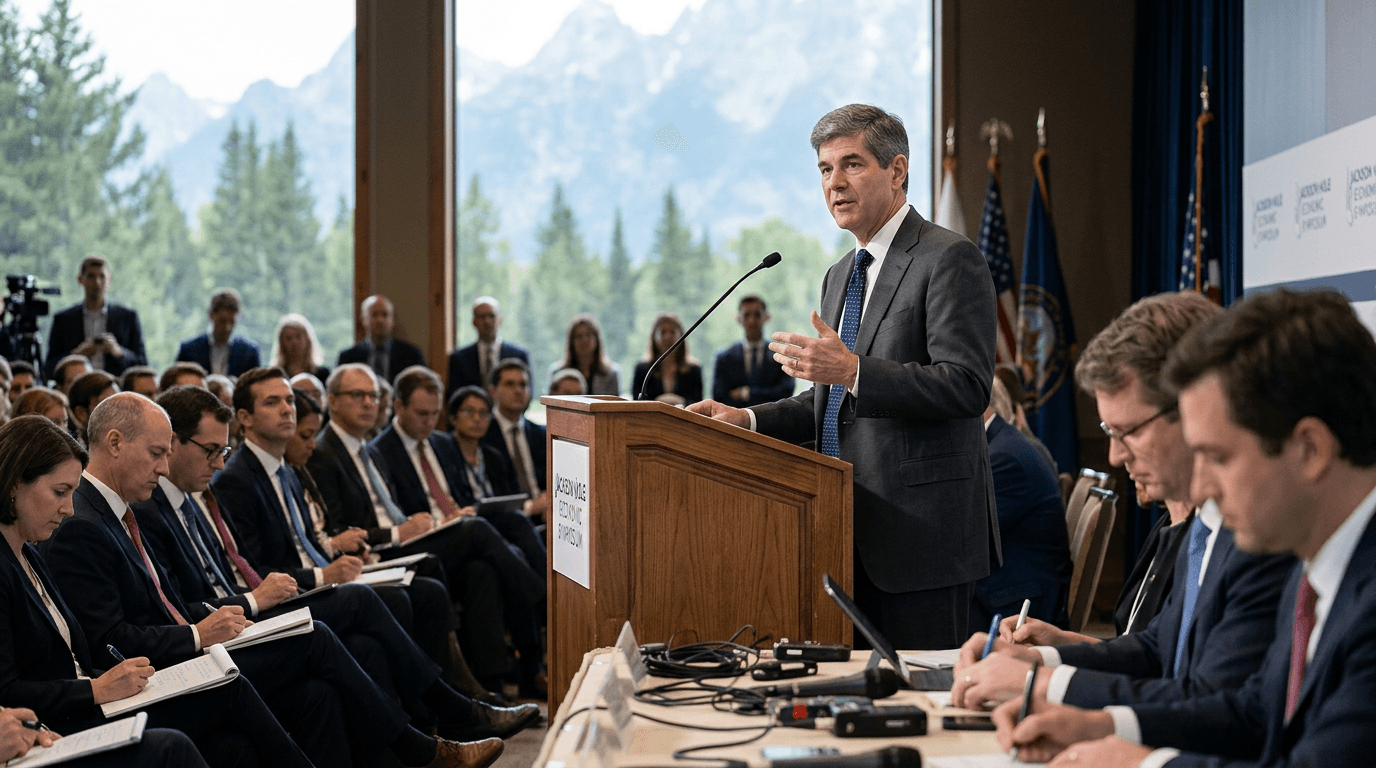
The US dollar is firming into the Jackson Hole Economic Symposium as traders position ahead of Fed Chair Kevin Warsh’s debut keynote, reflecting a market that sees more upside risk to US interest rates than just a few weeks ago.[2][9][14] Modest gains against the euro and yen, higher short‑dated Treasury yields, and a lift in FX volatility all point to investors bracing for a speech that could reinforce the Fed’s hawkish focus on inflation.[2][5][7] For traders, this is not just another central‑bank event—it is a live test of how Warsh’s Fed will balance price stability with market communication.[1][2][11]
WHAT’S DRIVING THE DOLLAR RIGHT NOW
Kevin Warsh has consistently framed inflation as the central challenge for the Fed, emphasizing that price growth remains above the 2% target and that policymakers still have “work to do” if underlying inflation does not move lower “clearly and at sufficient speed.”[1][2][3][7] Recent commentary has highlighted that a large share of the consumption basket is still running above 3% inflation, underscoring concerns about sticky price pressures.[3][7] That tone has led markets to build in a more hawkish reaction function, with odds of future rate hikes rising whenever Warsh underscores the priority of delivering price stability.[7][12][13]
This backdrop explains why the dollar is gaining even without dramatic moves in long‑term yields. Short‑dated Treasuries, which are most sensitive to Fed policy expectations, have ticked higher as traders shade in a greater likelihood of additional tightening if inflation fails to cool.[2][9][15] Rate futures are echoing this shift, showing a slightly steeper expected path for the federal funds rate over the next few years.[12][15] A firmer policy path boosts US yield differentials versus lower‑yielding economies like the euro area and Japan, naturally supporting the greenback versus the euro and yen.[2][5][7]
Warsh has also been critical of the Fed’s past reliance on detailed forward guidance, arguing that markets should play a bigger role in interpreting data and adjusting prices without constant central‑bank nudging.[11] That philosophy leaves investors more sensitive to each speech and appearance, because guidance is less explicit while the commitment to price stability remains “strong, unanimous and unambiguous.”[11][12][15] The combination of hawkish inflation rhetoric and reduced forward guidance is a key reason FX volatility is nudging higher as Jackson Hole approaches.[2][5][7]
Jackson Hole As A Policy Signal
Jackson Hole has long served as a venue for central bankers to sketch the medium‑term direction of policy, and Warsh’s first keynote as chair carries additional weight because investors are still learning his style and thresholds.[9][14] Ahead of the speech, bond markets have shown signs of anxiety, with traders scrutinizing every hint about how much inflation overshoot the Fed is willing to tolerate and how quickly it intends to restore price stability.[9][13][15]
Warsh’s prepared remarks are expected to focus on the need for confidence that underlying inflation is moving toward target at an acceptable speed, reiterating that failure to see such progress would mean more “work to do” on the policy front.[1][2][7] This language is read as optionality for further rate hikes rather than a promise, but it still nudges expectations toward a slightly higher terminal rate or a longer period of restrictive policy.[7][13][15] When markets revise those expectations, the impact is most visible in the front end of the yield curve and in rate futures curves that price the path of short‑term US interest rates.[2][9][15]
For traders, the key nuance is that Warsh is not offering detailed calendar‑based guidance but is making the inflation objective non‑negotiable.[11][12] That setup makes each inflation print and each major speech—especially one at Jackson Hole—a potential catalyst for repricing, even if no immediate policy decision is taken.[2][9]
Implications For Fx And Futures Markets
A firmer US rate outlook tends to pressure currencies with lower or more anchored yield profiles, which is why the yen and euro are under modest pressure as investors add to dollar‑positive positions.[2][5][7] In practice, this often shows up as: stronger USD/JPY and EUR/USD drifting lower, a rise in implied volatility around event dates, and more active trading in FX futures as participants hedge or express directional views.[2][5][7]
On the rates side, fed funds futures and other short‑rate contracts adjust their implied probabilities of upcoming meetings, translating Warsh’s inflation rhetoric into a market‑based forecast of where policy might go.[12][15] When traders infer a higher chance of rate hikes, front‑month and near‑term contracts tend to price higher rates, while longer‑dated contracts may steepen the expected path if persistent inflation becomes the dominant narrative.[9][13][15] This repricing is already visible in the modest rise in short‑dated Treasury yields ahead of Jackson Hole, even though Warsh has avoided promising specific moves.[2][9][15]
For portfolios that span FX and rates, the current environment reinforces familiar linkages: a stronger dollar aligned with higher US front‑end yields and a mild risk‑off tone toward currencies more exposed to global growth or low‑rate policies.[2][5][7] FX volatility edging higher around the event also reminds traders that macro speeches can matter even in the absence of formal decisions.[2][5]
How Simulated Finance Traders Can Position
In a simulated environment, Jackson Hole offers an ideal case study in event‑driven macro trading without real‑world capital at risk. Traders can build scenarios around three broad outcomes: a clearly hawkish speech that boosts hike odds, a balanced message that stresses data dependence, or a surprisingly cautious tone that cools rate expectations. Each scenario can be tested across USD/JPY, EUR/USD, and short‑rate futures to see how correlations and sensitivities play out.
A practical approach is to design trades that reflect the current bias—modest dollar strength and higher short‑dated yields—while planning how to adjust if Warsh’s tone diverges from expectations. For example, a simulated long USD/JPY position can be paired with a position in short‑rate futures that benefits from higher implied policy rates, reflecting the hawkish‑inflation narrative. If the speech turns out less hawkish than feared, traders can observe how quickly those positions would move against them and experiment with hedges, such as options or cross‑currency trades.
Risk management should be central to any Jackson Hole strategy, even in simulation. Event windows can feature gaps, rapid repricing, and temporary overshoots, so testing position sizing, stop‑loss levels, and diversification across instruments is as important as the directional call itself. Traders can also monitor how changes in implied volatility affect options pricing around the event, adding another layer to their learning.
Key Takeaways For Traders
The current move in the dollar and short‑dated US yields reflects markets leaning toward a more hawkish Fed path as Warsh reiterates that inflation remains too high and that the central bank has “work to do” if progress is insufficient.[1][2][3][7] Because Warsh is reducing reliance on detailed forward guidance while keeping the inflation objective rigid, speeches like Jackson Hole gain outsized importance as real‑time clues to the policy path.[11][12] This dynamic is lifting FX volatility, pressuring the yen and euro, and driving active repositioning in FX and rate futures.[2][5][7]
For traders, the practical playbook is straightforward: focus on Warsh’s language around inflation speed and confidence, watch how front‑end yields and rate futures react, and track whether dollar strength is broad‑based or concentrated in specific pairs.[2][9][15] Use simulation to rehearse event‑risk strategies, test correlations between FX and rates, and stress‑test risk management rules before deploying any approach in live markets.
Ultimately, Jackson Hole is less about a single headline and more about understanding the Fed’s evolving reaction function under Warsh. The firmer dollar going into the speech is a signal that markets expect the inflation fight to remain front and center, and traders who can read that signal across FX and futures will be better prepared for whatever tone emerges from Wyoming.[2][7][9]