
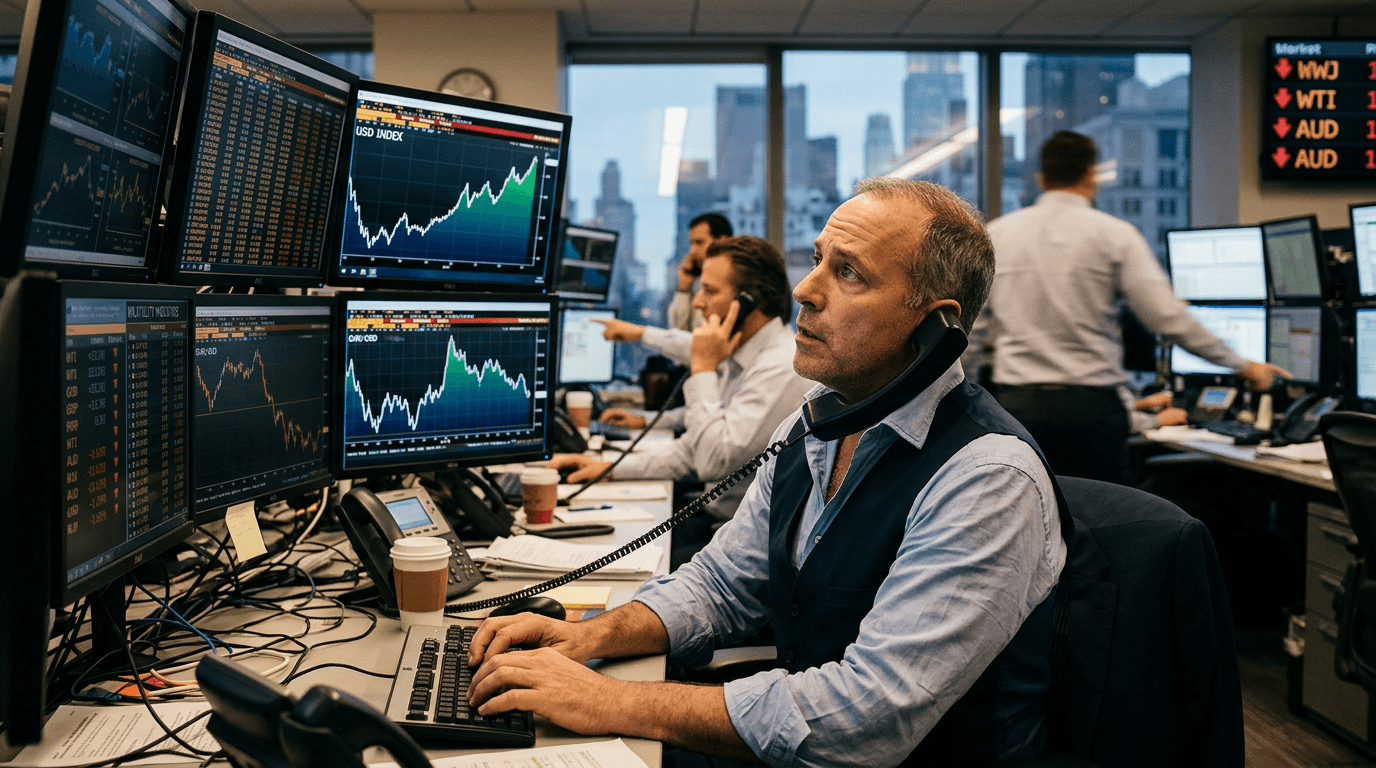
The U.S. dollar’s latest broad-based firming in the New York session underscores how quickly FX markets can pivot when geopolitics collide with risk sentiment. As traders reassess the trajectory of U.S.–Iran peace discussions, safe-haven demand has picked up, pressuring EUR, GBP and commodity-linked currencies while driving flows into dollar index futures and lifting volatility across both G10 and EM FX complexes.[2][4][5]
WHAT’S DRIVING THE LATEST DOLLAR STRENGTH
At the core of the move is a familiar combination: rising risk aversion and a reassessment of geopolitical risk premia. When uncertainty around U.S.–Iran peace prospects increases, the default market response is to rotate back into perceived safe-haven assets, with the U.S. dollar still at the top of that list.[1][3][5]
Earlier in the week, renewed optimism around a possible framework for U.S.–Iran de-escalation had encouraged risk-taking, pressuring the dollar lower as traders rotated into higher-yielding and pro‑cyclical currencies.[4] That episode illustrated how quickly improved sentiment can deflate the dollar: when geopolitical tensions appear to ease, investors feel more comfortable holding riskier assets, and demand for the greenback’s safety premium diminishes.[1][4]
As headlines shifted and doubts resurfaced over how realistic and durable any U.S.–Iran agreement might be, those earlier risk-on bets were forced to adjust. Market commentary has emphasized that the ceasefire or peace narrative was “fraught from the jump,” even as markets initially bought into the relief rally.[5] Once that narrative began to crack, demand rotated back into dollars, pushing the broader dollar index modestly higher and putting renewed pressure on peers.[1][2]
For traders, the lesson is clear: in a geopolitical tape, FX direction can pivot more on headline momentum and perceived risk than on traditional macro data, at least in the short term.
Geopolitics, Risk Aversion And Safe-haven Flows
The U.S.–Iran dynamic matters because it sits at the intersection of energy markets, regional security, and global risk appetite. Iran is a key energy producer, and any deterioration in peace prospects can quickly translate into higher perceived supply risk and a thicker geopolitical risk premium in crude oil.[1][5]
When that premium builds, markets often start to price: - Higher volatility in energy prices - A higher probability of growth headwinds, particularly for energy-importing economies - A general “risk-off” tilt as investors hedge tail risks
In this environment, capital tends to flow back into the U.S. dollar, U.S. Treasuries, and other perceived safe assets.[1][3][5] The dollar’s role as the dominant global reserve and invoicing currency means it typically benefits when investors de‑risk, even if the source of the shock is politically complex or geographically distant.[3]
Recent commentary from FX strategists has highlighted how U.S.–Iran headlines have been “whipsawing” markets, pushing traders rapidly between stability and downside pressure as sentiment oscillates.[2] When optimism around talks builds, risk appetite strengthens and the dollar softens; when that optimism fades, the sequence reverses—risk appetite weakens, volatility rises, and the dollar firms.[2][4][5]
Impact On Eur, Gbp And Commodity Currencies
The latest bout of dollar strength has been felt most clearly against the euro, the British pound, and commodity-linked currencies such as AUD, NZD and CAD.
For the euro, the backdrop was already fragile. Analysts note that EUR had shifted from being “supported but capped” to “increasingly exposed,” with underlying downside risks building as long as there is no clear de-escalation in geopolitical tensions or a meaningful shift in rate differentials.[2] In such a scenario, EUR/USD is seen as vulnerable to a move lower, with some research flagging potential for the pair to drift toward the 1.15 region if negative drivers persist.[2]
The pound typically trades as a higher‑beta G10 currency, meaning it tends to move more than the euro when global risk sentiment swings. Renewed risk aversion and concerns around global growth can therefore weigh disproportionately on GBP, especially against a firming dollar backdrop.
Commodity currencies face a more nuanced impact. On one hand, higher energy prices linked to geopolitical tension can offer some support to oil‑linked currencies like CAD and NOK. On the other hand, if markets interpret geopolitics as a threat to global demand or as a catalyst for broader volatility, the risk-off impulse usually dominates, pushing investors to reduce exposure to these pro‑cyclical currencies.[1][4][5]
Emerging‑market FX often feels the sharpest end of this dynamic. When volatility spikes and risk appetite deteriorates, carry trades in higher‑yielding EM currencies can unwind quickly, leading to outsized moves relative to G10 peers and amplifying overall FX market volatility.[2][5] This is consistent with the recent pickup in realized and implied volatility across both G10 and EM FX complexes as U.S.–Iran headlines continue to evolve.[2][5]
What This Means For Traders And Simulated Finance Participants
For discretionary and systematic traders alike, this environment demands an elevated focus on risk management. Headline risk can trigger abrupt intraday reversals, with moves that sometimes ignore traditional technical levels or scheduled economic data.
Key implications for active FX traders include: - Greater need to track geopolitical news flow alongside macro indicators - Potential for “whipsaw” price action, where breakouts fail and ranges reassert quickly - Larger intraday ranges, making position sizing and stop placement more critical
For participants using Simulated Finance (SimFi) platforms, this is a valuable live-fire environment—without the capital risk. You can practice: - Trading the dollar index alongside major pairs like EUR/USD, GBP/USD and USD/JPY to understand how they respond differently to the same news - Testing whether your strategy handles gap risk and volatility spikes well, or if it needs adjustments to filters, timeframes or position sizing - Experimenting with hedging approaches, such as using the dollar index or correlated pairs to offset directional exposure
Because the dollar remains central to global pricing and funding, understanding its behavior around geopolitical events is essential for anyone building a robust FX trading playbook.[1][3]
Practical Playbook: Navigating A Risk-off Dollar Spike
Whether you are trading live capital or in a simulated environment, a structured approach can help you navigate this kind of dollar-driven move more systematically.
First, anchor your view in scenarios. Map out at least two core paths: - De‑escalation path: constructive news on U.S.–Iran talks, softer dollar, stronger risk assets, support for EUR, GBP and commodity FX - Escalation or stalemate path: stalled or deteriorating talks, firmer dollar, weaker risk assets, pressure on pro‑cyclical and EM currencies
Second, monitor cross-asset confirmation. When the dollar firms on genuine risk aversion, you typically see correlated moves: softer equities, wider credit spreads, higher volatility indices, and often a bid for safe-haven bonds.[2][5] If the dollar rallies without those confirmations, it may be more about idiosyncratic FX positioning than a durable risk-off shift.
Third, respect volatility in your execution. In headline-driven sessions: - Consider reducing position size to account for larger swings - Avoid placing stops at obvious technical levels that might be hunted during illiquid moments - Be cautious about chasing late moves after large candles; wait for pullbacks or consolidation to define your risk more clearly
Finally, treat each episode as research. Document how the dollar and key pairs reacted to specific headlines, how correlations behaved, and which setups worked or failed. Over time, this builds a personal dataset that can refine both discretionary judgment and rule-based strategies.
Key Takeaways For The Days Ahead
The U.S. dollar’s broad firming in the New York session is less a standalone story and more a real-time barometer of shifting expectations around U.S.–Iran peace prospects and global risk sentiment.[1][2][4][5] As optimism and pessimism alternate, markets are likely to remain sensitive to every incremental headline, sustaining elevated volatility in G10 and EM FX.
For traders, that combination of macro narrative and intraday movement offers both opportunity and risk. Those who couple geopolitical awareness with disciplined risk management—and who use simulated environments to stress-test their approach—will be better positioned to navigate whatever direction the next U.S.–Iran headline sends the dollar.